Meoded Avner, Morrissette Arthur E, Katipally Rohan, Schanz Olivia, Gotts Stephen J, Floeter Mary Kay
National Institute of Neurological Disorders and Stroke, National Institutes of Health, Bethesda, MD, USA.
National Institute of Mental Health, National Institutes of Health, Bethesda, MD, USA.
Neuroimage Clin. 2014 Dec 9;7:288-96. doi: 10.1016/j.nicl.2014.12.009. eCollection 2015.
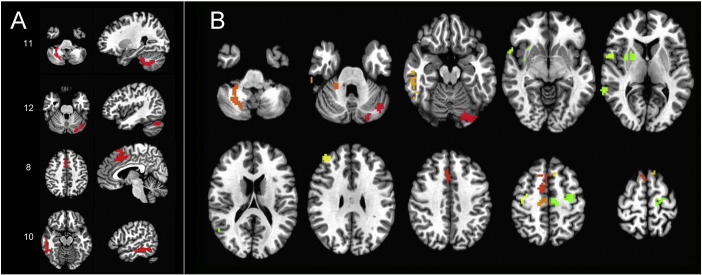
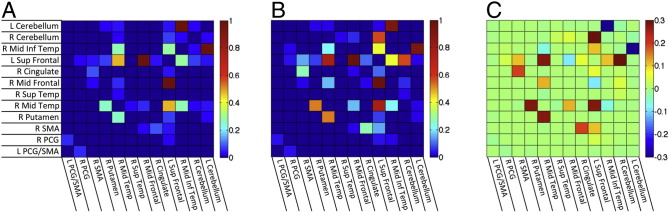
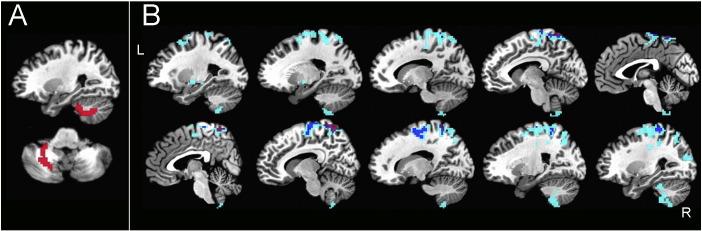
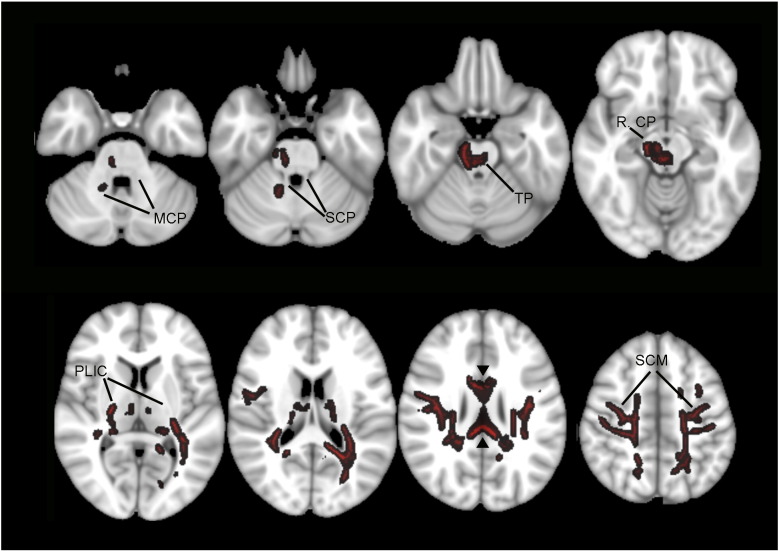
Increased functional connectivity in resting state networks was found in several studies of patients with motor neuron disorders, although diffusion tensor imaging studies consistently show loss of white matter integrity. To understand the relationship between structural connectivity and functional connectivity, we examined the structural connections between regions with altered functional connectivity in patients with primary lateral sclerosis (PLS), a long-lived motor neuron disease. Connectivity matrices were constructed from resting state fMRI in 16 PLS patients to identify areas of differing connectivity between patients and healthy controls. Probabilistic fiber tracking was used to examine structural connections between regions of differing connectivity. PLS patients had 12 regions with increased functional connectivity compared to controls, with a predominance of cerebro-cerebellar connections. Increased functional connectivity was strongest between the cerebellum and cortical motor areas and between the cerebellum and frontal and temporal cortex. Fiber tracking detected no difference in connections between regions with increased functional connectivity. We conclude that functional connectivity changes are not strongly based in structural connectivity. Increased functional connectivity may be caused by common inputs, or by reduced selectivity of cortical activation, which could result from loss of intracortical inhibition when cortical afferents are intact.
在多项针对运动神经元疾病患者的研究中,发现静息态网络中的功能连接性增强,尽管扩散张量成像研究一直显示白质完整性受损。为了理解结构连接性与功能连接性之间的关系,我们研究了原发性侧索硬化症(PLS,一种病程较长的运动神经元疾病)患者中功能连接性发生改变的区域之间的结构连接。从16例PLS患者的静息态功能磁共振成像构建连接矩阵,以识别患者与健康对照之间连接性不同的区域。使用概率纤维追踪来检查连接性不同的区域之间的结构连接。与对照组相比,PLS患者有12个区域的功能连接性增强,以脑-小脑连接为主。小脑与皮质运动区之间以及小脑与额叶和颞叶皮质之间的功能连接性增强最为明显。纤维追踪未发现功能连接性增强区域之间的连接存在差异。我们得出结论,功能连接性变化并非强烈基于结构连接性。功能连接性增加可能是由共同输入引起的,或者是由皮质激活的选择性降低引起的,当皮质传入完整时,这可能是由于皮质内抑制丧失所致。