Ruiz-Saenz A, Sandhu M, Carrasco Y, Maglathlin R L, Taunton J, Moasser M M
Department of Medicine, Helen Diller Family Comprehensive Cancer Center, University of California, San Francisco, San Francisco, CA, USA.
Department of Cellular and Molecular Pharmacology, University of California, San Francisco, San Francisco, CA, USA.
Oncogene. 2015 Oct 8;34(41):5288-94. doi: 10.1038/onc.2014.455. Epub 2015 Jan 26.
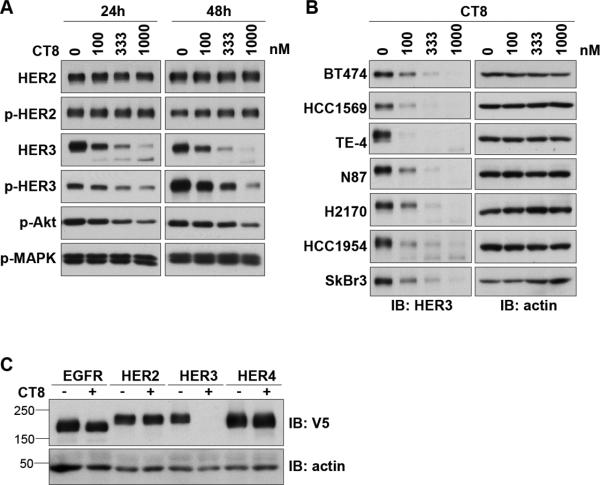
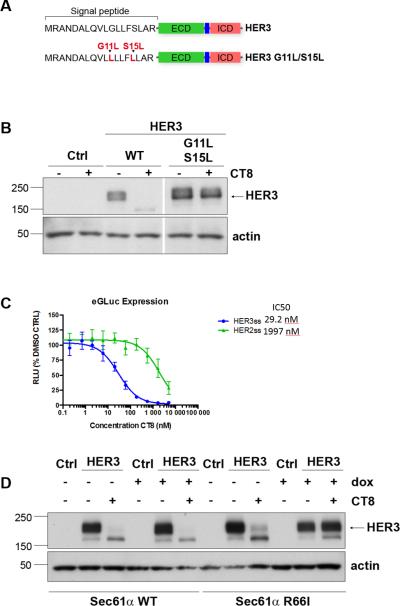
There is increasing evidence implicating human epidermal growth factor receptor 3 (HER3) in several types of cancer. However, the development of targeted therapies to inactivate HER3 function has been a challenging endeavor. Its kinase domain functions in allostery not catalysis, and the classical ATP-analog class of tyrosine kinase inhibitors fail to inactivate it. Here we describe a novel approach that eliminates HER3 expression. The small-molecule cotransin CT8 binds the Sec61 translocon and prevents the signal peptide of the nascent HER3 protein from initiating its cotranslational translocation, resulting in the degradation of HER3 but not the other HER proteins. CT8 treatment suppresses the induction of HER3 that accompanies lapatinib treatment of HER2-amplified cancers and synergistically enhances the apoptotic effects of lapatinib. The target selectivities of cotransins are highly dependent on their structure and the signal sequence of targeted proteins and can be narrowed through structure-function studies. Targeting Sec61-dependent processing identifies a novel strategy to eliminate HER3 function.
越来越多的证据表明,人类表皮生长因子受体3(HER3)与多种类型的癌症有关。然而,开发使HER3功能失活的靶向疗法一直是一项具有挑战性的工作。其激酶结构域发挥变构作用而非催化作用,经典的ATP类似物类酪氨酸激酶抑制剂无法使其失活。在此,我们描述了一种消除HER3表达的新方法。小分子转运蛋白CT8结合Sec61转位体,阻止新生HER3蛋白的信号肽启动其共翻译转运,导致HER3降解,但不影响其他HER蛋白。CT8处理可抑制拉帕替尼治疗HER2扩增型癌症时伴随的HER3诱导,并协同增强拉帕替尼的凋亡作用。转运蛋白的靶点选择性高度依赖于其结构和靶向蛋白的信号序列,可通过结构-功能研究使其变窄。靶向Sec61依赖性加工确定了一种消除HER3功能的新策略。