Guy Michael P, Phizicky Eric M
a Department of Biochemistry and Biophysics; Center for RNA Biology ; University of Rochester School of Medicine ; Rochester , NY USA.
RNA Biol. 2014;11(12):1608-18. doi: 10.1080/15476286.2015.1008360.
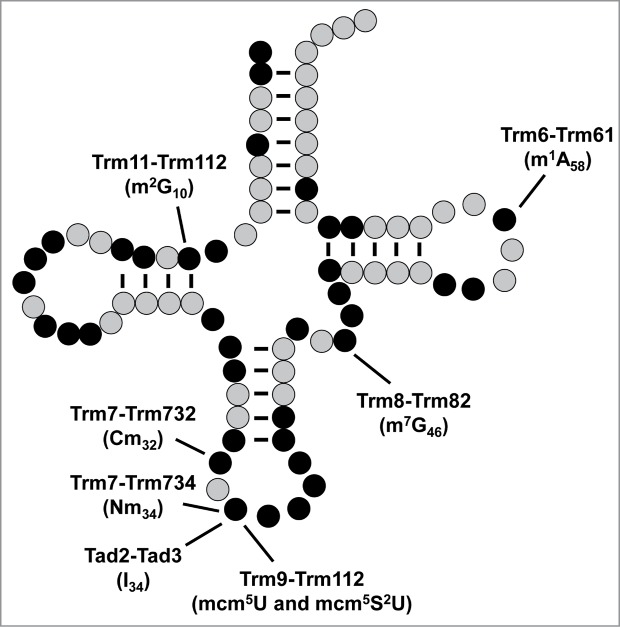
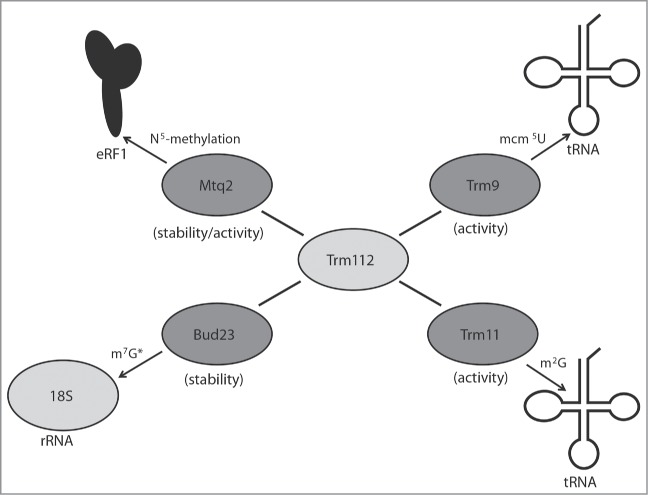
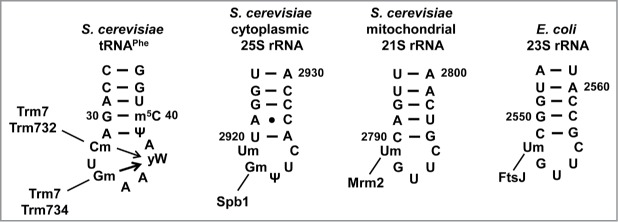
tRNA modifications are crucial for efficient and accurate protein translation, with defects often linked to disease. There are 7 cytoplasmic tRNA modifications in the yeast Saccharomyces cerevisiae that are formed by an enzyme consisting of a catalytic subunit and an auxiliary protein, 5 of which require only a single subunit in bacteria, and 2 of which are not found in bacteria. These enzymes include the deaminase Tad2-Tad3, and the methyltransferases Trm6-Trm61, Trm8-Trm82, Trm7-Trm732, and Trm7-Trm734, Trm9-Trm112, and Trm11-Trm112. We describe the occurrence and biological role of each modification, evidence for a required partner protein in S. cerevisiae and other eukaryotes, evidence for a single subunit in bacteria, and evidence for the role of the non-catalytic binding partner. Although it is unclear why these eukaryotic enzymes require partner proteins, studies of some 2-subunit modification enzymes suggest that the partner proteins help expand substrate range or allow integration of cellular activities.
转运RNA(tRNA)修饰对于高效且准确的蛋白质翻译至关重要,相关缺陷常常与疾病有关。酿酒酵母中有7种细胞质tRNA修饰,它们由一种由催化亚基和辅助蛋白组成的酶形成,其中5种在细菌中仅需单个亚基即可形成,另外2种在细菌中不存在。这些酶包括脱氨酶Tad2-Tad3,以及甲基转移酶Trm6-Trm61、Trm8-Trm82、Trm7-Trm732、Trm7-Trm734、Trm9-Trm112和Trm11-Trm112。我们描述了每种修饰的发生情况和生物学作用、酿酒酵母及其他真核生物中所需伴侣蛋白的证据、细菌中单个亚基的证据以及非催化结合伴侣的作用证据。尽管尚不清楚为何这些真核酶需要伴侣蛋白,但对一些双亚基修饰酶的研究表明,伴侣蛋白有助于扩大底物范围或实现细胞活动的整合。