Wang Yaping, Qian Ruizhe, Sun Ning, Lu Chao, Chen Zongyou, Hua Luchun
Department of Surgery, Huashan Hospital, Fudan University, Shanghai 200040, P.R. China.
Department of Physiology and Pathophysiology, Shanghai Medical College, Fudan University, Shanghai 200032, P.R. China.
Mol Med Rep. 2015 Jun;11(6):4204-10. doi: 10.3892/mmr.2015.3247. Epub 2015 Jan 26.
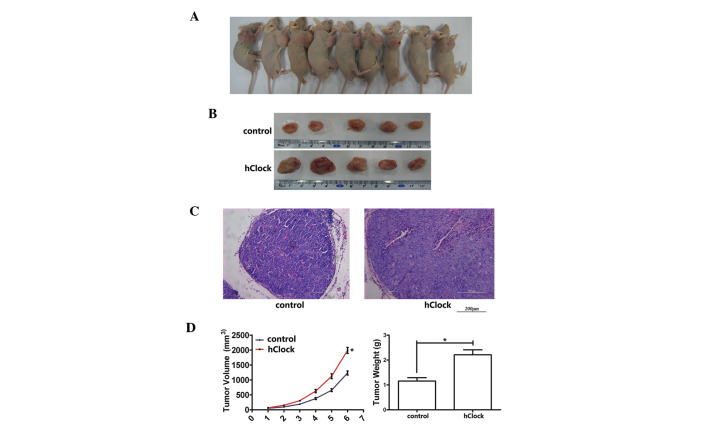
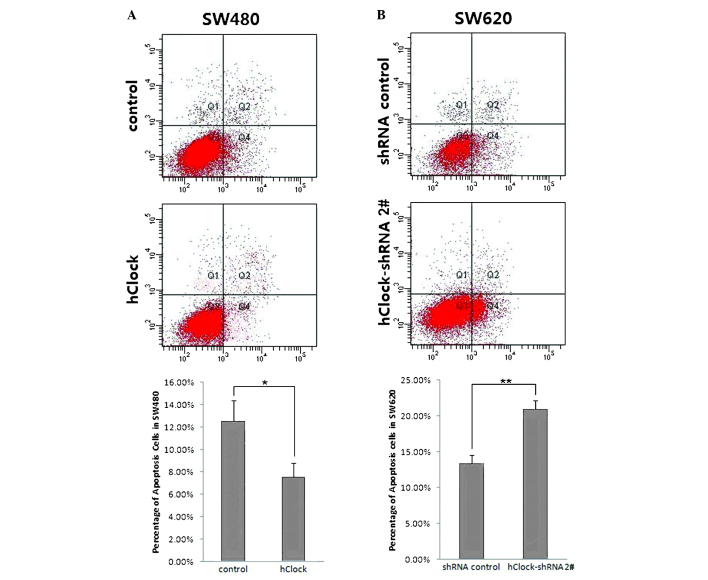
Colorectal carcinoma (CRC) is one of the most prevalent types of malignancy‑associated mortality worldwide. Previous studies have demonstrated that amplification and overexpression of the human circadian locomotor output cycles kaput gene (hClock) was closely associated with a high risk for CRC as well as poor prognosis in CRC patients. However, the underlying molecular mechanisms of CRC remain to be fully elucidated. In the present study, hClock was exogenously overexpressed in the CRC cell line SW480 via infection of a lentivirus vector expressing hClock; in addition, a lentivirus vector‑based RNA interference approach, using short hairpin RNA, was performed in order to knockdown hClock in SW620 cells. The results showed that upregulation of hClock promoted proliferation and inhibited apoptosis in SW480 cells in vitro and in vivo, while downregulation of hClock inhibited SW620 cell proliferation and accelerated apoptosis in vitro. Upregulation of hClock enhanced the activity of the anti‑apoptotic gene phosphorpylated (p‑)AKT and inhibited the expression of the pro‑apoptotic gene B cell lymphoma‑2 (Bcl‑2)‑associated X protein and Bcl‑2 homology 3 interacting domain death agonist. Furthermore, targeted inhibition of hClock activity reduced p‑AKT expression. In conclusion, the results of the present study suggested that the circadian gene hClock promoted CRC progression and inhibit tumor cell apoptosis in vitro and in vivo, while silencing hClock was able to reverse this effect.
结直肠癌(CRC)是全球范围内与恶性肿瘤相关死亡率最高的癌症类型之一。先前的研究表明,人类昼夜节律运动输出周期蛋白基因(hClock)的扩增和过表达与CRC的高风险以及CRC患者的不良预后密切相关。然而,CRC的潜在分子机制仍有待充分阐明。在本研究中,通过感染表达hClock的慢病毒载体,在CRC细胞系SW480中外源性过表达hClock;此外,为了在SW620细胞中敲低hClock,采用基于慢病毒载体的RNA干扰方法,使用短发夹RNA。结果表明,hClock的上调促进了SW480细胞在体外和体内的增殖并抑制了其凋亡,而hClock的下调则在体外抑制了SW620细胞的增殖并加速了其凋亡。hClock的上调增强了抗凋亡基因磷酸化(p-)AKT的活性,并抑制了促凋亡基因B细胞淋巴瘤-2(Bcl-2)相关X蛋白和Bcl-2同源3相互作用域死亡激动剂的表达。此外,靶向抑制hClock活性可降低p-AKT的表达。总之,本研究结果表明,昼夜节律基因hClock在体外和体内促进了CRC的进展并抑制了肿瘤细胞凋亡,而沉默hClock能够逆转这种作用。