Kalenzaga Sandrine, Sperduti Marco, Anssens Adèle, Martinelli Penelope, Devauchelle Anne-Dominique, Gallarda Thierry, Delhommeau Marion, Lion Stéphanie, Amado Isabelle, Krebs Marie-Odile, Oppenheim Catherine, Piolino Pascale
Memory and Cognition Laboratory, Institut de Psychologie, Université Paris Descartes, Sorbonne Paris Cité Boulogne-Billancourt, France ; Center of Psychiatry and Neurosciences, INSERM UMR S894, Université Paris Descartes Paris, France ; Research Center in Cognition and Learning, UMR-CNRS 7295, Université de Poitiers Poitiers, France.
Memory and Cognition Laboratory, Institut de Psychologie, Université Paris Descartes, Sorbonne Paris Cité Boulogne-Billancourt, France ; Center of Psychiatry and Neurosciences, INSERM UMR S894, Université Paris Descartes Paris, France.
Front Behav Neurosci. 2015 Jan 13;8:449. doi: 10.3389/fnbeh.2014.00449. eCollection 2014.
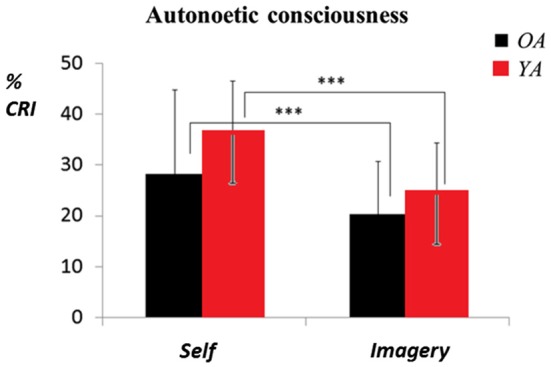
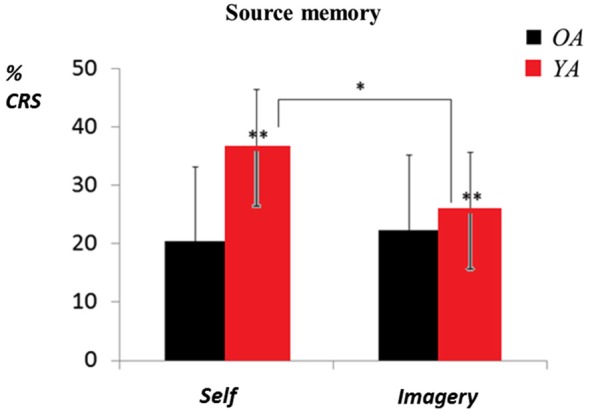
Self-referential processing relies mainly on the medial prefrontal cortex (MPFC) and enhances memory encoding (i.e., Self-Reference Effect, SRE) as it improves the accuracy and richness of remembering in both young and older adults. However, studies on age-related changes in the neural correlates of the SRE on the subjective (i.e., autonoetic consciousness) and the objective (i.e., source memory) qualitative features of episodic memory are lacking. In the present fMRI study, we compared the effects of a self-related (semantic autobiographical memory task) and a non self-related (general semantic memory task) encoding condition on subsequent episodic memory retrieval. We investigated encoding-related activity during each condition in two groups of 19 younger and 16 older adults. Behaviorally, the SRE improved subjective memory performance in both groups but objective memory only in young adults. At the neural level, a direct comparison between self-related and non self-related conditions revealed that SRE mainly activated the cortical midline system, especially the MPFC, in both groups. Additionally, in older adults and regardless of the condition, greater activity was found in a fronto-parietal network. Overall, correlations were noted between source memory performance and activity in the MPFC (irrespective of age) and visual areas (mediated by age). Thus, the present findings expand evidence of the role of the MPFC in self-referential processing in the context of source memory benefit in both young and older adults using incidental encoding via semantic autobiographical memory. However, our finding suggests that its role is less effective in aging.
自我参照加工主要依赖于内侧前额叶皮质(MPFC),并能增强记忆编码(即自我参照效应,SRE),因为它能提高年轻人和老年人记忆的准确性和丰富性。然而,关于SRE在情景记忆的主观(即自我觉知意识)和客观(即来源记忆)质性特征方面的神经关联随年龄变化的研究尚属空白。在本功能磁共振成像(fMRI)研究中,我们比较了自我相关(语义自传体记忆任务)和非自我相关(一般语义记忆任务)编码条件对后续情景记忆提取的影响。我们调查了两组分别为19名年轻人和16名老年人在每种条件下与编码相关的活动。在行为层面,SRE提高了两组的主观记忆表现,但仅提高了年轻人的客观记忆表现。在神经层面,自我相关和非自我相关条件之间的直接比较显示,SRE在两组中均主要激活了皮质中线系统,尤其是MPFC。此外,在老年人中,无论处于何种条件下,额顶叶网络中均发现了更强的活动。总体而言,在MPFC(与年龄无关)和视觉区域(受年龄介导)的活动与来源记忆表现之间存在相关性。因此,本研究结果扩展了MPFC在年轻人和老年人通过语义自传体记忆进行附带编码的情况下,在自我参照加工中对来源记忆有益作用的证据。然而,我们的研究结果表明,其作用在衰老过程中效果较差。