Li Xiaobin, Top Eva M, Wang Yafei, Brown Celeste J, Yao Fei, Yang Shan, Jiang Yong, Li Hui
State Key Laboratory of Forest and Soil Ecology, Institute of Applied Ecology, Chinese Academy of Sciences Shenyang, China ; College of Resources and Environment, University of Chinese Academy of Sciences Beijing, China.
Department of Biological Sciences, Institute for Bioinformatics and Evolutionary Studies, University of Idaho Moscow, ID, USA.
Front Microbiol. 2015 Jan 12;5:777. doi: 10.3389/fmicb.2014.00777. eCollection 2014.
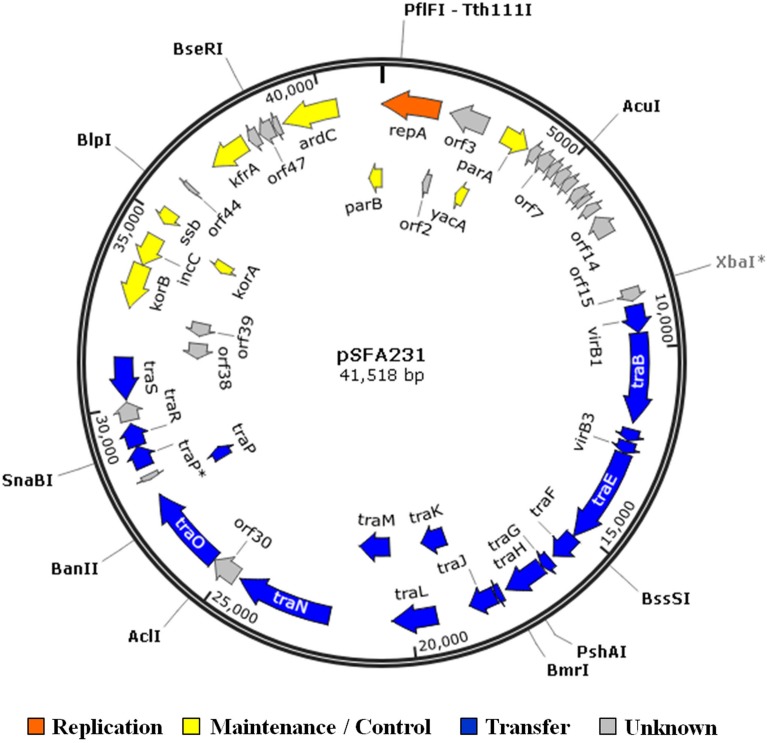
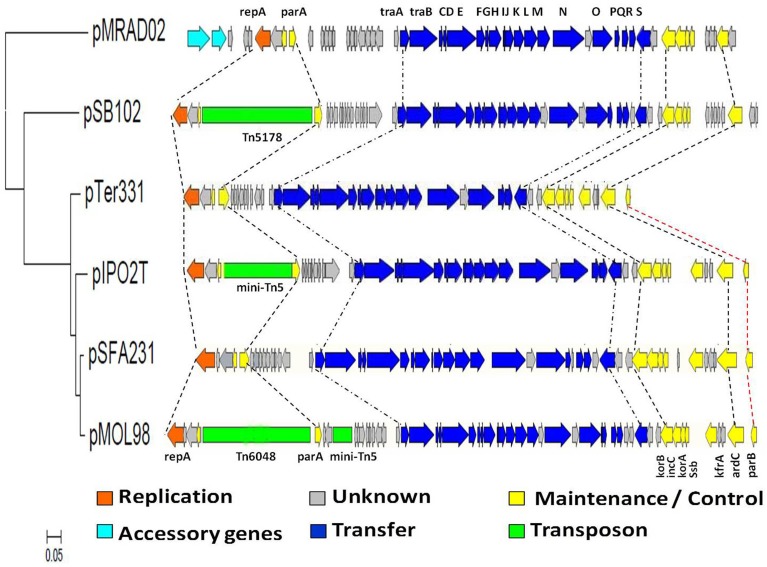
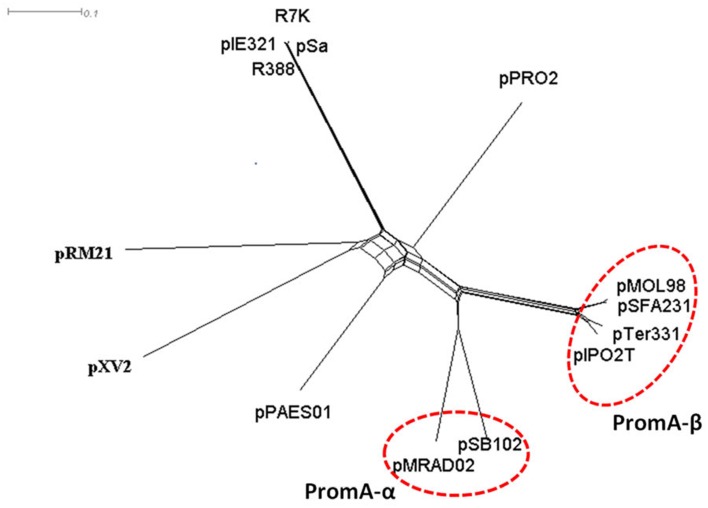
A self-transmissible broad-host-range (BHR) plasmid pSFA231 was isolated from petroleum-contaminated sediment in Shen-fu wastewater irrigation zone, China, using the triparental mating exogenous plasmid capture method. Based on its complete sequence the plasmid has a size of 41.5 kb and codes for 50 putative open reading frames (orfs), 29 of which represent genes involved in replication, partitioning and transfer functions of the plasmid. Phylogenetic analysis grouped pSFA231 into the newly defined PromA plasmid family, which currently includes five members. Further comparative genomic analysis shows that pSFA231 shares the common backbone regions with the other PromA plasmids, i.e., genes involved in replication, maintenance and control, and conjugative transfer. Nevertheless, phylogenetic divergence was found in specific gene products. We propose to divide the PromA group into two subgroups, PromA-α (pMRAD02, pSB102) and PromA-β (pMOL98, pIPO2T, pSFA231, pTer331), based on the splits network analysis of the RepA protein. Interestingly, a cluster of hypothetical orfs located between parA and traA of pSFA231 shows high similarity with the corresponding regions on pMOL98, pIPO2T, and pTer331, suggesting these hypothetical orfs may represent "essential" plasmid backbone genes for the PromA-β subgroup. Alternatively, they may also be accessory genes that were first acquired and then stayed as the plasmid diverged. Our study increases the available collection of complete genome sequences of BHR plasmids, and since pSFA231 is the only characterized PromA plasmid from China, our findings also enhance our understanding of the genetic diversity of this plasmid group in different parts of the world.
利用三亲本杂交外源质粒捕获法,从中国神府污水灌溉区受石油污染的沉积物中分离出一种自我传递的广宿主范围(BHR)质粒pSFA231。根据其完整序列,该质粒大小为41.5 kb,编码50个推定的开放阅读框(orfs),其中29个代表参与质粒复制、分配和转移功能的基因。系统发育分析将pSFA231归入新定义的PromA质粒家族,该家族目前包括五个成员。进一步的比较基因组分析表明,pSFA231与其他PromA质粒共享共同的主干区域,即参与复制、维持和控制以及接合转移的基因。然而,在特定基因产物中发现了系统发育差异。基于RepA蛋白的分裂网络分析,我们建议将PromA组分为两个亚组,PromA-α(pMRAD02、pSB102)和PromA-β(pMOL98、pIPO2T、pSFA231、pTer331)。有趣的是,位于pSFA231的parA和traA之间的一组假定orfs与pMOL98、pIPO2T和pTer331上的相应区域具有高度相似性,表明这些假定orfs可能代表PromA-β亚组的“必需”质粒主干基因。或者,它们也可能是最初获得的辅助基因,然后随着质粒的分化而保留下来。我们的研究增加了BHR质粒完整基因组序列的可用集合,并且由于pSFA231是来自中国的唯一已表征的PromA质粒,我们的发现也增进了我们对世界各地该质粒组遗传多样性的理解。