Rohlfs Marko
Johann-Friedrich-Blumenbach Institute of Zoology and Anthropology, Georg-August-University Göttingen Göttingen, Germany.
Front Microbiol. 2015 Jan 13;5:788. doi: 10.3389/fmicb.2014.00788. eCollection 2014.
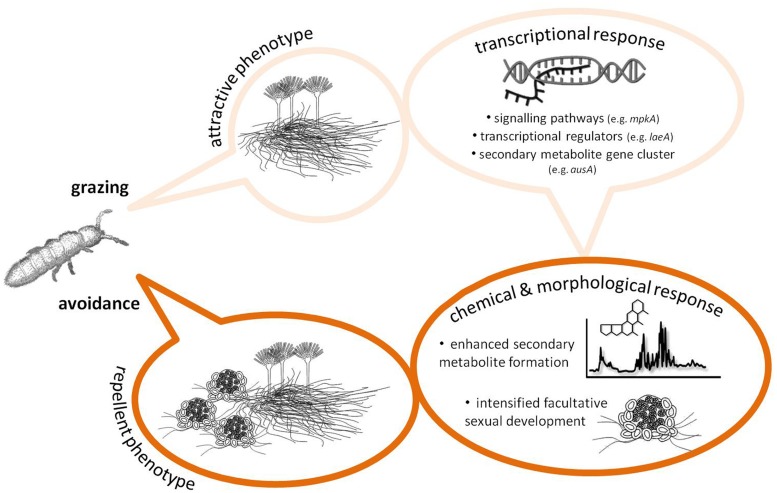
In response to fungivore grazing fungi are assumed to have evolved secondary metabolite-based defense mechanisms that harm and repel grazers, and hence provide a benefit to the metabolite producer. However, since research into the ecological meaning of highly diverse fungal secondary metabolites is still in its infancy, many central questions still remain. Which components of the enormous metabolite diversity of fungi act as direct chemical defense mechanisms against grazers? Is the proposed chemical defense of fungi induced by grazer attack? Which role do volatile compounds play in communicating noxiousness to grazers? What is the relative impact of grazers and that of interactions with competing microbes on the evolution of fungal secondary metabolism? Here, I briefly summarize and discuss the results of the very few studies that have tried to tackle some of these questions by (i) using secondary metabolite mutant fungi in controlled experiments with grazers, and by (ii) investigating fungal secondary metabolism as a flexible means to adapt to grazer-rich niches.
针对食真菌动物的啃食,人们认为真菌进化出了基于次生代谢产物的防御机制,这些机制会伤害并驱赶啃食者,从而为次生代谢产物生产者带来益处。然而,由于对高度多样的真菌次生代谢产物的生态学意义的研究仍处于起步阶段,许多核心问题仍然存在。真菌巨大的代谢产物多样性中的哪些成分充当了针对啃食者的直接化学防御机制?所提出的真菌化学防御是否由啃食者的攻击所诱导?挥发性化合物在向啃食者传达有害性方面发挥着什么作用?啃食者以及与竞争性微生物的相互作用对真菌次生代谢进化的相对影响是什么?在此,我简要总结并讨论了极少数试图通过以下方式解决其中一些问题的研究结果:(i)在与啃食者的对照实验中使用次生代谢产物突变真菌,以及(ii)将真菌次生代谢作为适应富含啃食者的生态位的灵活手段进行研究。