School of Immunity and Infection, University of Birmingham, Birmingham, B15 2TT UK ; MRC-Arthritis Research UK Centre for Musculoskeletal Ageing Research and, University of Birmingham, Birmingham, B15 2TT UK.
School of Sport, Exercise and Rehabilitation Sciences, University of Birmingham, Birmingham, B15 2TT UK.
Immun Ageing. 2014 Dec 16;11(1):25. doi: 10.1186/s12979-014-0025-5. eCollection 2014.
Ageing is accompanied by reduced immunity, termed immunesenescence. The immune system does not act in isolation and is sensitive to both psychological and physical stress. Hip fracture is a common physical stressor in older adults with a high incidence of new onset depression, which relates to poorer prognosis. We therefore set out to examine the possible synergistic effects of physical stress (hip fracture) and psychological stress (depressive symptoms) on the aged immune system.
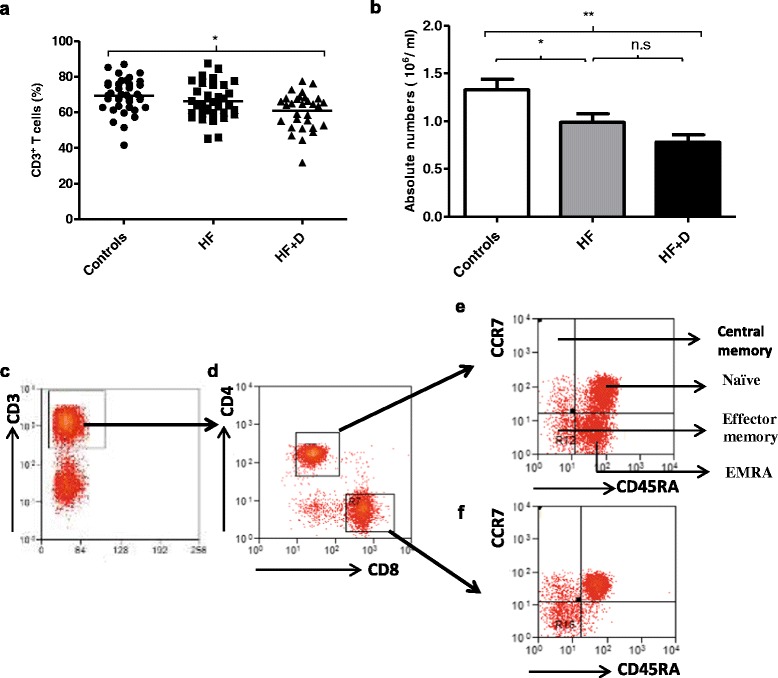
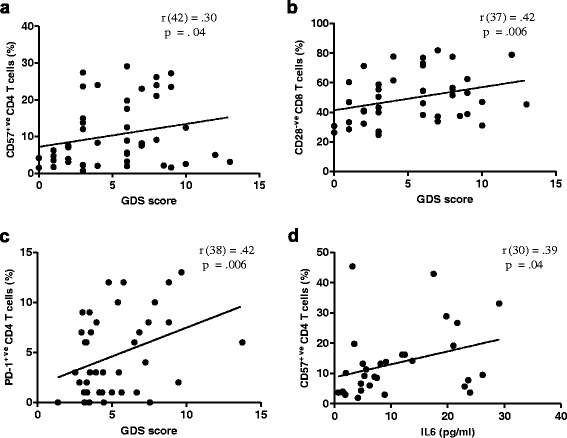
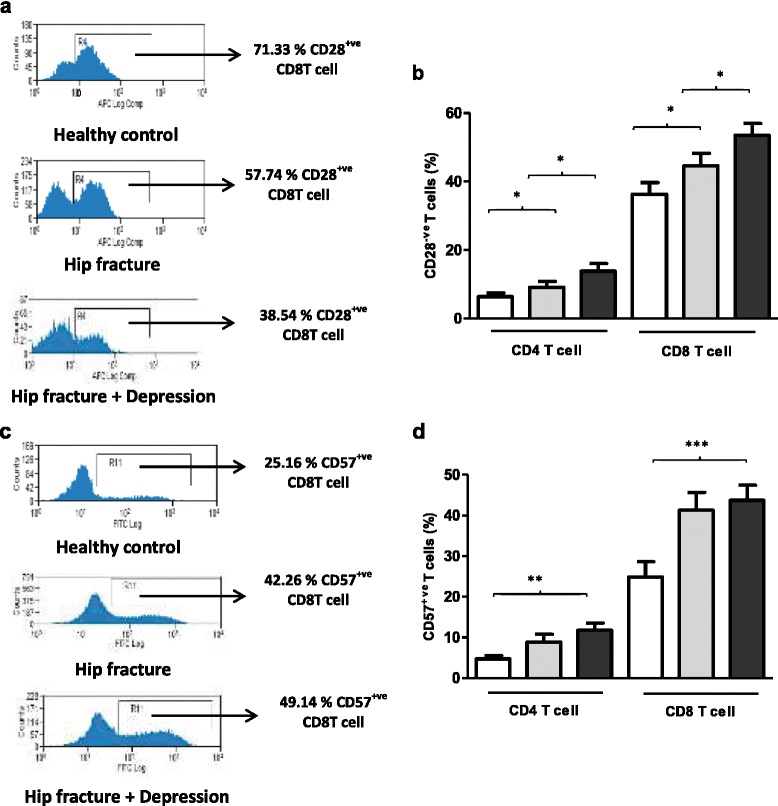
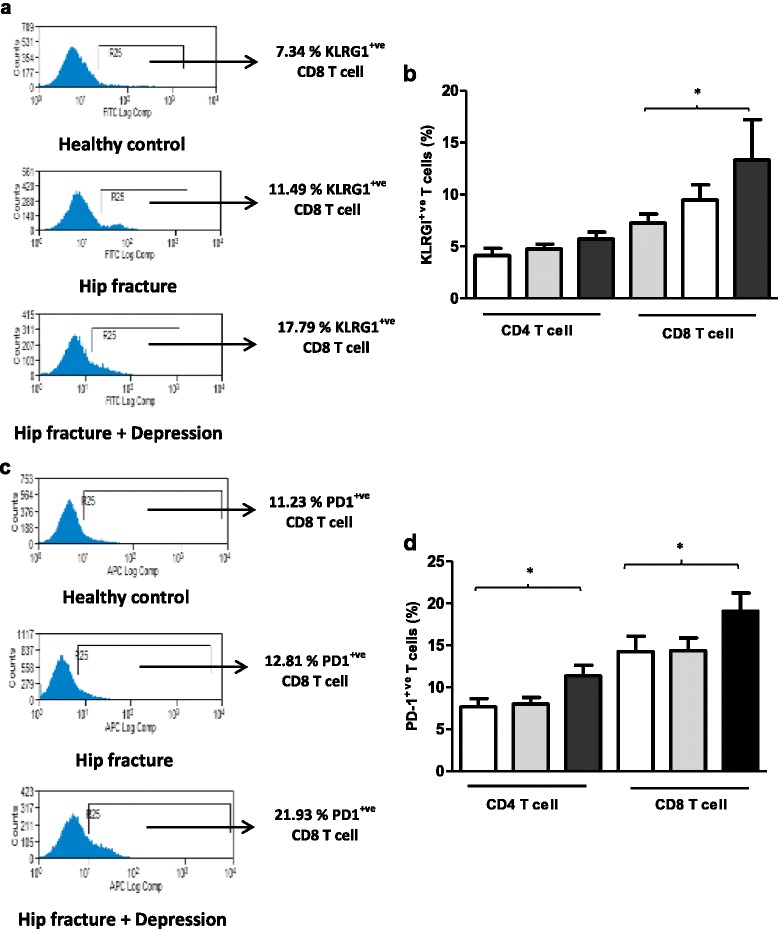
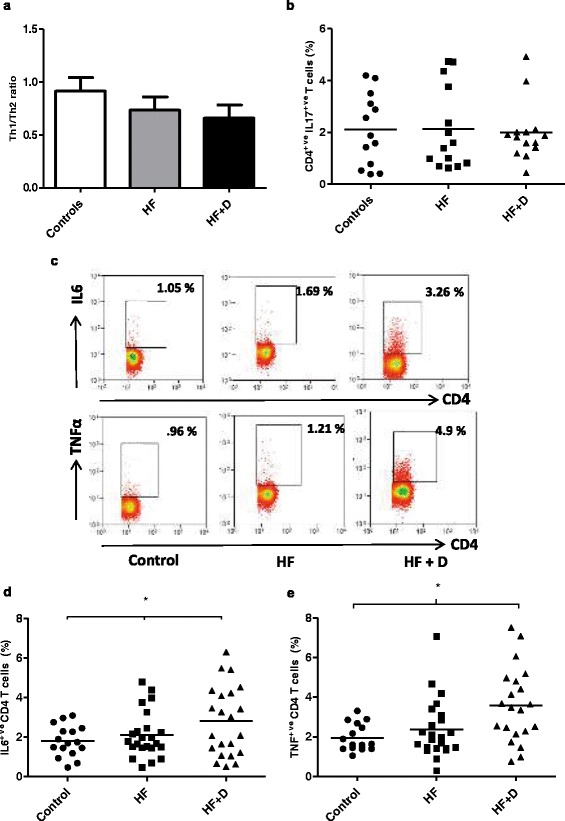
T cell phenotype and function was assessed in 101 hip fracture patients (81 female) 6 weeks after hip fracture and 43 healthy age-matched controls (26 female). 38 fracture patients had depressive symptoms at 6 weeks. T cell frequency (p = .01) and numbers (p = .003) were both lower in depressed hip fracture patients compared to healthy controls. The frequency of senescent CD28(-ve) (p = .001), CD57(+ve) (p = .001), KLRG1(+ve) (p = .03) CD8 T cells, as well as senescent CD28(-ve) CD4(+ve) (p = .01) and CD57(+ve) CD4(+ve) (p = .003) T cells were higher in depressed hip fracture patients compared with healthy controls and the frequency of CD28(-ve) CD8 T cells was also higher when compared to patients with hip fracture alone (p = .01). Additionally, activated CD69(+ve) (p = .005) and HLADR(+ve) (p < .001) CD8 T cells, were also higher in depressed hip fracture patients compared to healthy controls. On examining cytokine production by activated T cells, a significant increase in TNFα (p = .03) and IL6 (p = .04) production was observed in CD4 T cells from hip fracture patients with depressive symptoms compared to healthy controls.
As none of the patients in the study had a prior history of depression, our data suggest that the development of depressive symptoms in hip fracture patients is associated with altered T cell phenotype and increased pro-inflammatory function which is not seen in patients who do not develop depression after hip fracture. Treating depressive symptoms promptly in hip fracture patients may therefore improve immunity and outcomes in these patients.
随着年龄的增长,免疫力会下降,这被称为免疫衰老。免疫系统并非孤立运作,它对心理和身体压力都很敏感。髋部骨折是老年人中常见的身体应激源,其新发抑郁症的发病率较高,与预后较差有关。因此,我们着手研究身体应激(髋部骨折)和心理应激(抑郁症状)对老年免疫系统的可能协同作用。
在髋部骨折后 6 周,我们评估了 101 例髋部骨折患者(81 名女性)和 43 名年龄匹配的健康对照者(26 名女性)的 T 细胞表型和功能。38 例骨折患者在 6 周时出现抑郁症状。与健康对照组相比,抑郁的髋部骨折患者的 T 细胞频率(p=0.01)和数量(p=0.003)均较低。衰老的 CD28(-ve)(p=0.001)、CD57(+ve)(p=0.001)、KLRG1(+ve)(p=0.03)、CD8 T 细胞的频率,以及衰老的 CD28(-ve)CD4(+ve)(p=0.01)和 CD57(+ve)CD4(+ve)(p=0.003)T 细胞在抑郁的髋部骨折患者中也更高,与单纯髋部骨折患者相比,CD28(-ve)CD8 T 细胞的频率也更高(p=0.01)。此外,与健康对照组相比,激活的 CD69(+ve)(p=0.005)和 HLA-DR(+ve)(p<0.001)CD8 T 细胞在抑郁的髋部骨折患者中也更高。在检查激活的 T 细胞产生的细胞因子时,我们发现与健康对照组相比,有抑郁症状的髋部骨折患者的 CD4 T 细胞中 TNF-α(p=0.03)和 IL6(p=0.04)的产生显著增加。
由于研究中的患者均无抑郁病史,因此我们的数据表明,髋部骨折患者出现抑郁症状与 T 细胞表型改变和促炎功能增强有关,而在髋部骨折后不发生抑郁的患者中则没有这种情况。因此,髋部骨折患者出现抑郁症状时及时进行治疗可能会改善这些患者的免疫功能和预后。