Institute of Inflammation and Ageing, University of Birmingham, Birmingham, UK.
NIHR Surgical Reconstruction and Microbiology Research Centre, University Hospital Birmingham, Mindelsohn Way, Birmingham, UK.
Sci Rep. 2018 Jul 5;8(1):10186. doi: 10.1038/s41598-018-28409-7.
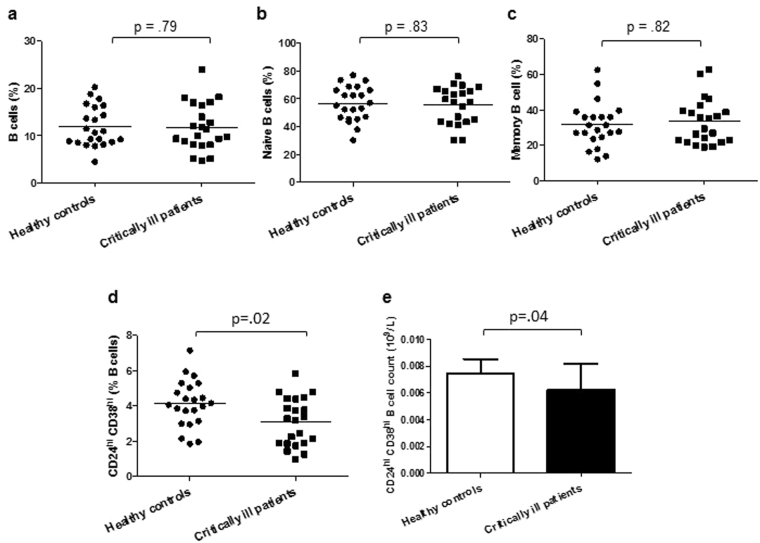
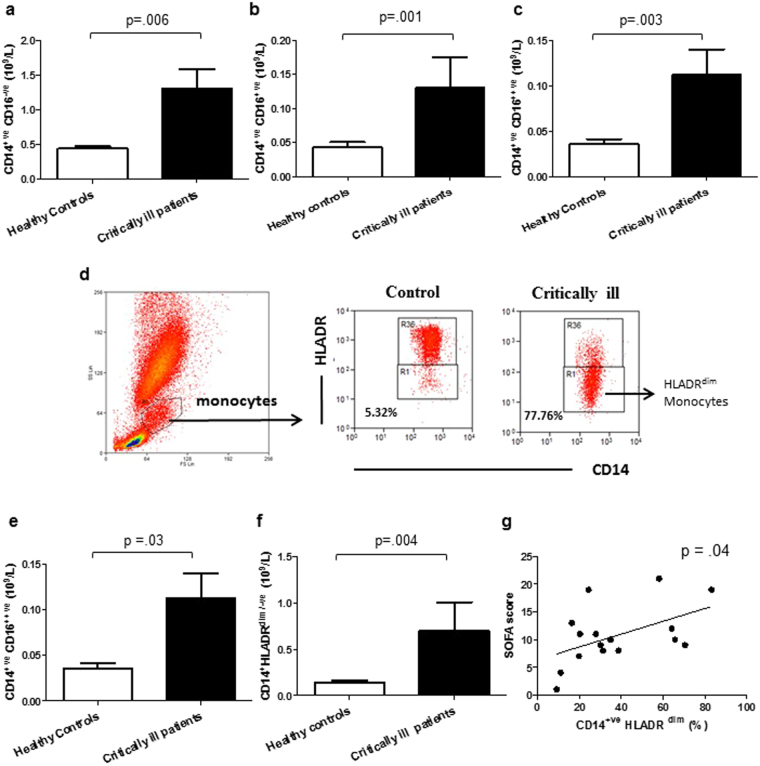
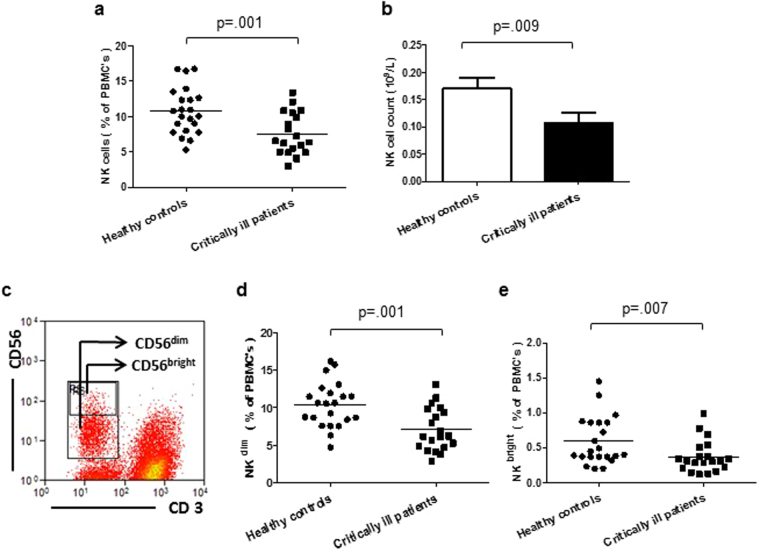
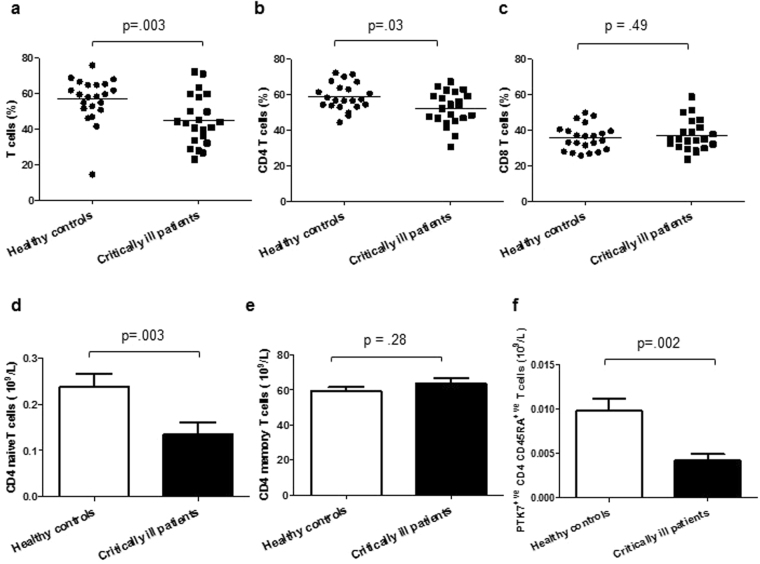
This study aimed to evaluate whether ICU patients who developed persistent critical illness displayed an immune profile similar to an aged immune phenotype and any associations with patient outcomes. Twenty two critically ill ICU patients (27-76 years, 15 males), at day 5 of mechanical ventilation, and 22 healthy age-matched controls (27-77 years, 13 males) were recruited. Frequency and phenotype of innate and adaptive immune cells and telomere length in peripheral blood mononuclear cells (PBMCs) were measured. An elevated granulocyte count (p < 0.0001), increased numbers of immature granulocytes (p < 0.0001), increased CD16 monocytes (p = 0.003) and CD14 HLADR monocytes (p = 0.004) and lower NK cell numbers (p = 0.007) were observed in ICU patients compared to controls. Critically ill patients also had lower numbers of total T lymphocytes (p = 0.03), naïve CD4 T cells (p = 0.003) and PTK7 recent thymic emigrants (p = 0.002), and increased senescent CD28 CD57 CD4 T cells (p = 0.02), but there was no difference in PBMC telomere length. Regulatory immune cell frequency was affected with reduced circulating CD19CD24CD38 regulatory B cells (p = 0.02). However, only a raised neutrophil:lymphocyte ratio and reduced frequency of CD14 HLADR monocytes were associated with poor outcomes. We conclude that persistent critical illness results in changes to immune cell phenotype only some of which are similar to that seen in physiological ageing of the immune system.
这项研究旨在评估在机械通气第 5 天发生持续严重疾病的 ICU 患者是否表现出类似于衰老免疫表型的免疫特征,以及与患者预后的任何关联。招募了 22 名危重病 ICU 患者(27-76 岁,15 名男性)和 22 名年龄匹配的健康对照组(27-77 岁,13 名男性)。测量了外周血单核细胞(PBMC)中固有和适应性免疫细胞的频率和表型以及端粒长度。与对照组相比,ICU 患者的粒细胞计数升高(p < 0.0001),幼稚粒细胞数量增加(p < 0.0001),CD16 单核细胞(p = 0.003)和 CD14 HLADR 单核细胞(p = 0.004)增加,NK 细胞数量减少(p = 0.007)。重症患者的总 T 淋巴细胞数量也较低(p = 0.03),幼稚 CD4 T 细胞数量较低(p = 0.003)和最近胸腺迁出的 PTK7 细胞数量较低(p = 0.002),衰老的 CD28 CD57 CD4 T 细胞数量增加(p = 0.02),但 PBMC 端粒长度没有差异。调节性免疫细胞频率受到影响,循环 CD19CD24CD38 调节性 B 细胞减少(p = 0.02)。然而,只有高中性粒细胞:淋巴细胞比值和 CD14 HLADR 单核细胞频率降低与不良预后相关。我们得出结论,持续的严重疾病导致免疫细胞表型发生变化,其中一些变化类似于免疫系统的生理衰老。