Barua Subit, Kuizon Salomon, Chadman Kathryn K, Brown W Ted, Junaid Mohammed A
Developmental Biochemistry, New York State Institute for Basic Research in Developmental Disabilities, 1050 Forest Hill Road, Staten Island, NY 10314, USA.
Developmental Neurobiology, New York State Institute for Basic Research in Developmental Disabilities, 1050 Forest Hill Road, Staten Island, NY 10314, USA.
Brain Sci. 2015 Jan 26;5(1):14-31. doi: 10.3390/brainsci5010014.
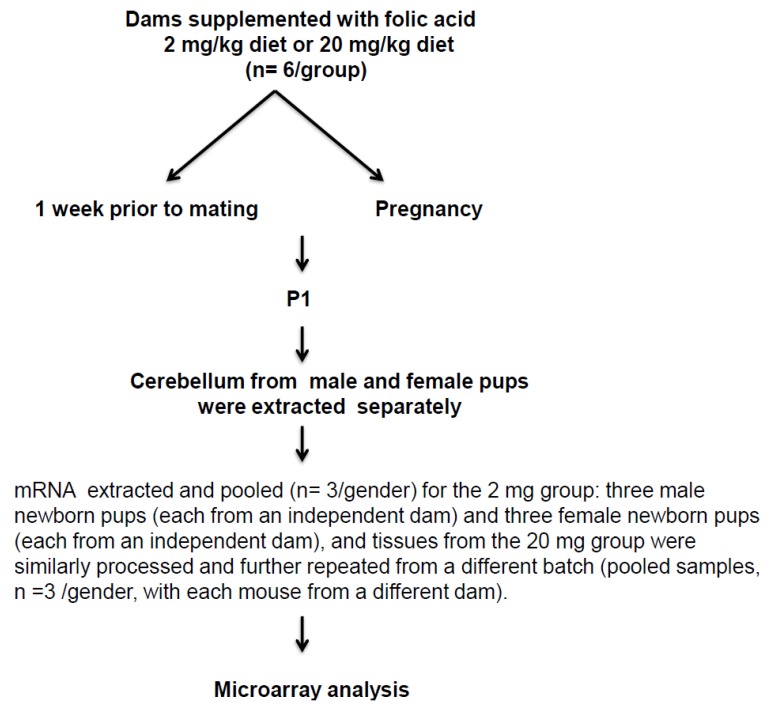
Folate is a water-soluble vitamin that is critical for nucleotide synthesis and can modulate methylation of DNA by altering one-carbon metabolism. Previous studies have shown that folate status during pregnancy is associated with various congenital defects including the risk of aberrant neural tube closure. Maternal exposure to a methyl supplemented diet also can alter DNA methylation and gene expression, which may influence the phenotype of offspring. We investigated if higher gestational folic acid (FA) in the diet dysregulates the expression of genes in the cerebellum of offspring in C57BL/6 J mice. One week before gestation and throughout the pregnancy, groups of dams were supplemented with FA either at 2 mg/kg or 20 mg/kg of diet. Microarray analysis was used to investigate the genome wide gene expression profile in the cerebellum from day old pups. Our results revealed that exposure to the higher dose FA diet during gestation dysregulated expression of several genes in the cerebellum of both male and female pups. Several transcription factors, imprinted genes, neuro-developmental genes and genes associated with autism spectrum disorder exhibited altered expression levels. These findings suggest that higher gestational FA potentially dysregulates gene expression in the offspring brain and such changes may adversely alter fetal programming and overall brain development.
叶酸是一种水溶性维生素,对核苷酸合成至关重要,并且可以通过改变一碳代谢来调节DNA甲基化。先前的研究表明,孕期叶酸状态与包括神经管闭合异常风险在内的各种先天性缺陷有关。母体摄入添加甲基的饮食也会改变DNA甲基化和基因表达,这可能会影响后代的表型。我们研究了孕期饮食中较高剂量的叶酸(FA)是否会失调C57BL/6 J小鼠后代小脑基因的表达。在妊娠前一周及整个孕期,给几组母鼠分别补充2 mg/kg或20 mg/kg饮食的FA。利用微阵列分析研究出生一天幼崽小脑中全基因组基因表达谱。我们的结果显示,孕期暴露于较高剂量FA饮食会失调雄性和雌性幼崽小脑中几个基因的表达。几种转录因子、印记基因、神经发育基因以及与自闭症谱系障碍相关的基因表现出表达水平改变。这些发现表明,孕期较高剂量的FA可能会失调后代大脑中的基因表达,而这种变化可能会对胎儿编程和整体大脑发育产生不利影响。