Bruins Maaike J, Mugambi Gladys, Verkaik-Kloosterman Janneke, Hoekstra Jeljer, Kraemer Klaus, Osendarp Saskia, Melse-Boonstra Alida, Gallagher Alison M, Verhagen Hans
DSM Biotechnology Center, Delft, The Netherlands.
Nutrition and Dietetics Unit, Ministry of Health, Nairobi, Kenya.
Food Nutr Res. 2015 Jan 27;59:26020. doi: 10.3402/fnr.v58.26020. eCollection 2015.
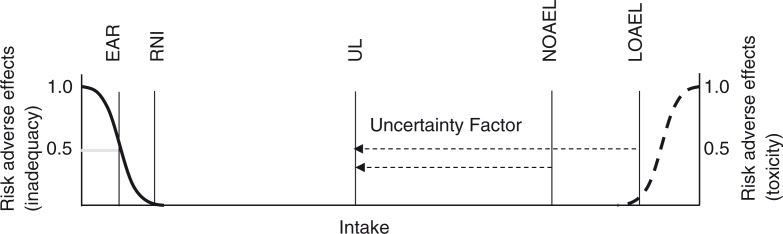
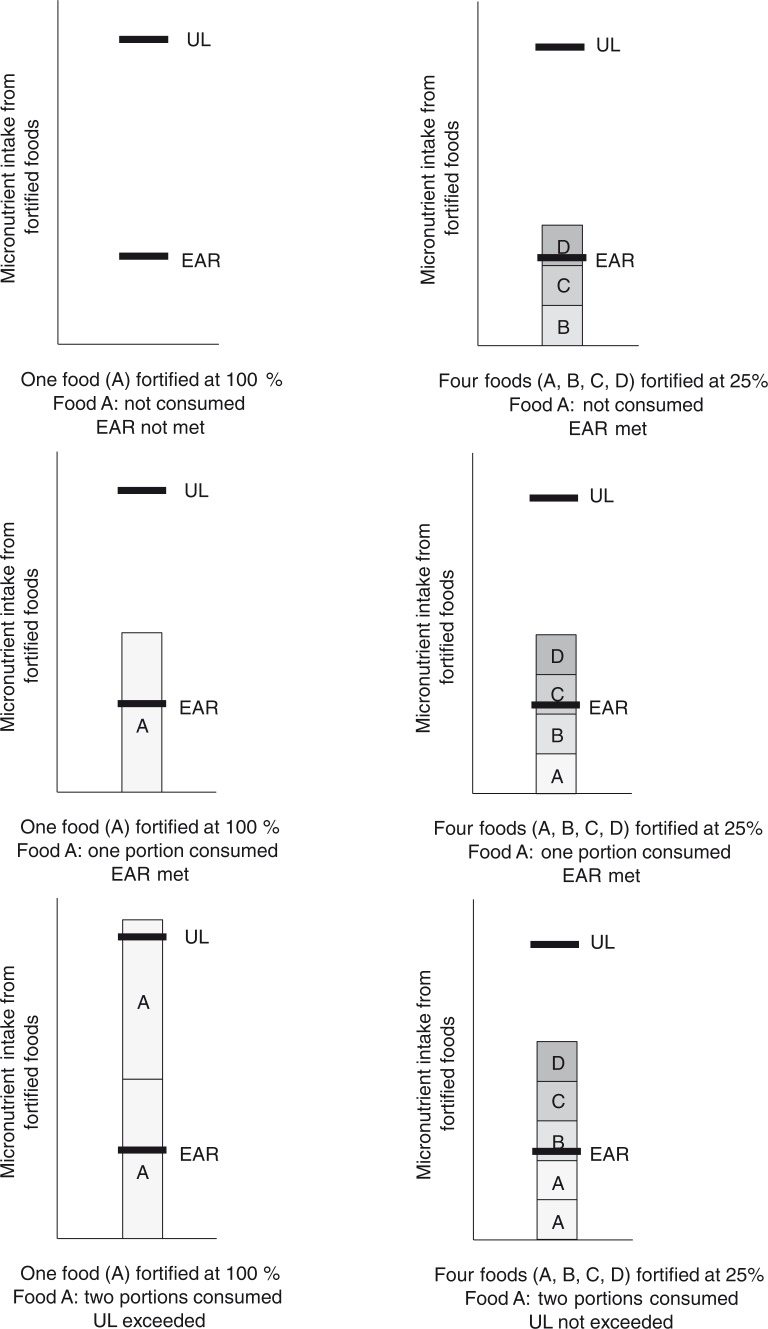
Fortification of foods consumed by the general population or specific food products or supplements designed to be consumed by vulnerable target groups is amongst the strategies in developing countries to address micronutrient deficiencies. Any strategy aimed at dietary change needs careful consideration, ensuring the needs of at-risk subgroups are met whilst ensuring safety within the general population. This paper reviews the key principles of two main assessment approaches that may assist developing countries in deciding on effective and safe micronutrient levels in foods or special products designed to address micronutrient deficiencies, that is, the cut-point method and the stepwise approach to risk-benefit assessment. In the first approach, the goal is to shift population intake distributions such that intake prevalences below the Estimated Average Requirement (EAR) and above the Tolerable Upper Intake Level (UL) are both minimized. However, for some micronutrients like vitamin A and zinc, a narrow margin between the EAR and UL exists. Increasing their intakes through mass fortification may pose a dilemma; not permitting the UL to be exceeded provides assurance about the safety within the population but can potentially leave a proportion of the target population with unmet needs, or . Risk-benefit approaches assist in decision making at different micronutrient intake scenarios by balancing the magnitude of potential health benefits of reducing inadequate intakes against health risks of excessive intakes. Risk-benefit approaches consider different aspects of health risk including severity and number of people affected. This approach reduces the uncertainty for policy makers as compared to classic cut-point methods.
在发展中国家,对普通人群食用的食品进行强化,或针对易受影响的目标群体设计特定的食品或补充剂,是解决微量营养素缺乏问题的策略之一。任何旨在改变饮食的策略都需要仔细考虑,要确保满足高危亚群体的需求,同时确保普通人群的安全。本文回顾了两种主要评估方法的关键原则,这两种方法可能有助于发展中国家确定用于解决微量营养素缺乏问题的食品或特殊产品中有效且安全的微量营养素水平,即切点法和风险效益评估的逐步方法。在第一种方法中,目标是改变人群的摄入量分布,使低于估计平均需求量(EAR)和高于可耐受最高摄入量(UL)的摄入流行率都降至最低。然而,对于一些微量营养素,如维生素A和锌,EAR和UL之间的差距很窄。通过大规模强化增加它们的摄入量可能会带来两难境地;不允许超过UL可确保人群安全,但可能会使一部分目标人群的需求无法得到满足,或者……风险效益方法通过平衡减少摄入不足的潜在健康益处的大小与过量摄入的健康风险,协助在不同的微量营养素摄入情况下进行决策。风险效益方法考虑健康风险的不同方面,包括严重程度和受影响的人数。与经典的切点法相比,这种方法减少了政策制定者面临的不确定性。