Hsieh Ji-Cheng, Liu Lei, Zeilani Mamane, Ickes Scott, Trehan Indi, Maleta Ken, Craig Christina, Thakwalakwa Chrissie, Singh Lauren, Brenna J Thomas, Manary Mark J
*Department of Pediatrics, Washington University, St. Louis, MO †Division of Nutritional Sciences, Cornell University, Ithaca, NY ‡Nutriset, Malaunay, France §Department of Kinesiology and Health Sciences, College of William and Mary, Williamsburg, VA ||College of Medicine, University of Malawi, Blantyre, Malawi, Africa.
J Pediatr Gastroenterol Nutr. 2015 Jul;61(1):138-43. doi: 10.1097/MPG.0000000000000741.
Ready-to-use therapeutic food (RUTF) is the preferred treatment for uncomplicated severe acute malnutrition. It contains large amounts of linoleic acid and little α-linolenic acid, which may reduce the availability of docosahexaenoic acid (DHA) and eicosapentaenoic acid (EPA) to the recovering child. A novel high-oleic RUTF (HO-RUTF) was developed with less linoleic acid to determine its effect on DHA and EPA status.
We conducted a prospective, randomized, double-blind clinical effectiveness trial treating rural Malawian children with severe acute malnutrition. Children were treated with either HO-RUTF or standard RUTF. Plasma phospholipid fatty acid status was measured on enrollment and after 4 weeks and compared between the 2 intervention groups.
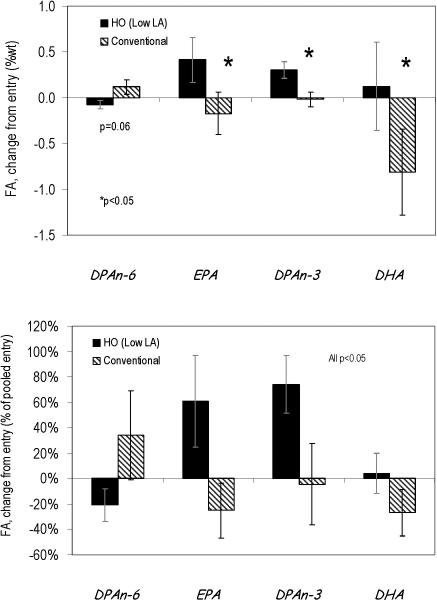
Among the 141 children enrolled, 48 of 71 receiving HO-RUTF and 50 of 70 receiving RUTF recovered. Plasma phospholipid samples were analyzed from 43 children consuming HO-RUTF and 35 children consuming RUTF. The change in DHA content during the first 4 weeks was +4% and -25% in the HO-RUTF and RUTF groups, respectively (P = 0.04). For EPA, the change in content was 63% and -24% in the HO-RUTF and RUTF groups, respectively (P < 0.001). For arachidonic acid, the change in content was -3% and 13% in the HO-RUTF and RUTF groups, respectively (P < 0.009).
The changes in DHA and EPA seen in the children treated with HO-RUTF warrant further investigation because they suggest that HO-RUTF support improved polyunsaturated fatty acid status, necessary for neural development and recovery.
即食治疗性食品(RUTF)是治疗无并发症的重度急性营养不良的首选疗法。它含有大量亚油酸,而α-亚麻酸含量很少,这可能会降低康复期儿童体内二十二碳六烯酸(DHA)和二十碳五烯酸(EPA)的可利用性。一种新型的高油酸RUTF(HO-RUTF)被研发出来,其亚油酸含量较低,以确定其对DHA和EPA状态的影响。
我们开展了一项前瞻性、随机、双盲临床疗效试验,治疗马拉维农村地区患有重度急性营养不良的儿童。儿童分别接受HO-RUTF或标准RUTF治疗。在入组时和4周后测量血浆磷脂脂肪酸状态,并在两个干预组之间进行比较。
在141名入组儿童中,71名接受HO-RUTF治疗的儿童中有48名康复,70名接受RUTF治疗的儿童中有50名康复。对43名食用HO-RUTF的儿童和35名食用RUTF的儿童的血浆磷脂样本进行了分析。在HO-RUTF组和RUTF组中,前4周DHA含量的变化分别为+4%和-25%(P = 0.04)。对于EPA,HO-RUTF组和RUTF组中含量的变化分别为63%和-24%(P < 0.001)。对于花生四烯酸,HO-RUTF组和RUTF组中含量的变化分别为-3%和13%(P < 0.009)。
接受HO-RUTF治疗的儿童中DHA和EPA的变化值得进一步研究,因为这表明HO-RUTF有助于改善多不饱和脂肪酸状态,而这对神经发育和康复是必需的。