Salvador Fernando, Los-Arcos Ibai, Sánchez-Montalvá Adrián, Tórtola Teresa, Curran Adrian, Villar Ana, Saborit Nuria, Castellví Josep, Molina Israel
From the Department of Infectious Diseases (FS, IL-A, AS-M, AC, NS, IM), Vall d'Hebron University Hospital, Universitat Autònoma de Barcelona, PROSICS Barcelona; Department of Microbiology (TT), Vall d'Hebron University Hospital; Department of Pneumology (AV); and Department of Pathology (JC), Vall d'Hebron University Hospital, Barcelona, Spain.
Medicine (Baltimore). 2015 Jan;94(4):e509. doi: 10.1097/MD.0000000000000509.
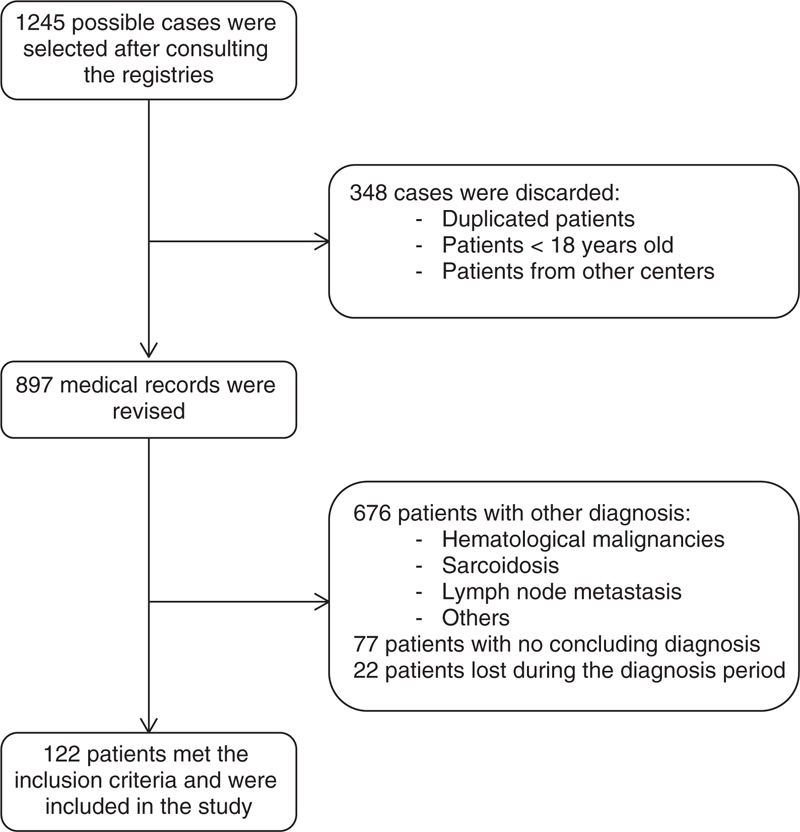
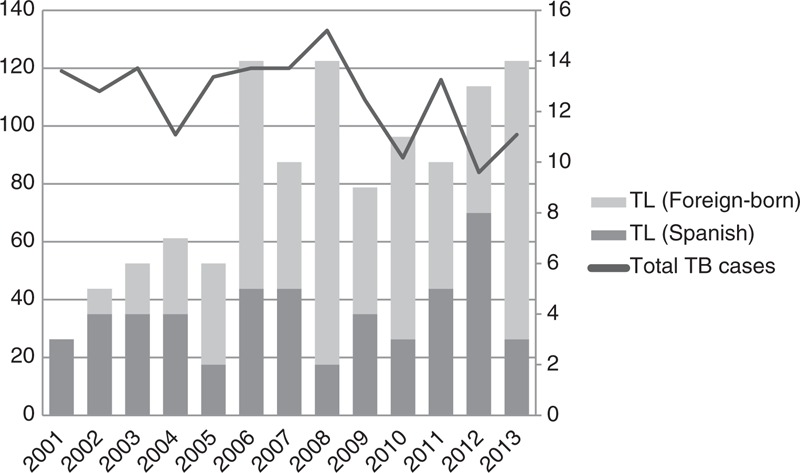
The aim of this article is to describe epidemiological and clinical data of patients with tuberculous lymphadenitis (TL) and evaluate the yield of the diagnostic techniques employed. Retrospective observational study was performed at the Vall d'Hebron University Hospital, Barcelona, Spain. All adult patients with confirmed TL (microbiologically) or probable TL (suspected by clinical presentation, cyto/histopathological features, and clinical improvement after specific treatment) diagnosed from January 2001 to December 2013 were included. One hundred twenty-two patients were included: 78 (63.9%) patients with confirmed diagnosis and 44 (36.1%) patients with probable TL. Seventy (57.4%) patients were nonnative residents. From 83 fine-needle aspiration (FNA) specimens, 54.8% (40/73) showed granulomatous inflammation, 62.5% (40/64) had positive mycobacterial culture, and 73.3% (11/15) tested positive with Xpert MTB/RIF (Cepheid, Sunnyvale, CA). From 62 biopsy samples, 96.8% (60/62) showed granulomatous inflammation, 64.6% (31/48) had positive mycobacterial culture, and 46.1% (6/13) tested positive with Xpert MTB/RIF. TL has increasingly been diagnosed in our setting, mostly because of cases diagnosed in nonnative residents. FNA is an easy and safe technique for the diagnosis of suspected TL, and the yield regarding mycobacterial culture seems to be similar to the obtained with biopsy. The Xpert MTB/RIF test from FNA specimens may increase the accuracy of the TL diagnosis and provides quicker results.
本文旨在描述结核性淋巴结炎(TL)患者的流行病学和临床数据,并评估所采用诊断技术的检出率。在西班牙巴塞罗那的瓦尔德希伯伦大学医院进行了一项回顾性观察研究。纳入了2001年1月至2013年12月期间确诊(微生物学确诊)或疑似TL(根据临床表现、细胞/组织病理学特征以及特异性治疗后的临床改善情况怀疑)的所有成年患者。共纳入122例患者:78例(63.9%)确诊患者,44例(36.1%)疑似TL患者。70例(57.4%)患者为非本地居民。在83份细针穿刺(FNA)标本中,54.8%(40/73)显示肉芽肿性炎症,62.5%(40/64)结核分枝杆菌培养阳性,73.3%(11/15)Xpert MTB/RIF检测(Cepheid公司,加利福尼亚州森尼韦尔市)呈阳性。在62份活检样本中,96.8%(60/62)显示肉芽肿性炎症,64.6%(31/48)结核分枝杆菌培养阳性,46.1%(6/13)Xpert MTB/RIF检测呈阳性。在我们的研究环境中,TL的诊断越来越多,主要是因为非本地居民中诊断出的病例。FNA是诊断疑似TL的一种简单且安全的技术,其结核分枝杆菌培养的检出率似乎与活检相似。FNA标本的Xpert MTB/RIF检测可能会提高TL诊断的准确性并提供更快的结果。