Kurtz Matthew M, Mueser Kim T, Thime Warren R, Corbera Silvia, Wexler Bruce E
Department of Psychology and Program in Neuroscience and Behavior, Wesleyan University, Middletown, CT, United States; Schizophrenia Rehabilitation Program, Institute of Living, Hartford, CT, United States; Department of Psychiatry, Yale School of Medicine, New Haven, CT, United States.
Center for Psychiatric Rehabilitation, College of Health and Rehabilitation Sciences, Sargent College, Boston University, Boston, MA, United States.
Schizophr Res. 2015 Mar;162(1-3):35-41. doi: 10.1016/j.schres.2015.01.020. Epub 2015 Jan 29.
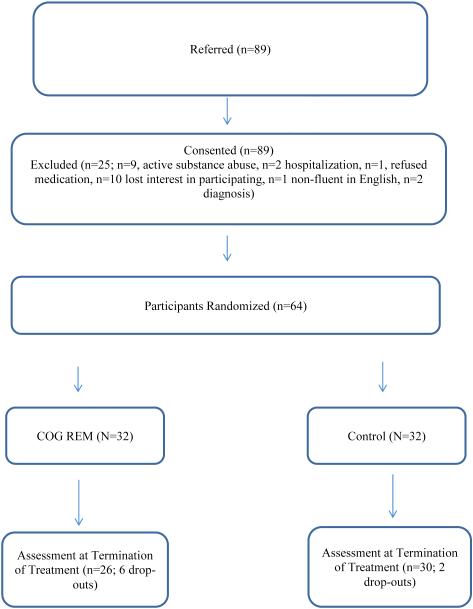
A growing body of research shows that cognitive remediation (COG REM), consisting of drill-and-practice and/or strategy training in neurocognitive functions, produces moderate improvements in neurocognition. These improvements generalize to functioning when COG REM is provided with other rehabilitation interventions (Wykes et al., 2011). The number of studies using COG REM as an adjunct to other behavioral-based rehabilitation interventions however remains small and consists of widely varying interventions with few active control conditions. This study compared the effects of an extended (6-month), standardized, computer-assisted cognitive remediation intervention, administered along with a standardized program of social skills-training (SST), with those of an active control condition that included participation in the same SST program and a computer skills training program (Computer Skills). Sixty-four individuals with schizophrenia recruited from two treatment sites were randomly assigned to one of two conditions and were assessed by blinded raters on neurocognitive measures, performance-based measures of social skill, and ratings of psychosocial function before and after treatment. Results revealed that the COG REM group improved significantly more in attention, working memory, and empathy than the Computer Skills group, but there were no differences between groups on other measures of psychosocial functioning or skills. Taken together, these findings suggest that COG REM used in the context of other evidence-based psychosocial interventions (SST) improves working memory in schizophrenia and suggests that this effect may generalize to improved empathy.
越来越多的研究表明,认知康复(COG REM),包括神经认知功能的练习与实践和/或策略训练,会使神经认知有适度改善。当认知康复与其他康复干预措施同时进行时,这些改善会推广到功能方面(Wykes等人,2011年)。然而,将认知康复作为其他基于行为的康复干预措施辅助手段的研究数量仍然很少,而且这些研究包含广泛不同的干预措施,积极对照条件很少。本研究比较了一种延长(6个月)的、标准化的、计算机辅助认知康复干预措施(与标准化社交技能训练计划(SST)一起实施)与一种积极对照条件(包括参与相同的社交技能训练计划和计算机技能训练计划(计算机技能))的效果。从两个治疗地点招募的64名精神分裂症患者被随机分配到两种条件之一,并由不知情的评估者在治疗前后对神经认知指标、基于表现的社交技能指标和心理社会功能评分进行评估。结果显示,与计算机技能组相比,认知康复组在注意力、工作记忆和同理心方面的改善明显更大,但在心理社会功能或技能的其他指标上两组之间没有差异。综上所述,这些发现表明,在其他循证心理社会干预措施(社交技能训练)背景下使用的认知康复可改善精神分裂症患者的工作记忆,并表明这种效果可能推广到同理心的改善。