Hoencamp Rigo, Idenburg Floris J, van Dongen Thijs T C F, de Kruijff Loes G M, Huizinga Eelco P, Plat Marie-Christine J, Hoencamp Erik, Leenen Luke P H, Hamming Jaap F, Vermetten Eric
Department of Surgery, Leiden University Medical Centre, Leiden, The Netherlands.
Department of Surgery, Medical Centre Haaglanden, The Hague, The Netherlands.
PLoS One. 2015 Feb 2;10(2):e0115119. doi: 10.1371/journal.pone.0115119. eCollection 2015.
Units deployed to armed conflicts are at high risk for exposure to combat events. Many battle casualties (BCs) have been reported in the recent deployment to Afghanistan. The long-term impact of these combat injuries, at their five-year end point, is currently unknown. To date, no systematic inventory has been performed of an identified group of BCs in comparison to non-injured service members from the same operational theatre.
Observational cross-sectional cohort study.
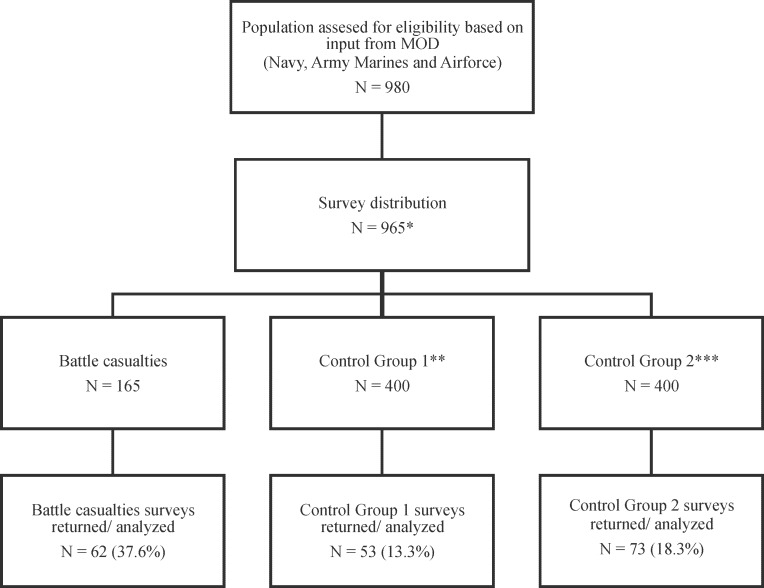
Open online survey among Dutch BCs that deployed to Afghanistan (2006-2010).
The Dutch BCs (n = 62) were compared to two control groups of non-injured combat groups (battle exposed [n = 53], and non-battle exposed [n = 73]).
Participants rated their impact of trauma exposure (Impact of Events [IES]), post deployment reintegration (Post Deployment Reintegration Scale [PDRS]), general symptoms of distress (Symptom Checklist 90 [SCL-90]), as well as their current perceived quality of life (EuroQol-6D [EQ-6D]). Also cost effectiveness (Short From health survey [SF-36]) and care consumption were assessed (Trimbos/iMTA questionnaire).
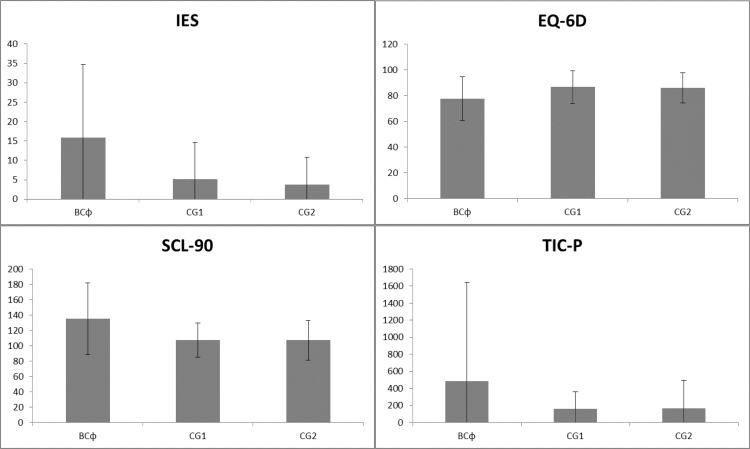
Over 90% of BCs were still in active duty. The mean scores of all questionnaires (IES, EQ-6D, SF-36, and SCL-90) of the BC group were significantly higher than in the control groups (p<0.05). The PDRS showed a significantly lower (p<0.05) outcome in the negative subscales. The mean consumption of care was triple that of both control groups. A lower score on quality of life was related to higher levels of distress and impact of trauma exposure.
This study showed a clear long-term impact on a wide range of scales that contributes to a reduced quality of life in a group of BCs. Low perceived cost effectiveness matched with high consumption of care in the BC group in comparison to the control groups. These results warrant continuous monitoring of BCs.
部署到武装冲突地区的部队面临着接触战斗事件的高风险。在最近一次对阿富汗的部署中,有许多战斗伤员(BCs)的报告。这些战斗损伤在五年终点的长期影响目前尚不清楚。迄今为止,尚未对一组已确认的战斗伤员与来自同一作战区域的未受伤服役人员进行系统的清查。
观察性横断面队列研究。
对部署到阿富汗(2006 - 2010年)的荷兰战斗伤员进行开放式在线调查。
将荷兰战斗伤员(n = 62)与两个未受伤战斗组的对照组进行比较(战斗暴露组[n = 53]和非战斗暴露组[n = 73])。
参与者对创伤暴露的影响(事件影响量表[IES])、部署后重新融入(部署后重新融入量表[PDRS])、一般痛苦症状(症状自评量表90[SCL - 90])以及他们当前感知的生活质量(欧洲五维度健康量表[EQ - 6D])进行评分。还评估了成本效益(简易健康调查[SF - 36])和护理消耗(Trimbos/iMTA问卷)。
超过90%的战斗伤员仍在现役。战斗伤员组所有问卷(IES、EQ - 6D、SF - 36和SCL - 90)的平均得分显著高于对照组(p<0.05)。PDRS在负性子量表中的结果显著更低(p<0.05)。护理的平均消耗量是两个对照组的三倍。生活质量得分较低与更高水平的痛苦和创伤暴露影响相关。
本研究表明,在广泛的量表上存在明显的长期影响,这导致一组战斗伤员的生活质量下降。与对照组相比,战斗伤员组的成本效益感知较低,护理消耗量较高。这些结果值得对战斗伤员进行持续监测。