Zhou Min-Xiong, Yan Xu, Xie Hai-Bin, Zheng Hui, Xu Dongrong, Yang Guang
Shanghai Key Laboratory of Magnetic Resonance, Physics Department, East China Normal University, Shanghai, China; Shanghai Medical Instrumentation College, University of Shanghai for Science and Technology, Shanghai, China.
MR Collaboration NE Asia, Siemens Healthcare, Shanghai, China.
PLoS One. 2015 Feb 2;10(2):e0116986. doi: 10.1371/journal.pone.0116986. eCollection 2015.
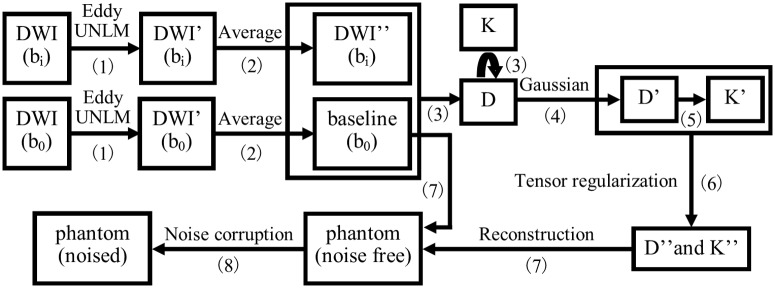
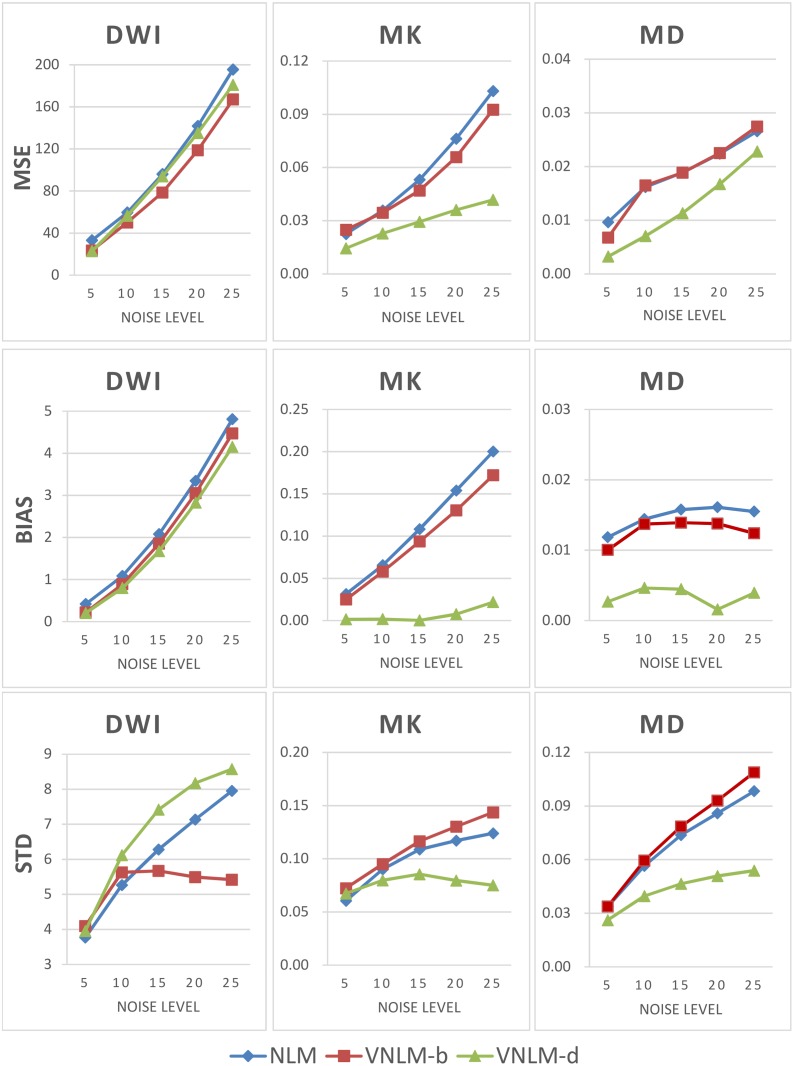
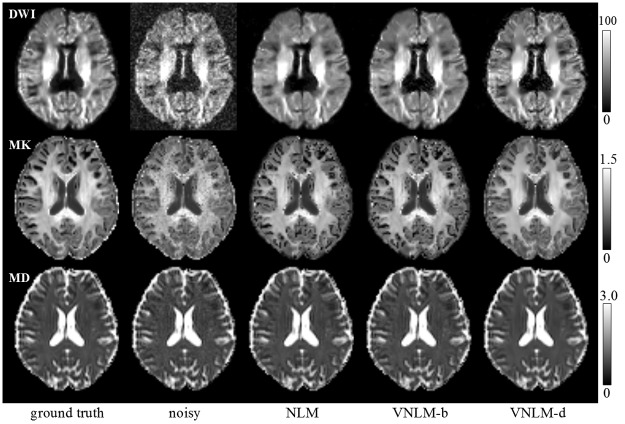
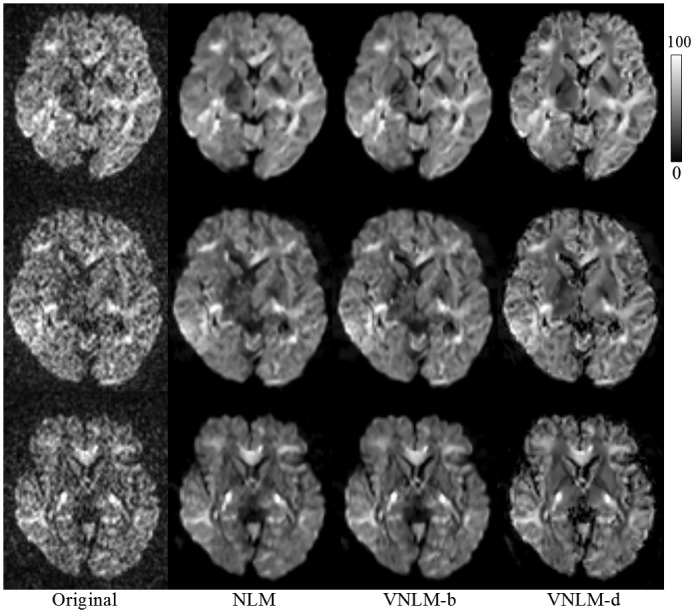
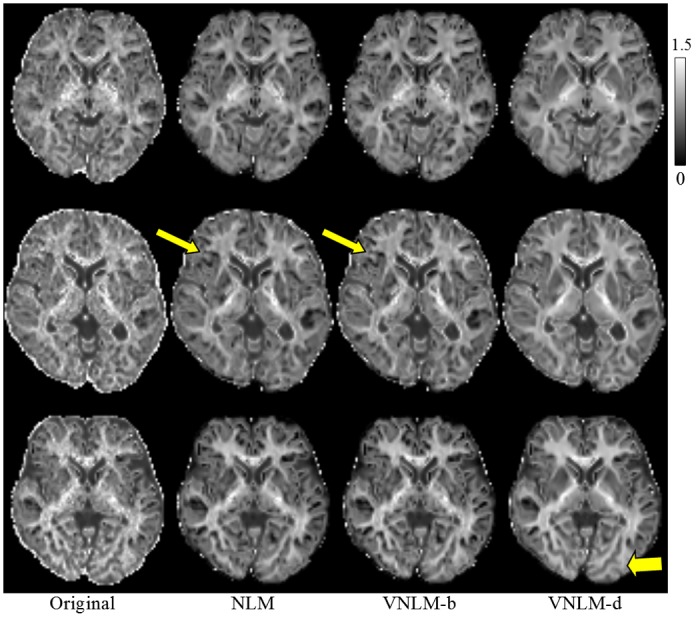
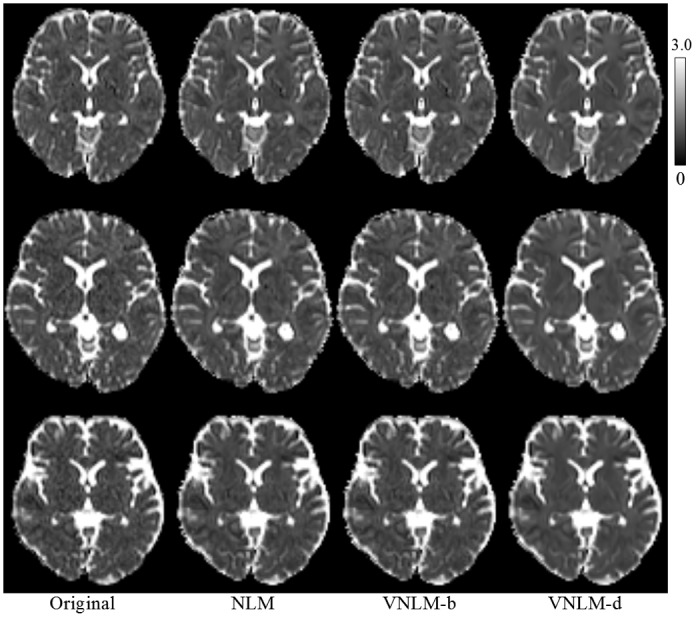
Image denoising has a profound impact on the precision of estimated parameters in diffusion kurtosis imaging (DKI). This work first proposes an approach to constructing a DKI phantom that can be used to evaluate the performance of denoising algorithms in regard to their abilities of improving the reliability of DKI parameter estimation. The phantom was constructed from a real DKI dataset of a human brain, and the pipeline used to construct the phantom consists of diffusion-weighted (DW) image filtering, diffusion and kurtosis tensor regularization, and DW image reconstruction. The phantom preserves the image structure while minimizing image noise, and thus can be used as ground truth in the evaluation. Second, we used the phantom to evaluate three representative algorithms of non-local means (NLM). Results showed that one scheme of vector-based NLM, which uses DWI data with redundant information acquired at different b-values, produced the most reliable estimation of DKI parameters in terms of Mean Square Error (MSE), Bias and standard deviation (Std). The result of the comparison based on the phantom was consistent with those based on real datasets.
图像去噪对扩散峰度成像(DKI)中估计参数的精度有深远影响。这项工作首先提出了一种构建DKI体模的方法,该体模可用于评估去噪算法在提高DKI参数估计可靠性方面的性能。该体模由人脑的真实DKI数据集构建而成,用于构建体模的流程包括扩散加权(DW)图像滤波、扩散和峰度张量正则化以及DW图像重建。该体模在最小化图像噪声的同时保留了图像结构,因此可作为评估中的真实基准。其次,我们使用该体模评估了三种代表性的非局部均值(NLM)算法。结果表明,基于向量的NLM的一种方案,即使用在不同b值下获取的具有冗余信息的DWI数据,在均方误差(MSE)、偏差和标准差(Std)方面产生了最可靠的DKI参数估计。基于体模的比较结果与基于真实数据集的结果一致。