
探索细菌细胞器相互作用组:Pdu微区室中蛋白质-蛋白质相互作用网络的模型
Exploring bacterial organelle interactomes: a model of the protein-protein interaction network in the Pdu microcompartment.
作者信息
Jorda Julien, Liu Yu, Bobik Thomas A, Yeates Todd O
机构信息
UCLA-DOE Institute for Genomics and Proteomics, Los Angeles, California, United States of America.
Roy J. Carver Department of Biochemistry, Biophysics and Molecular Biology, Iowa State University, Ames, Iowa, United States of America.
出版信息
PLoS Comput Biol. 2015 Feb 3;11(2):e1004067. doi: 10.1371/journal.pcbi.1004067. eCollection 2015 Feb.
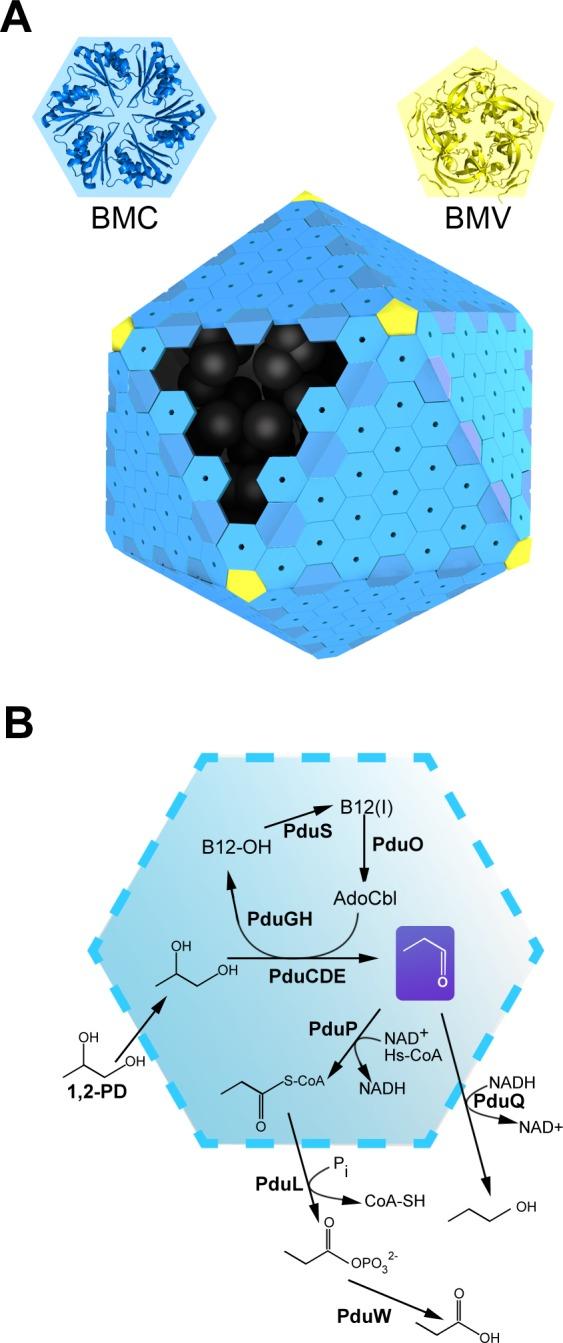
Bacterial microcompartments (MCPs) are protein-bound organelles that carry out diverse metabolic pathways in a wide range of bacteria. These supramolecular assemblies consist of a thin outer protein shell, reminiscent of a viral capsid, which encapsulates sequentially acting enzymes. The most complex MCP elucidated so far is the propanediol utilizing (Pdu) microcompartment. It contains the reactions for degrading 1,2-propanediol. While several experimental studies on the Pdu system have provided hints about its organization, a clear picture of how all the individual components interact has not emerged yet. Here we use co-evolution-based methods, involving pairwise comparisons of protein phylogenetic trees, to predict the protein-protein interaction (PPI) network governing the assembly of the Pdu MCP. We propose a model of the Pdu interactome, from which selected PPIs are further inspected via computational docking simulations. We find that shell protein PduA is able to serve as a "universal hub" for targeting an array of enzymes presenting special N-terminal extensions, namely PduC, D, E, L and P. The varied N-terminal peptides are predicted to bind in the same cleft on the presumptive luminal face of the PduA hexamer. We also propose that PduV, a protein of unknown function with remote homology to the Ras-like GTPase superfamily, is likely to localize outside the MCP, interacting with the protruding β-barrel of the hexameric PduU shell protein. Preliminary experiments involving a bacterial two-hybrid assay are presented that corroborate the existence of a PduU-PduV interaction. This first systematic computational study aimed at characterizing the interactome of a bacterial microcompartment provides fresh insight into the organization of the Pdu MCP.
细菌微区室(MCPs)是蛋白质结合的细胞器,在多种细菌中执行不同的代谢途径。这些超分子组装体由一层薄的外部蛋白质外壳组成,类似于病毒衣壳,包裹着顺序作用的酶。迄今为止阐明的最复杂的MCP是利用丙二醇的(Pdu)微区室。它包含降解1,2 - 丙二醇的反应。虽然对Pdu系统的几项实验研究已经提供了关于其组织的线索,但所有单个组件如何相互作用的清晰图景尚未出现。在这里,我们使用基于共同进化的方法,涉及蛋白质系统发育树的成对比较,来预测控制Pdu MCP组装的蛋白质 - 蛋白质相互作用(PPI)网络。我们提出了一个Pdu相互作用组模型,通过计算对接模拟进一步检查从中选择的PPI。我们发现外壳蛋白PduA能够作为一个“通用枢纽”,用于靶向一系列具有特殊N端延伸的酶,即PduC、D、E、L和P。预测不同的N端肽会结合在PduA六聚体假定腔内表面的同一裂隙中。我们还提出,PduV是一种功能未知的蛋白质,与Ras样GTPase超家族具有远缘同源性,可能定位于MCP外部,与六聚体PduU外壳蛋白突出的β桶相互作用。提出了涉及细菌双杂交试验的初步实验,证实了PduU - PduV相互作用的存在。这项旨在表征细菌微区室相互作用组的首次系统计算研究为Pdu MCP的组织提供了新的见解。



 Zotero 插件