Venkataswamy Manjunatha Muniswamappa, Madhusudana Shampur Narayan, Sanyal Sampada Sudarshan, Taj Shaheen, Belludi Ashwin Yajaman, Mani Reeta Subramaniam, Hazra Nandita
Deptartment of Neurovirology, National Institute of Mental Health and Neurosciences, Bangalore, India.
Clin Exp Vaccine Res. 2015 Jan;4(1):68-74. doi: 10.7774/cevr.2015.4.1.68. Epub 2015 Jan 30.
Immunization against rabies in humans induces protective neutralizing antibodies; however, the induction of type 1 or type 2 cytokine mediated cellular immune responses following rabies vaccination is not understood. Hence, the present study investigated cellular cytokine responses in vaccinated individuals.
The study groups included healthy rabies antigen naive controls (n=10), individuals who received intradermal primary (n=10) or booster pre-exposure vaccination (n=20) and subjects who received postexposure rabies vaccination either by intradermal (n=18) or intramuscular (n=20) routes. The antigen specific cellular responses were analyzed by stimulating peripheral blood mononuclear cells with a rabies vaccine antigen in the interferon-γ (IFN-γ) and interleukin-4 (IL-4) enzyme-linked immunospot (ELISpot) assay. These responses were compared to the rabies virus neutralizing antibody (RVNA) titers that were measured by rapid fluorescent focus inhibition test.
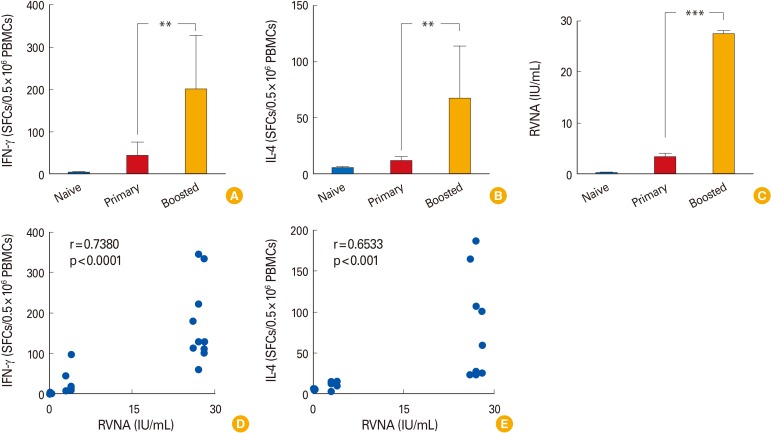
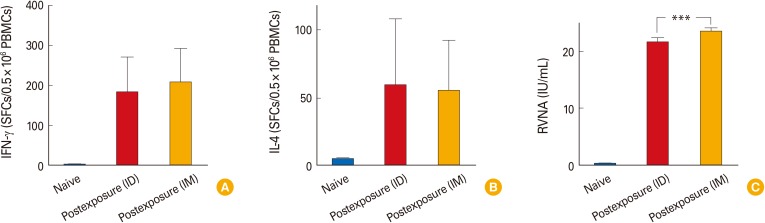
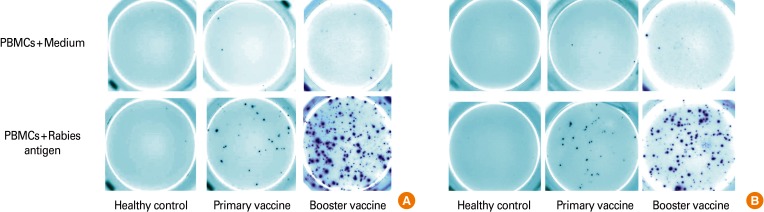
We observed that cellular and humoral immune responses to primary intradermal rabies vaccination could be greatly enhanced by a booster vaccine; and both type 1 and type 2 cytokine responses were significantly elevated. The magnitude of type 1 and type 2 cytokine responses did not differ significantly among the intramuscular and intradermal routes of postexposure vaccination. The number of cells producing IFN-γ and IL-4 correlated significantly with the levels of RVNA.
Both type 1 and type 2 cellular cytokine responses are strongly induced after rabies vaccination and directly correlate with levels of RVNA titers. The neutralizing antibody as well as the type 1 and type 2 cytokine responses may be important for vaccine induced protective responses against rabies.
人用狂犬病疫苗可诱导产生保护性中和抗体;然而,狂犬病疫苗接种后1型或2型细胞因子介导的细胞免疫反应尚未明确。因此,本研究调查了接种疫苗个体的细胞细胞因子反应。
研究组包括健康的未接触过狂犬病抗原的对照组(n = 10)、接受皮内初次(n = 10)或暴露前加强疫苗接种的个体(n = 20)以及通过皮内(n = 18)或肌肉注射(n = 20)途径接受暴露后狂犬病疫苗接种的受试者。通过在干扰素-γ(IFN-γ)和白细胞介素-4(IL-4)酶联免疫斑点(ELISpot)试验中用狂犬病疫苗抗原刺激外周血单核细胞来分析抗原特异性细胞反应。将这些反应与通过快速荧光灶抑制试验测量的狂犬病病毒中和抗体(RVNA)滴度进行比较。
我们观察到,加强疫苗可大大增强对皮内初次狂犬病疫苗接种的细胞和体液免疫反应;1型和2型细胞因子反应均显著升高。暴露后疫苗接种的肌肉注射和皮内注射途径之间,1型和2型细胞因子反应的强度没有显著差异。产生IFN-γ和IL-4的细胞数量与RVNA水平显著相关。
狂犬病疫苗接种后可强烈诱导1型和2型细胞细胞因子反应,且与RVNA滴度水平直接相关。中和抗体以及1型和2型细胞因子反应可能对疫苗诱导的抗狂犬病保护性反应很重要。