Wang Mingyi, Shah Ajay M
Laboratory of Cardiovascular Science, National Institute on Aging, National Institutes of Health, Biomedical Research Center (BRC), 251 Bayview Blvd, Baltimore, MD 21224, USA.
Cardiovascular Division, King's College London British Heart Foundation Centre of Excellence, London, UK.
J Mol Cell Cardiol. 2015 Jun;83:101-11. doi: 10.1016/j.yjmcc.2015.02.004. Epub 2015 Feb 7.
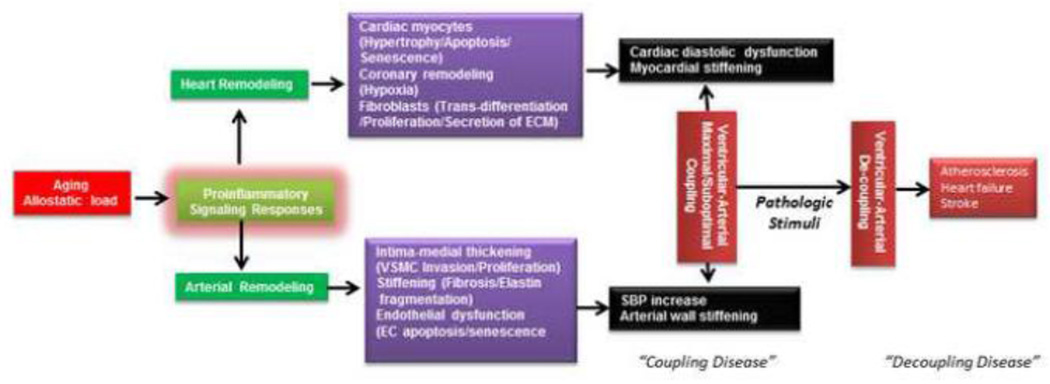
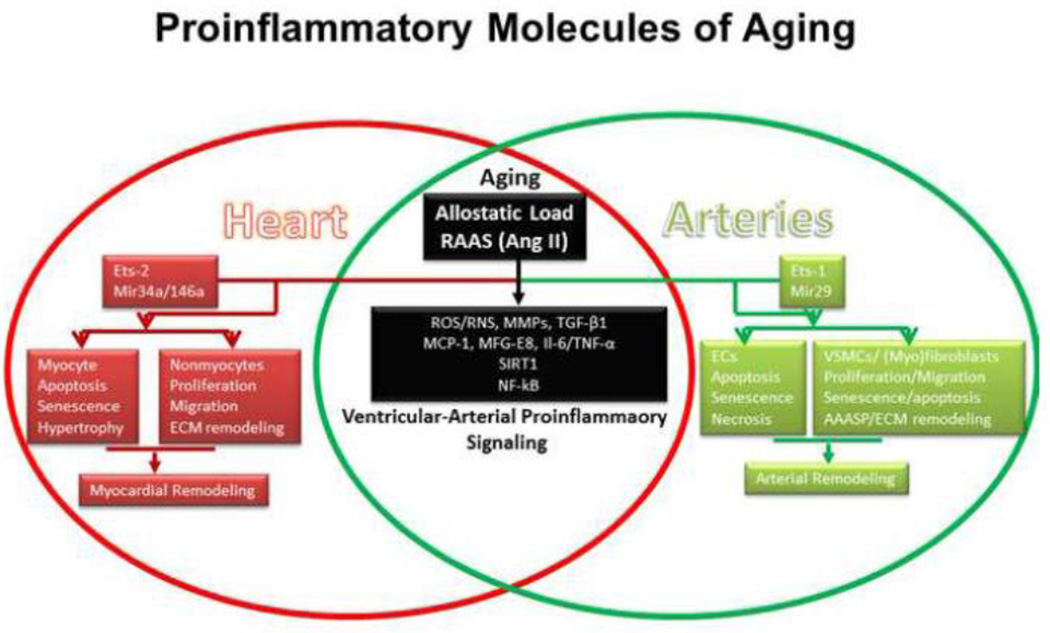
The aging population is increasing dramatically. Aging-associated stress simultaneously drives proinflammatory remodeling, involving angiotensin II and other factors, in both the heart and large arteries. The structural remodeling and functional changes that occur with aging include cardiac and vascular wall stiffening, systolic hypertension and suboptimal ventricular-arterial coupling, features that are often clinically silent and thus termed a silent syndrome. These age-related effects are the result of responses initiated by cardiovascular proinflammatory cells. Local proinflammatory signals are coupled between the heart and arteries due to common mechanical and humoral messengers within a closed circulating system. Thus, targeting proinflammatory signaling molecules would be a promising approach to improve age-associated suboptimal ventricular-arterial coupling, a major predisposing factor for the pathogenesis of clinical cardiovascular events such as heart failure.
老年人口正在急剧增加。衰老相关应激同时驱动心脏和大动脉的促炎重塑,涉及血管紧张素II和其他因素。随着衰老发生的结构重塑和功能变化包括心脏和血管壁僵硬、收缩期高血压以及心室-动脉耦联欠佳,这些特征在临床上通常没有症状,因此被称为沉默综合征。这些与年龄相关的影响是心血管促炎细胞引发的反应的结果。由于封闭循环系统内常见的机械和体液信使,局部促炎信号在心脏和动脉之间相互关联。因此,靶向促炎信号分子将是一种有前景的方法,可改善与年龄相关的心室-动脉耦联欠佳,而心室-动脉耦联欠佳是心力衰竭等临床心血管事件发病机制的主要易感因素。