Green David W, Kwon Hyuk-Jae, Jung Han-Sung
Oral Biosciences, Faculty of Dentistry, The University of Hong Kong, Hong Kong SAR.
Division of Developmental Biology, Cincinnati Children's Hospital Medical Center, Cincinnati, OH 45229, USA.
Mol Cells. 2015 Mar;38(3):267-72. doi: 10.14348/molcells.2015.2315. Epub 2015 Feb 5.
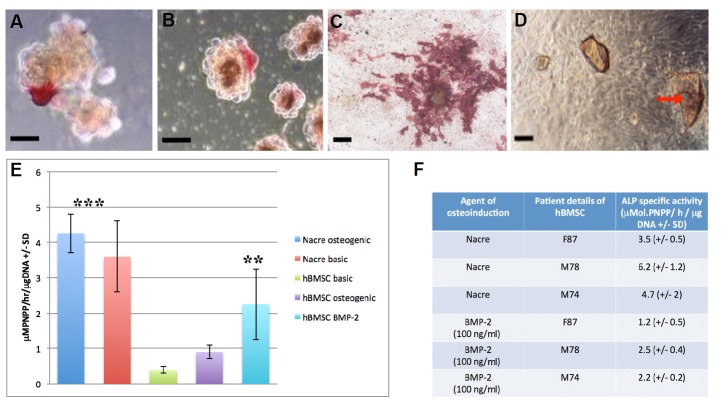
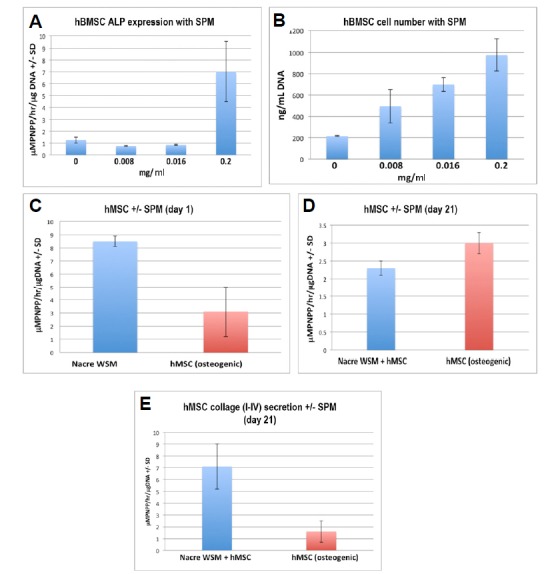
Nacre seashell is a natural osteoinductive biomaterial with strong effects on osteoprogenitors, osteoblasts, and osteoclasts during bone tissue formation and morphogenesis. Although nacre has shown, in one study, to induce bridging of new bone across large non-union bone defects in 8 individual human patients, there have been no succeeding human surgical studies to confirm this outstanding potency. But the molecular mechanisms associated with nacre osteoinduction and the influence on bone marrow-derived mesenchymal stem cells (BMSC's), skeletal stem cells or bone marrow stromal cells remain elusive. In this study we highlight the phenotypic and biochemical effects of Pinctada maxima nacre chips and the global nacre soluble protein matrix (SPM) on primary human bone marrow-derived stromal cells (hBMSCs) in vitro. In static co-culture with nacre chips, the hBMSCs secreted Alkaline phosphatase (ALP) at levels that exceeded bone morphogenetic protein (rhBMP-2) treatment. Concentrated preparation of SPM applied to Stro-1 selected hBMSC's led to rapid ALP secretions, at concentrations exceeding the untreated controls even in osteogenic conditions. Within 21 days the same population of Stro-1 selected hBMSCs proliferated and secreted collagens I-IV, indicating the premature onset of an osteoblast phenotype. The same SPM was found to promote unselected hBMSC differentiation with osteocalcin detected at 7 days, and proliferation increased at 7 days in a dose-dependent manner. In conclusion, nacre particles and nacre SPM induced the early stages of human bone cell differentiation, indicating that they may be promising soluble factors with osteoinductive capacity in primary human bone cell progenitors such as, hBMSC's.
珍珠母贝是一种天然的骨诱导生物材料,在骨组织形成和形态发生过程中对骨祖细胞、成骨细胞和破骨细胞有显著作用。尽管在一项研究中,珍珠母贝已显示能诱导8例人类个体患者的大的骨不连骨缺损处形成新骨桥接,但尚无后续的人体手术研究来证实这种显著功效。但与珍珠母贝骨诱导相关的分子机制以及对骨髓间充质干细胞(BMSC)、骨骼干细胞或骨髓基质细胞的影响仍不清楚。在本研究中,我们着重探讨了大珠母贝珍珠母芯片和整体珍珠母可溶性蛋白基质(SPM)对原代人骨髓来源的基质细胞(hBMSC)的表型和生化作用。在与珍珠母芯片的静态共培养中,hBMSC分泌碱性磷酸酶(ALP)的水平超过了骨形态发生蛋白(rhBMP - 2)处理组。将浓缩的SPM制剂应用于经Stro - 1筛选的hBMSC,即使在成骨条件下,其浓度超过未处理对照组时也能导致ALP快速分泌。在21天内,同一群经Stro - 1筛选的hBMSC增殖并分泌I - IV型胶原蛋白,表明成骨细胞表型过早出现。发现相同的SPM能促进未筛选的hBMSC分化,在7天时检测到骨钙素,且在7天时增殖呈剂量依赖性增加。总之,珍珠母颗粒和珍珠母SPM诱导了人骨细胞分化的早期阶段,表明它们可能是在原代人骨细胞祖细胞如hBMSC中具有骨诱导能力的有前景的可溶性因子。