Bryan Brett A, Huai Jianjun, Connor Jeff, Gao Lei, King Darran, Kandulu John, Zhao Gang
CSIRO Land and Water Flagship and Agriculture Flagship, Waite Campus, Urrbrae, South Australia, Australia.
CSIRO Land and Water Flagship and Agriculture Flagship, Waite Campus, Urrbrae, South Australia, Australia; College of Economics and Management, Northwest A&F University, Yangling, Shaanxi, China.
PLoS One. 2015 Feb 10;10(2):e0117600. doi: 10.1371/journal.pone.0117600. eCollection 2015.
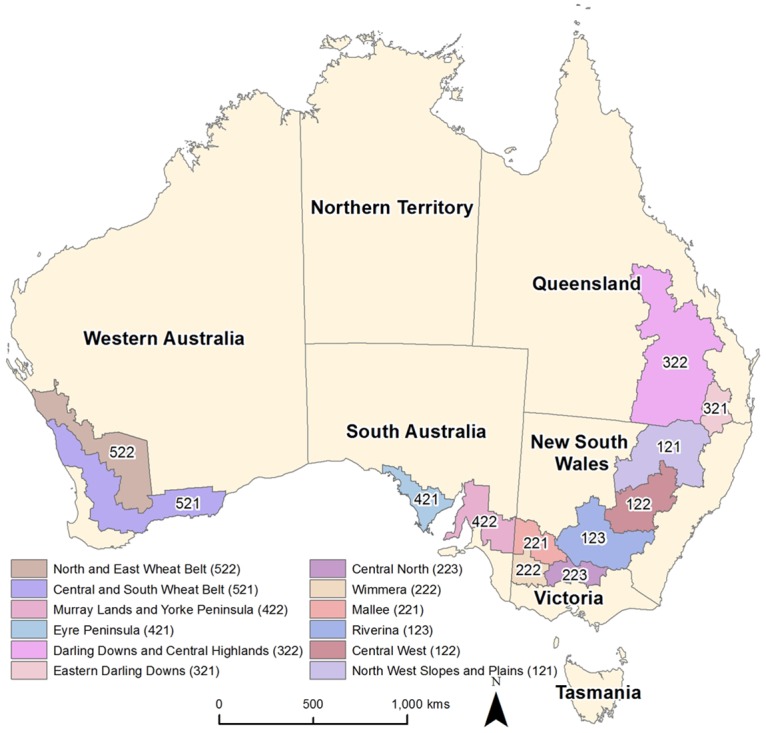
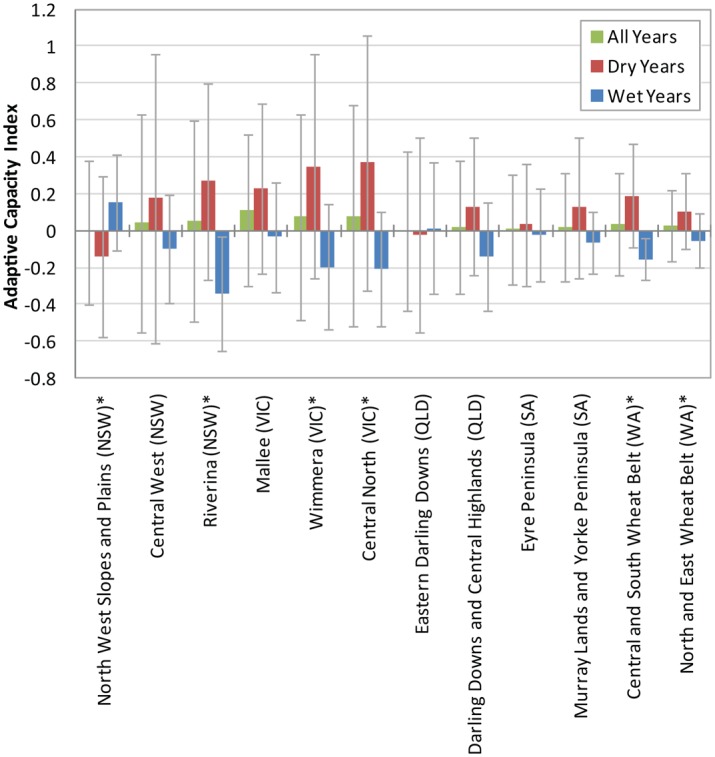
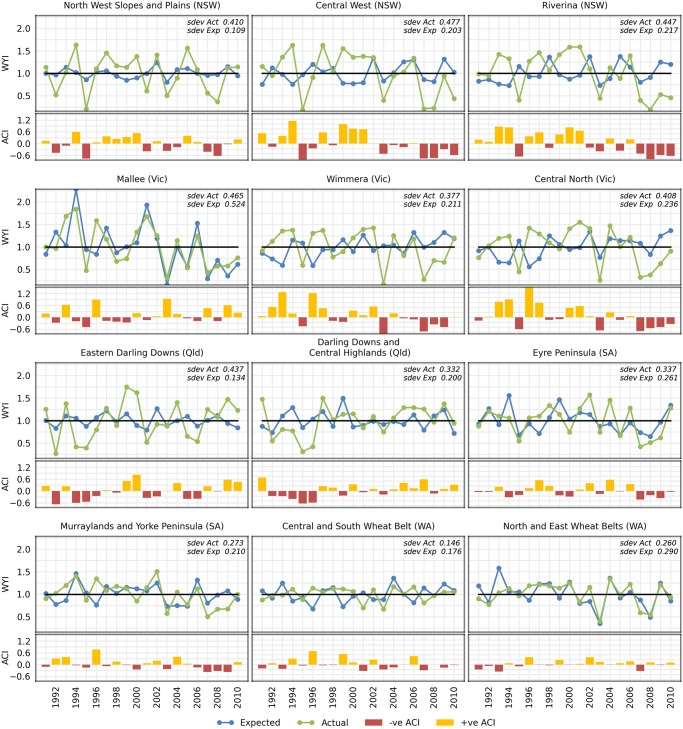
Vulnerability assessments have often invoked sustainable livelihoods theory to support the quantification of adaptive capacity based on the availability of capital--social, human, physical, natural, and financial. However, the assumption that increased availability of these capitals confers greater adaptive capacity remains largely untested. We quantified the relationship between commonly used capital indicators and an empirical index of adaptive capacity (ACI) in the context of vulnerability of Australian wheat production to climate variability and change. We calculated ACI by comparing actual yields from farm survey data to climate-driven expected yields estimated by a crop model for 12 regions in Australia's wheat-sheep zone from 1991-2010. We then compiled data for 24 typical indicators used in vulnerability analyses, spanning the five capitals. We analyzed the ACI and used regression techniques to identify related capital indicators. Between regions, mean ACI was not significantly different but variance over time was. ACI was higher in dry years and lower in wet years suggesting that farm adaptive strategies are geared towards mitigating losses rather than capitalizing on opportunity. Only six of the 24 capital indicators were significantly related to adaptive capacity in a way predicted by theory. Another four indicators were significantly related to adaptive capacity but of the opposite sign, countering our theory-driven expectation. We conclude that the deductive, theory-based use of capitals to define adaptive capacity and vulnerability should be more circumspect. Assessments need to be more evidence-based, first testing the relevance and influence of capital metrics on adaptive capacity for the specific system of interest. This will more effectively direct policy and targeting of investment to mitigate agro-climatic vulnerability.
脆弱性评估常常援引可持续生计理论,以支持基于资本(社会资本、人力资本、物质资本、自然资本和金融资本)可得性对适应能力进行量化。然而,这些资本可得性增加会带来更强适应能力这一假设在很大程度上仍未得到验证。在澳大利亚小麦生产对气候变率和变化的脆弱性背景下,我们量化了常用资本指标与适应能力实证指数(ACI)之间的关系。我们通过将农场调查数据中的实际产量与作物模型估算的、1991 - 2010年澳大利亚小麦 - 绵羊区12个地区的气候驱动预期产量进行比较,计算出ACI。然后,我们汇编了脆弱性分析中使用的24个典型指标的数据,涵盖了五种资本。我们分析了ACI,并使用回归技术来识别相关的资本指标。各地区之间,平均ACI没有显著差异,但随时间的方差存在差异。干旱年份的ACI较高,湿润年份的ACI较低,这表明农场的适应策略旨在减轻损失而非利用机会。24个资本指标中只有6个以理论预测的方式与适应能力显著相关。另外4个指标与适应能力显著相关,但符号相反,这与我们基于理论的预期相悖。我们得出结论,基于理论演绎使用资本来定义适应能力和脆弱性应该更加谨慎。评估需要更多基于证据,首先测试资本指标对特定感兴趣系统的适应能力的相关性和影响。这将更有效地指导政策制定和投资目标,以减轻农业气候脆弱性。