Kyba Christopher C M, Tong Kai Pong, Bennie Jonathan, Birriel Ignacio, Birriel Jennifer J, Cool Andrew, Danielsen Arne, Davies Thomas W, Outer Peter N den, Edwards William, Ehlert Rainer, Falchi Fabio, Fischer Jürgen, Giacomelli Andrea, Giubbilini Francesco, Haaima Marty, Hesse Claudia, Heygster Georg, Hölker Franz, Inger Richard, Jensen Linsey J, Kuechly Helga U, Kuehn John, Langill Phil, Lolkema Dorien E, Nagy Matthew, Nievas Miguel, Ochi Nobuaki, Popow Emil, Posch Thomas, Puschnig Johannes, Ruhtz Thomas, Schmidt Wim, Schwarz Robert, Schwope Axel, Spoelstra Henk, Tekatch Anthony, Trueblood Mark, Walker Constance E, Weber Michael, Welch Douglas L, Zamorano Jaime, Gaston Kevin J
1] Leibniz-Institute for Freshwater Ecology and Inland Fisheries [2] Institute for Space Sciences, Freie Universität Berlin, Berlin, Germany [3] Deutsches GeoForschungsZentrum Potsdam, Potsdam, Germany.
Institut für Umweltphysik, Universität Bremen, Bremen, Germany.
Sci Rep. 2015 Feb 12;5:8409. doi: 10.1038/srep08409.
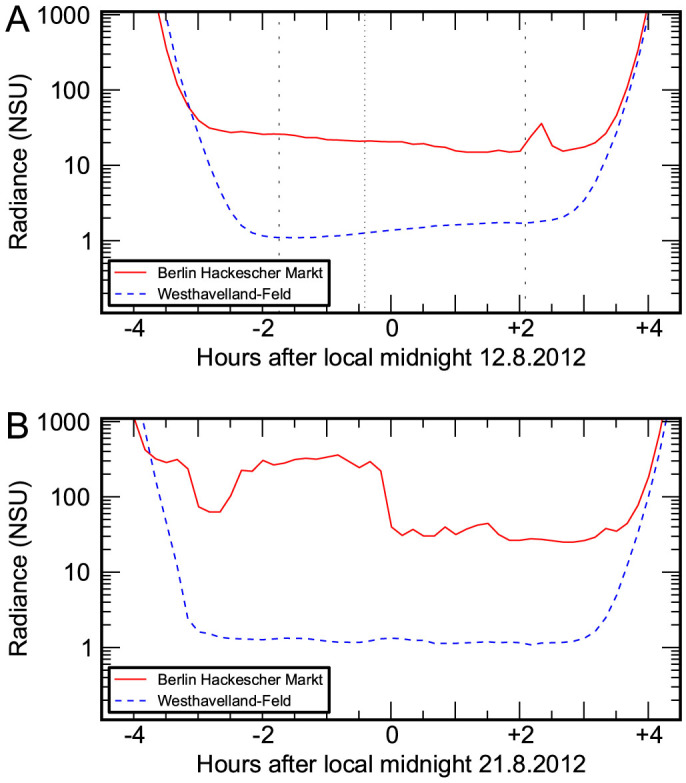
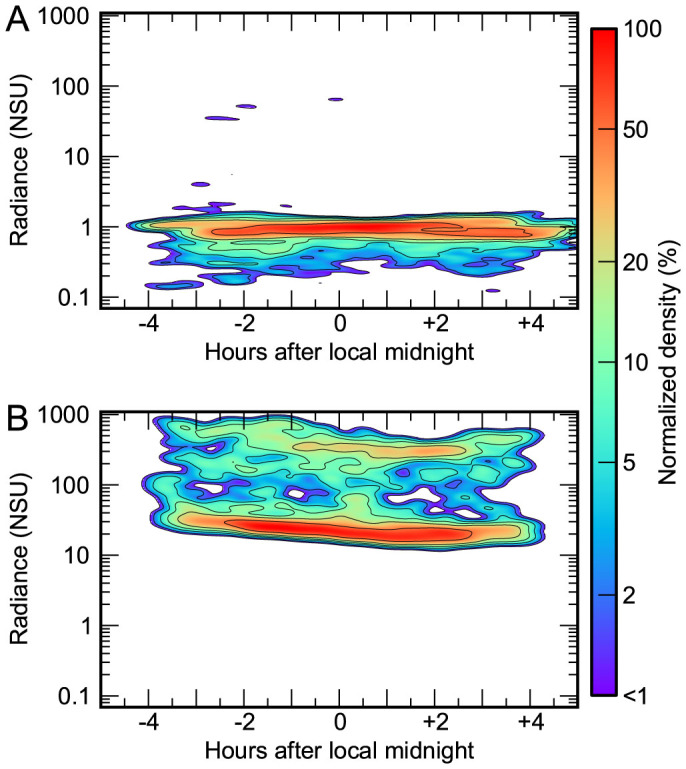
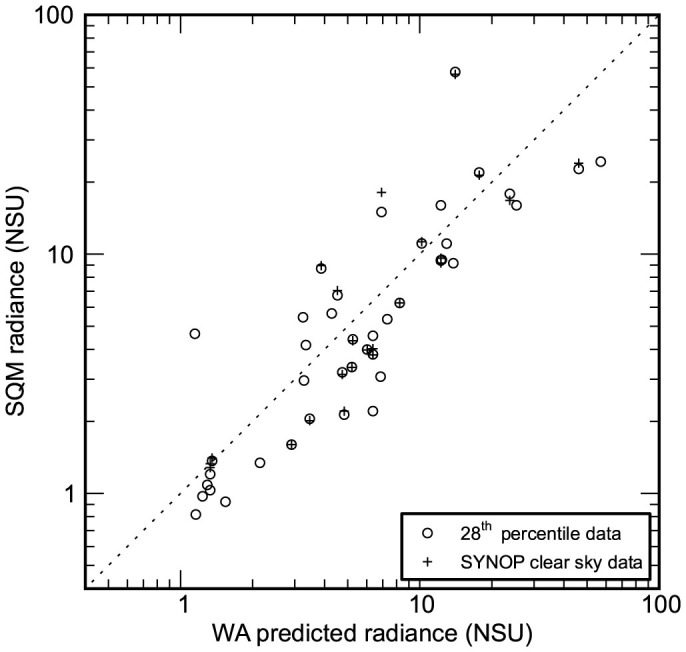
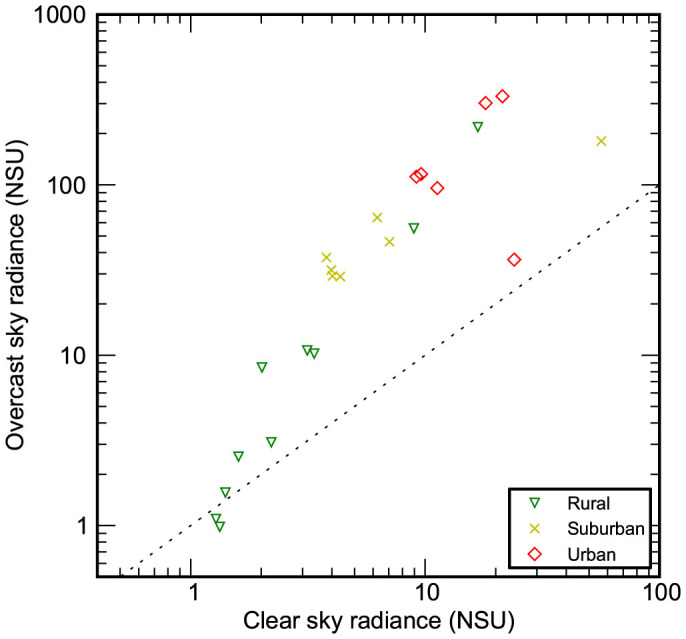
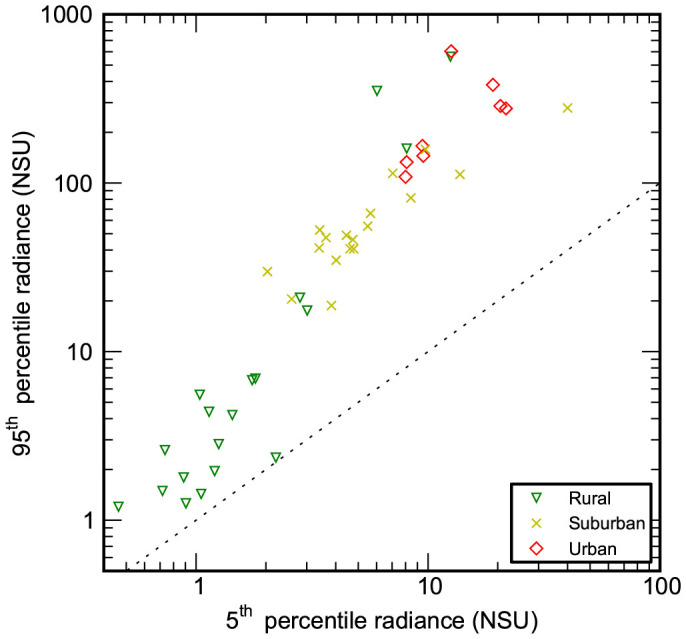
Despite constituting a widespread and significant environmental change, understanding of artificial nighttime skyglow is extremely limited. Until now, published monitoring studies have been local or regional in scope, and typically of short duration. In this first major international compilation of monitoring data we answer several key questions about skyglow properties. Skyglow is observed to vary over four orders of magnitude, a range hundreds of times larger than was the case before artificial light. Nearly all of the study sites were polluted by artificial light. A non-linear relationship is observed between the sky brightness on clear and overcast nights, with a change in behavior near the rural to urban landuse transition. Overcast skies ranged from a third darker to almost 18 times brighter than clear. Clear sky radiances estimated by the World Atlas of Artificial Night Sky Brightness were found to be overestimated by ~25%; our dataset will play an important role in the calibration and ground truthing of future skyglow models. Most of the brightly lit sites darkened as the night progressed, typically by ~5% per hour. The great variation in skyglow radiance observed from site-to-site and with changing meteorological conditions underlines the need for a long-term international monitoring program.
尽管人工夜间天光构成了一种广泛且显著的环境变化,但人们对它的了解极为有限。到目前为止,已发表的监测研究范围局限于局部或区域,而且持续时间通常较短。在这份首次的重大国际监测数据汇编中,我们回答了几个关于天光特性的关键问题。观测到天光变化幅度超过四个数量级,这一范围比人工照明出现之前的情况大数百倍。几乎所有的研究地点都受到了人工光污染。在晴朗夜晚和多云夜晚的天空亮度之间观察到一种非线性关系,在从农村到城市土地利用过渡区域附近行为发生变化。多云天空的亮度比晴朗天空暗三分之一到亮近18倍。《世界人工夜空亮度图集》估计的晴朗天空辐射亮度被发现高估了约25%;我们的数据集将在未来天光模型的校准和地面实况调查中发挥重要作用。大多数光照强烈的地点随着夜晚推进而变暗,通常每小时变暗约5%。各地观测到的天光辐射亮度的巨大差异以及随着气象条件变化而产生的差异,凸显了开展长期国际监测计划的必要性。