Hassler Marco Ronald, Vedadinejad Mariam, Flechl Birgit, Haberler Christine, Preusser Matthias, Hainfellner Johannes Andreas, Wöhrer Adelheid, Dieckmann Karin Ute, Rössler Karl, Kast Richard, Marosi Christine
Department of Internal Medicine I, Clinical Division of Oncology, 1-3 Comprehensive Cancer Center-Central Nervous System Tumors Unit (CCC-CNS), Medical University of Vienna, Vienna, Austria.
Institute of Neurology, 1-3 Comprehensive Cancer Center-Central Nervous System Tumors Unit (CCC-CNS), Medical University of Vienna, Vienna, Austria.
Springerplus. 2014 Feb 25;3:111. doi: 10.1186/2193-1801-3-111. eCollection 2014.
Despite some progress in the treatment of glioblastoma, most patients experience tumor recurrence. Imatinib mesylate, a tyrosine kinase inhibitor of platelet derived growth factor receptor-alpha and -beta, c-fms, c-kit, abl and arg kinase (imatinib targets), has been shown to prevent tumor progression in early studies of recurrent gliomas, but has shown weak activity in randomized controlled trials. We studied the response to oral imatinib in 24 patients with recurrent glioblastoma who showed immunohistochemical expression of these imatinib targets in the initially resected tumor tissue.
We offered oral imatinib, 400 mg once daily treatment to 24 recurrent glioblastoma patients whose initial biopsy showed presence of at least one imatinib inhibitable tyrosine kinase.
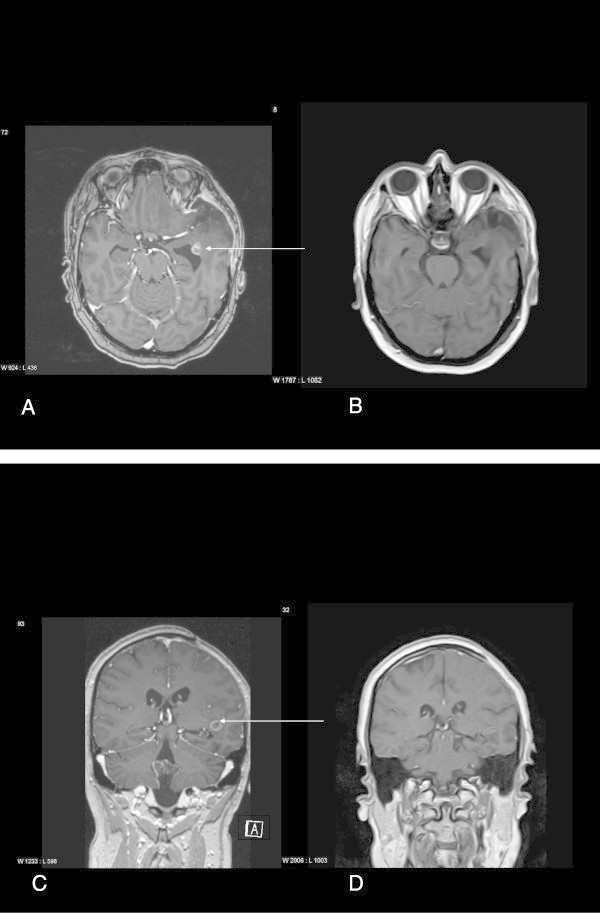
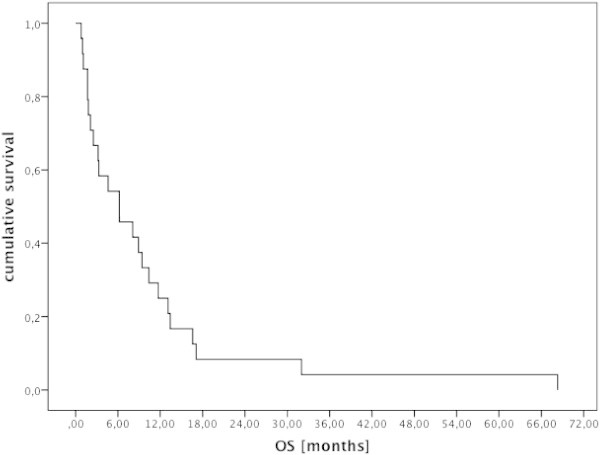
Six imatinib treated patients survived over one year. Twelve patients achieved at least tumor stabilisations from 2.6 months to 13.4 months. Median progression free survival was 3 months and median overall survival was 6 months. Imatinib was well tolerated. We found evidence, though not statistically significant, that arg kinase [Abl-2] immunopositivity had shorter survival [5 months] than the arg kinase immunonegative group [9 months].
Responses to imatinib observed in this patient series where imatinib inhibitable tyrosine kinases were documented on the original biopsy are marginally better than that previously reported in imatinib treatment of unselected recurrent glioblastoma patients. We thus present a suggestion for defining a patient sub-population who might potentially benefit from imatinib.
尽管胶质母细胞瘤的治疗取得了一些进展,但大多数患者仍会出现肿瘤复发。甲磺酸伊马替尼是一种血小板衍生生长因子受体α和β、c-fms、c-kit、abl和arg激酶(伊马替尼靶点)的酪氨酸激酶抑制剂,在复发性胶质瘤的早期研究中已显示可预防肿瘤进展,但在随机对照试验中显示活性较弱。我们研究了24例复发性胶质母细胞瘤患者口服伊马替尼的反应,这些患者在最初切除的肿瘤组织中显示出这些伊马替尼靶点的免疫组化表达。
我们为24例复发性胶质母细胞瘤患者提供口服伊马替尼治疗,每日一次,剂量为400mg,这些患者的初始活检显示至少存在一种可被伊马替尼抑制的酪氨酸激酶。
6例接受伊马替尼治疗的患者存活超过一年。12例患者实现了至少2.6个月至13.4个月的肿瘤稳定。无进展生存期的中位数为3个月,总生存期的中位数为6个月。伊马替尼耐受性良好。我们发现有证据表明,尽管无统计学意义,但arg激酶[Abl-2]免疫阳性组的生存期[5个月]比arg激酶免疫阴性组[9个月]短。
在该患者系列中观察到的对伊马替尼的反应略优于先前报道的伊马替尼治疗未选择的复发性胶质母细胞瘤患者的反应,该系列患者在最初活检中记录了可被伊马替尼抑制的酪氨酸激酶。因此,我们提出了一种定义可能从伊马替尼治疗中潜在获益的患者亚群的建议。