Duraisingham S S, Manson A, Grigoriadou S, Buckland M, Tong C Y W, Longhurst H J
Immunology Department, Barts Health NHS Trust, London, UK.
Department of Infection, Barts Health NHS Trust, London, UK.
Clin Exp Immunol. 2015 Aug;181(2):267-74. doi: 10.1111/cei.12600.
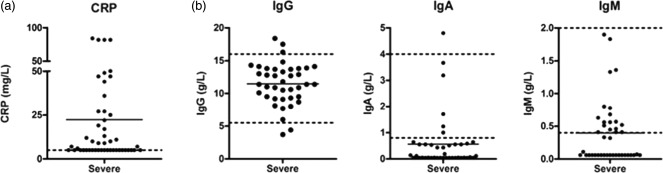
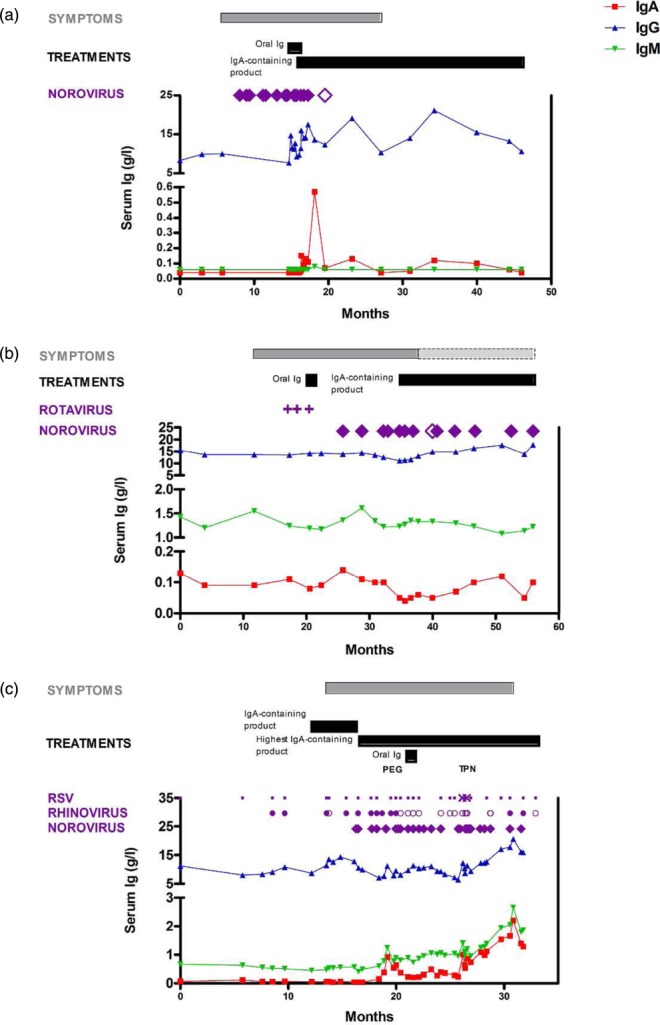
Current UK national standards recommend routine bacteriology surveillance in severe antibody-deficient patients, but less guidance exists on virology screening and viral infections in these patients. In this retrospective audit, we assessed the proportion of positive virology or bacteriology respiratory and stool samples from patients with severe, partial or no immune deficiency during a 2-year period. Medical notes were reviewed to identify symptomatic viral infections and to describe the course of persistent viral infections. During the 2-year period, 31 of 78 (39·7%) severe immune-deficient patients tested had a positive virology result and 89 of 160 (55.6%) had a positive bacteriology result. The most commonly detected pathogens were rhinovirus (12 patients), norovirus (6), Haemophilus influenzae (24), Pseudomonas spp. (22) and Staphylococcus aureus (21). Ninety-seven per cent of positive viral detection samples were from patients who were symptomatic. Low serum immunoglobulin IgA levels were more prevalent in patients with a positive virology sample compared to the total cohort (P = 0·0078). Three patients had persistent norovirus infection with sequential positive isolates for 9, 30 and 16 months. Virology screening of symptomatic antibody-deficient patients may be useful as a guide to anti-microbial treatment. A proportion of these patients may experience persistent viral infections with significant morbidity.
英国现行国家标准建议对严重抗体缺陷患者进行常规细菌学监测,但对于这些患者的病毒学筛查和病毒感染的指导较少。在这项回顾性审计中,我们评估了2年期间严重、部分或无免疫缺陷患者呼吸道和粪便样本病毒学或细菌学检测呈阳性的比例。查阅病历以确定有症状的病毒感染情况,并描述持续性病毒感染的病程。在这2年期间,78例接受检测的严重免疫缺陷患者中有31例(39.7%)病毒学检测结果呈阳性,160例中有89例(55.6%)细菌学检测结果呈阳性。最常检测到的病原体是鼻病毒(12例患者)、诺如病毒(6例)、流感嗜血杆菌(24例)、假单胞菌属(22例)和金黄色葡萄球菌(21例)。97%的病毒检测阳性样本来自有症状的患者。与整个队列相比,病毒学检测样本呈阳性的患者血清免疫球蛋白IgA水平较低(P = 0.0078)。3例患者感染诺如病毒持续不愈,连续9个月、30个月和16个月分离出阳性菌株。对有症状的抗体缺陷患者进行病毒学筛查可能有助于指导抗菌治疗。这些患者中有一部分可能会经历持续性病毒感染,并伴有严重的发病率。