Watanabe Noriya, Haruno Masahiko
1] Center for Information and Neural Networks, National Institute of Information and Communications Technology, Suita, Osaka 565-0871, Japan [2] Japan Society for Promotion of Science [3] Graduate School of Environmental Studies, Nagoya University.
1] Center for Information and Neural Networks, National Institute of Information and Communications Technology, Suita, Osaka 565-0871, Japan [2] Japan Science and Technology Agency.
Sci Rep. 2015 Feb 16;5:8478. doi: 10.1038/srep08478.
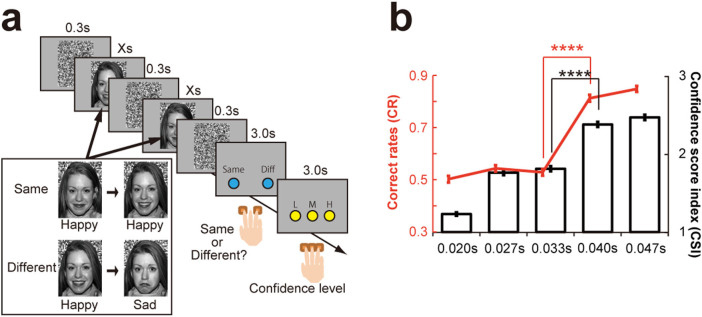
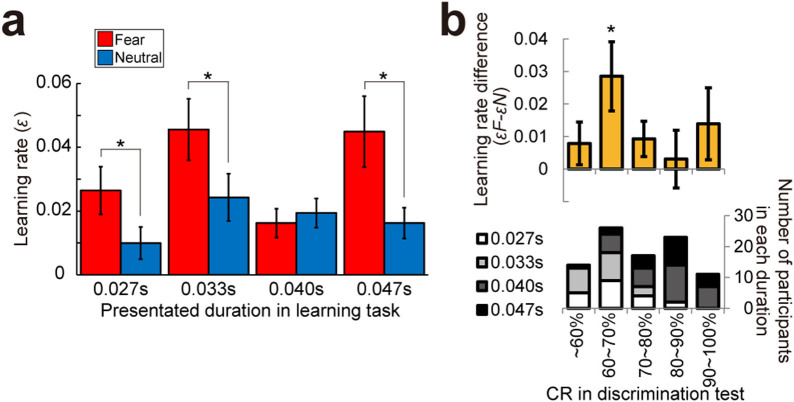
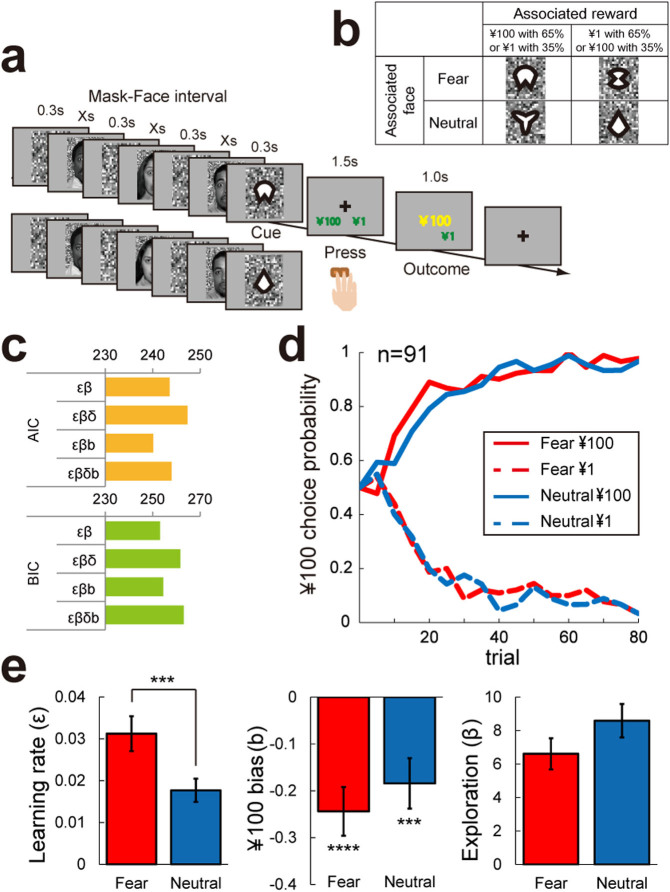
Life demands that we adapt our behaviour continuously in situations in which much of our incoming information is emotional and unrelated to our immediate behavioural goals. Such information is often processed without our consciousness. This poses an intriguing question of whether subconscious exposure to irrelevant emotional information (e.g. the surrounding social atmosphere) affects the way we learn. Here, we addressed this issue by examining whether the learning of cue-reward associations changes when an emotional facial expression is shown subconsciously or consciously prior to the presentation of a reward-predicting cue. We found that both subconscious (0.027 s and 0.033 s) and conscious (0.047 s) emotional signals increased the rate of learning, and this increase was smallest at the border of conscious duration (0.040 s). These data suggest not only that the subconscious and conscious processing of emotional signals enhances value-updating in cue-reward association learning, but also that the computational processes underlying the subconscious enhancement is at least partially dissociable from its conscious counterpart.
生活要求我们在许多传入信息带有情感且与我们当前行为目标无关的情况下,持续调整自己的行为。这类信息常常在我们无意识的情况下得到处理。这就引出了一个有趣的问题:潜意识中接触无关的情感信息(例如周围的社会氛围)是否会影响我们的学习方式。在此,我们通过研究在呈现奖励预测线索之前,下意识或有意识地展示情感面部表情时,线索 - 奖励关联的学习是否会发生变化,来解决这个问题。我们发现,下意识(0.027秒和0.033秒)和有意识(0.047秒)的情感信号都会提高学习速度,并且这种提高在意识持续时间的边界(0.040秒)处最小。这些数据不仅表明情感信号的下意识和有意识处理会增强线索 - 奖励关联学习中的价值更新,还表明下意识增强背后的计算过程至少部分可与有意识的对应过程分离。