Aali Ehsan, Mirzamohammadi Solmaz, Ghaznavi Habib, Madjd Zahra, Larijani Bagher, Rayegan Samira, Sharifi Ali M
Razi Drug Research Center and Department of Pharmacology, Iran University of Medical Sciences, Tehran, Iran.
Oncopathology Research Center and Department of Pathology, Iran University of Medical Sciences, Tehran, Iran.
J Diabetes Metab Disord. 2014 Aug 11;13(1):76. doi: 10.1186/2251-6581-13-76. eCollection 2014.
Many studies suggested mesenchymal stem cells (MSCs) transplantation as a new approach to control hyperglycemia in type 1 diabetes mellitus through differentiation mechanism. In contrary others believed that therapeutic properties of MSCs is depends on paracrine mechanisms even if they were not engrafted. This study aimed to compare these two approaches in control of hyperglycemia in STZ-induced diabetic rats.
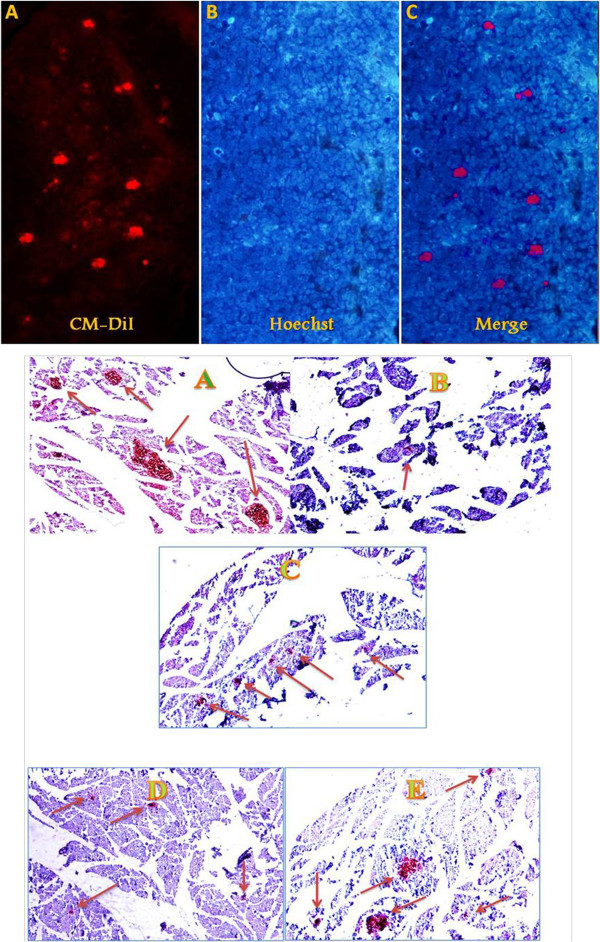
Animals were divided into five groups: normal; diabetic control; diabetic received MSCs; diabetic received supernatant of MSCs; diabetic received co-administration of MSCs with supernatant. Blood glucose, insulin levels and body weight of animals were monitored during experiment. Immunohistochemical and immunofluorescence analysis were performed to monitor functionality and migration of labeled-MSCs to pancreas.
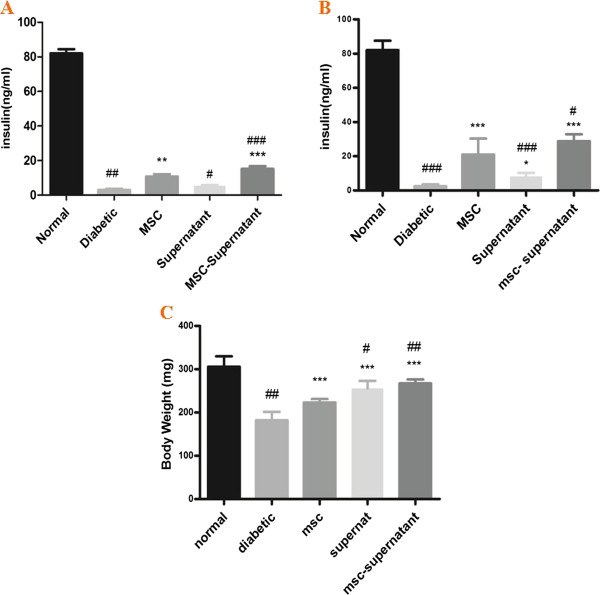
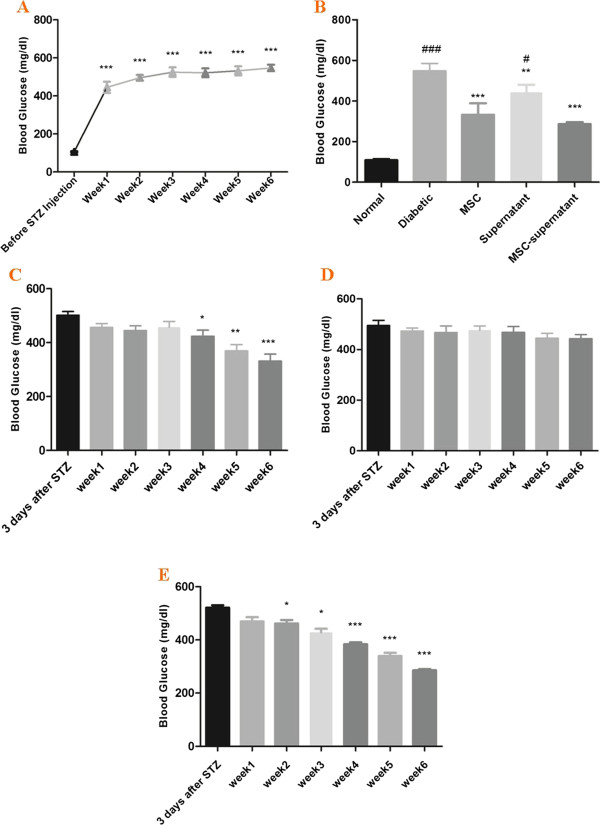
First administration of MSCs within the first 3 weeks could not reduce blood glucose, but second administration significantly reduced blood glucose after week four compared to diabetic controls. Daily injection of supernatant could not reduce blood glucose as efficient as MSCs. Interestingly; Co-administration of MSCs with supernatant significantly reduced blood glucose more than other treated groups. Insulin levels and body weight were significantly increased in MSCs + supernatant-treated animals compared to other groups. Immunohistological analysis showed an increase in number and size of islets per section respectively in supernatant, MSCs and MSCs + supernatant-treated groups.
Present study exhibited that repeated-injection of MSCs reduced blood glucose and increased serum insulin levels in recipient rats. Injection of supernatant could not reverse hyperglycemia as efficient as MSCs. Interestingly; co-administration of MSCs with supernatant could reverse hyperglycemia more than either group alone.
许多研究表明,间充质干细胞(MSCs)移植是通过分化机制控制1型糖尿病高血糖的一种新方法。相反,其他人认为,即使间充质干细胞没有植入,其治疗特性也取决于旁分泌机制。本研究旨在比较这两种控制链脲佐菌素诱导的糖尿病大鼠高血糖的方法。
将动物分为五组:正常组;糖尿病对照组;糖尿病大鼠接受间充质干细胞治疗;糖尿病大鼠接受间充质干细胞上清液治疗;糖尿病大鼠接受间充质干细胞与上清液联合治疗。在实验过程中监测动物的血糖、胰岛素水平和体重。进行免疫组织化学和免疫荧光分析,以监测标记的间充质干细胞向胰腺的功能和迁移。
在前三周首次给予间充质干细胞不能降低血糖,但与糖尿病对照组相比,在第四周后第二次给予间充质干细胞能显著降低血糖。每日注射上清液降低血糖的效果不如间充质干细胞。有趣的是,间充质干细胞与上清液联合给药比其他治疗组更能显著降低血糖。与其他组相比,间充质干细胞+上清液治疗的动物胰岛素水平和体重显著增加。免疫组织学分析显示,上清液、间充质干细胞和间充质干细胞+上清液治疗组每切片胰岛的数量和大小分别增加。
本研究表明,重复注射间充质干细胞可降低受体大鼠的血糖并提高血清胰岛素水平。注射上清液不能像间充质干细胞那样有效地逆转高血糖。有趣的是,间充质干细胞与上清液联合给药比单独使用任何一组更能逆转高血糖。