Patel Meenal J, Andreescu Carmen, Price Julie C, Edelman Kathryn L, Reynolds Charles F, Aizenstein Howard J
Department of Bioengineering, University of Pittsburgh, PA, USA.
Department of Psychiatry, University of Pittsburgh School of Medicine, PA, USA.
Int J Geriatr Psychiatry. 2015 Oct;30(10):1056-67. doi: 10.1002/gps.4262. Epub 2015 Feb 17.
Currently, depression diagnosis relies primarily on behavioral symptoms and signs, and treatment is guided by trial and error instead of evaluating associated underlying brain characteristics. Unlike past studies, we attempted to estimate accurate prediction models for late-life depression diagnosis and treatment response using multiple machine learning methods with inputs of multi-modal imaging and non-imaging whole brain and network-based features.
Late-life depression patients (medicated post-recruitment) (n = 33) and older non-depressed individuals (n = 35) were recruited. Their demographics and cognitive ability scores were recorded, and brain characteristics were acquired using multi-modal magnetic resonance imaging pretreatment. Linear and nonlinear learning methods were tested for estimating accurate prediction models.
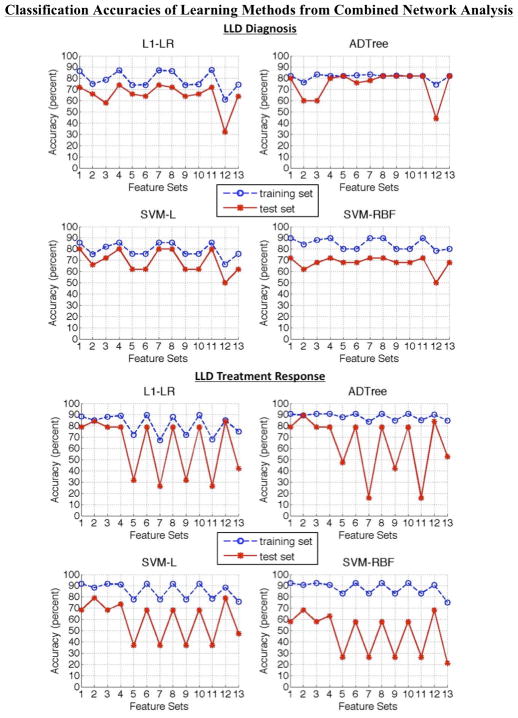
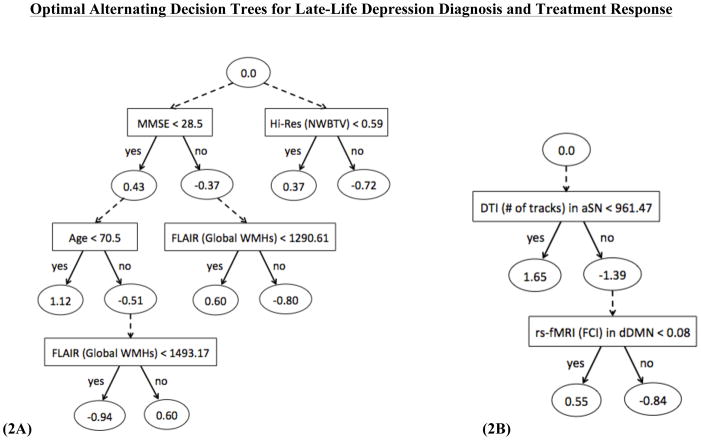
A learning method called alternating decision trees estimated the most accurate prediction models for late-life depression diagnosis (87.27% accuracy) and treatment response (89.47% accuracy). The diagnosis model included measures of age, Mini-mental state examination score, and structural imaging (e.g. whole brain atrophy and global white mater hyperintensity burden). The treatment response model included measures of structural and functional connectivity.
Combinations of multi-modal imaging and/or non-imaging measures may help better predict late-life depression diagnosis and treatment response. As a preliminary observation, we speculate that the results may also suggest that different underlying brain characteristics defined by multi-modal imaging measures-rather than region-based differences-are associated with depression versus depression recovery because to our knowledge this is the first depression study to accurately predict both using the same approach. These findings may help better understand late-life depression and identify preliminary steps toward personalized late-life depression treatment.
目前,抑郁症诊断主要依赖行为症状和体征,治疗靠反复试验而非评估相关潜在脑特征。与以往研究不同,我们尝试使用多种机器学习方法,以多模态成像以及基于全脑和网络的非成像特征作为输入,来估计晚年抑郁症诊断和治疗反应的准确预测模型。
招募了晚年抑郁症患者(招募后接受药物治疗)(n = 33)和老年非抑郁症个体(n = 35)。记录他们的人口统计学和认知能力得分,并使用多模态磁共振成像预处理获取脑特征。测试了线性和非线性学习方法以估计准确的预测模型。
一种称为交替决策树的学习方法估计出了用于晚年抑郁症诊断(准确率87.27%)和治疗反应(准确率89.47%)的最准确预测模型。诊断模型包括年龄、简易精神状态检查表得分以及结构成像指标(如全脑萎缩和全脑白质高信号负荷)。治疗反应模型包括结构和功能连接性指标。
多模态成像和/或非成像测量的组合可能有助于更好地预测晚年抑郁症的诊断和治疗反应。作为初步观察结果,我们推测这些结果可能还表明,由多模态成像测量定义的不同潜在脑特征——而非基于区域的差异——与抑郁症和抑郁症康复相关,因为据我们所知,这是第一项使用相同方法准确预测两者的抑郁症研究。这些发现可能有助于更好地理解晚年抑郁症,并确定迈向个性化晚年抑郁症治疗的初步步骤。