Saito Mika, Soukaloun Douangdao, Phongsavath Khampe, Phommasack Bounlay, Makino Yoshihiro
Department of Microbiology and Oncology, Graduate School of Medicine, University of the Ryukyus, 207 Uehara, Nishihara, Okinawa 903-0215, Japan.
Department of Pediatrics, Mahosot Hospital, Mahosot Road, 01030 Vientiane, Laos.
ScientificWorldJournal. 2015;2015:235934. doi: 10.1155/2015/235934. Epub 2015 Jan 28.
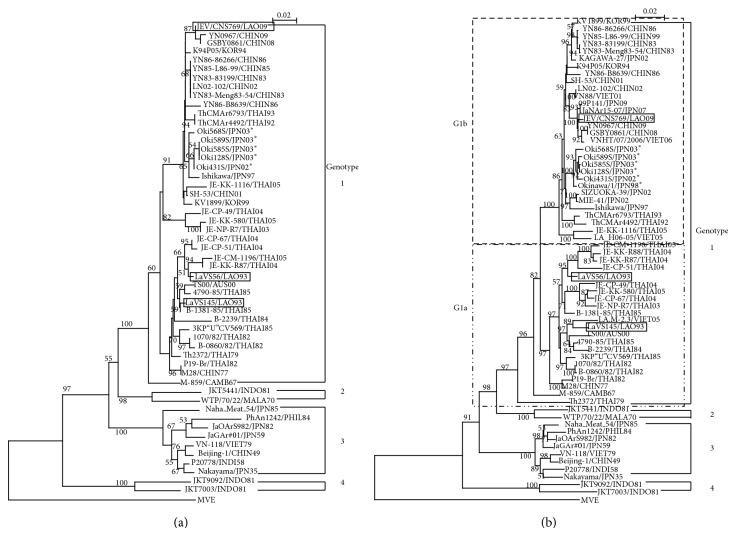
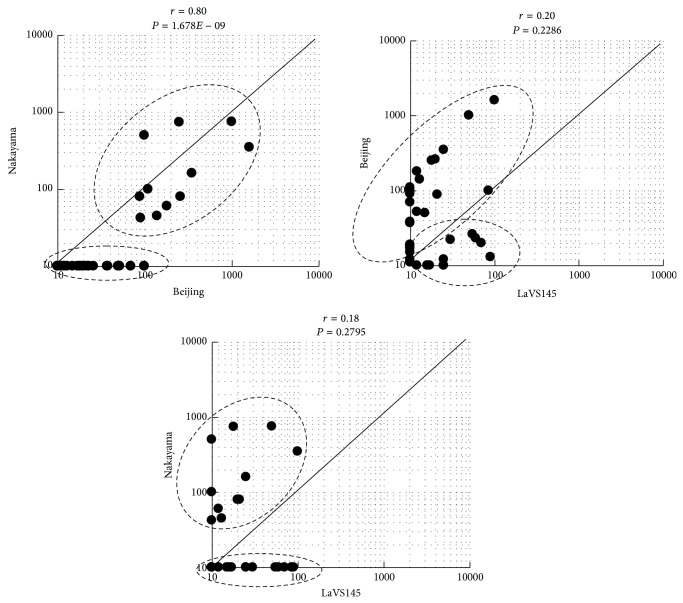
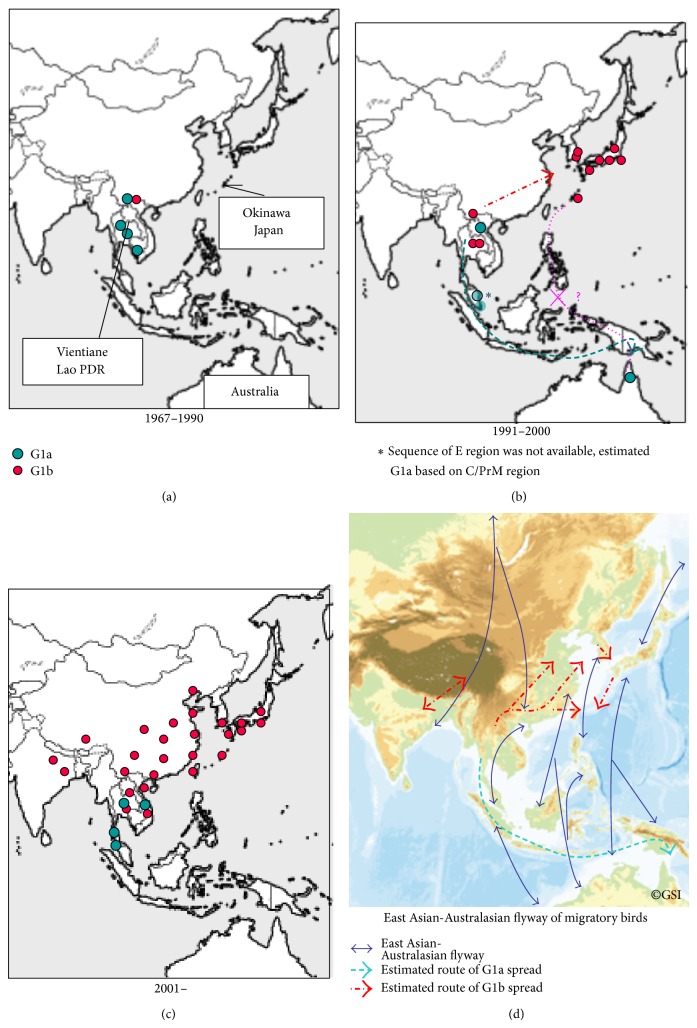
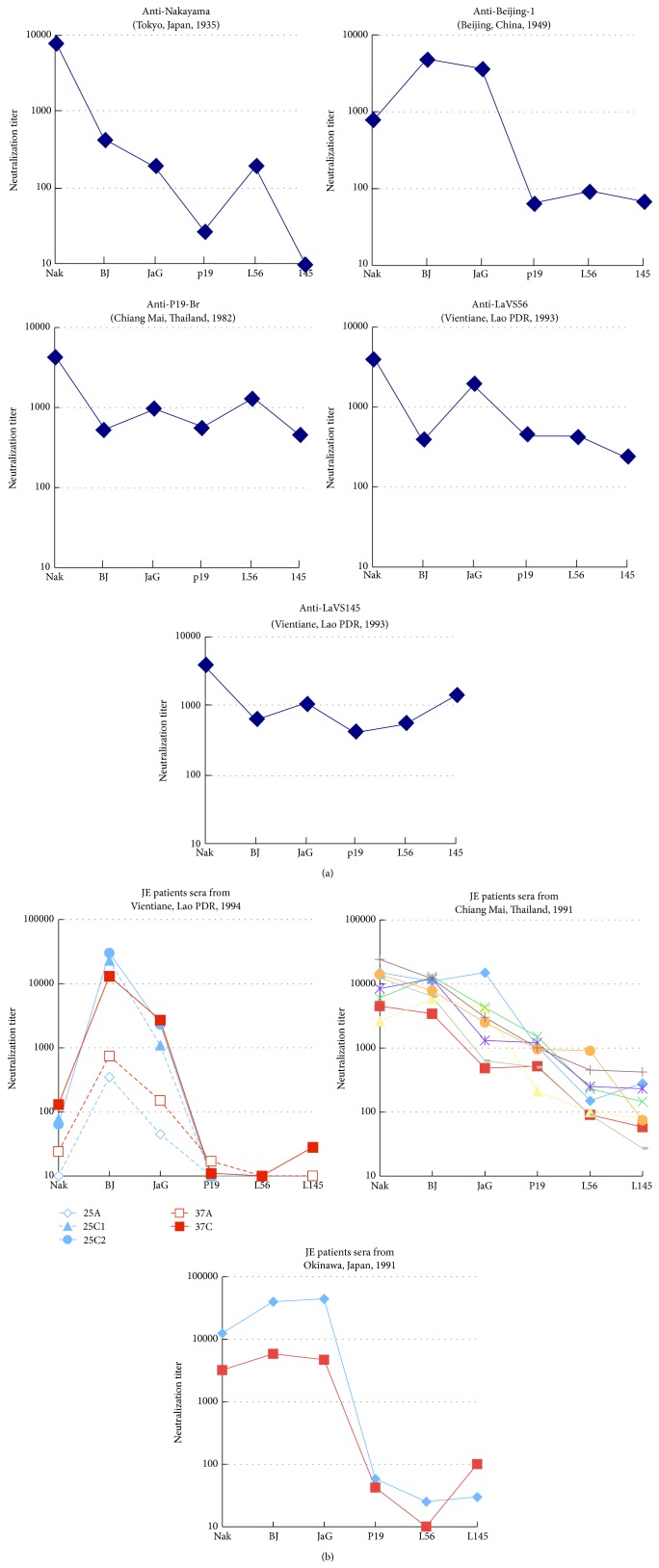
Phylogenetic analysis of Japanese encephalitis virus (JEV) was conducted using core-premembrane and envelope gene sequence data of two strains from Vientiane, Lao People's Democratic Republic, in 1993 and five from Okinawa, Japan, in 2002 and 2003, and previously published strains. The two Vientiane strains designated as LaVS56 and LaVS145 belonged to genotype 1 (G1) and the same subcluster of G1 as Australian strain in 2000, Thai strains in 1982-1985 and 2004-2005, and Vietnamese strain in 2005, but were distinct from the subcluster of recently distributing G1 strains widely in Asia including Okinawan strains and recent Lao strain in 2009. These clusters with own distinct distributions indicated involvements of different mechanisms and routes of spreading viruses and clarified that Australian G1 strain is from Southeast Asia, not from East Asia. Both Vientiane strains were antigenically close to P19-Br (G1, isolate, Thailand), but distinct from Nakayama (G3, prototype strain, Japan), Beijing-1 (G3, laboratory strain, China), and JaGAr#01 (G3, laboratory strain, Japan), demonstrated by cross-neutralization tests using polyclonal antisera. These results together with seroepidemiologic study conducted in Vientiane strongly suggest that diversified JEV cocirculated there in early 1990s.
利用1993年从老挝人民民主共和国万象分离出的2株病毒以及2002年和2003年从日本冲绳分离出的5株病毒的核心-前膜和包膜基因序列数据,对日本脑炎病毒(JEV)进行了系统发育分析,并与先前发表的毒株进行了比较。这两株万象毒株分别命名为LaVS56和LaVS145,属于基因型1(G1),与2000年的澳大利亚毒株、1982 - 1985年和2004 - 2005年的泰国毒株以及2005年的越南毒株属于G1的同一亚群,但与最近在亚洲广泛传播的G1毒株亚群不同,包括冲绳毒株和2009年的老挝毒株。这些具有不同分布的簇表明病毒传播的机制和途径不同,并明确了澳大利亚G1毒株来自东南亚,而非东亚。通过使用多克隆抗血清进行的交叉中和试验表明,两株万象毒株在抗原性上与P19 - Br(G1,分离株,泰国)接近,但与Nakayama(G3,原型株,日本)、Beijing - 1(G3,实验室株,中国)和JaGAr#01(G3,实验室株,日本)不同。这些结果与在万象进行的血清流行病学研究一起强烈表明,20世纪90年代初多种JEV在那里共同流行。