ICMR virus unit, ID & BG Hospital, 57, Dr, S, C, Banerjee Road, Beliaghata, Kolkata-700010, West Bengal, India.
Virol J. 2012 Nov 15;9:271. doi: 10.1186/1743-422X-9-271.
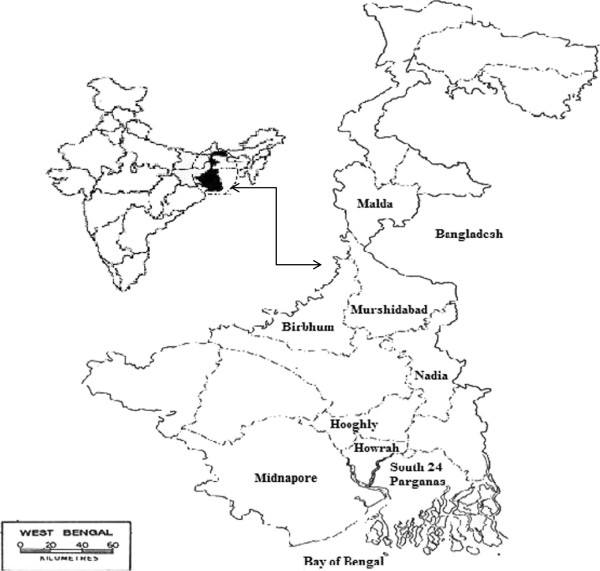
Japanese encephalitis virus (JEV), a mosquito-borne zoonotic pathogen, is the sole etiologic agent of Japanese Encephalitis (JE); a neurotropic killer disease which is one of the major causes of viral encephalitis worldwide with prime public health concern. JE was first reported in the state of West Bengal, India in 1973. Since then it is being reported every year from different districts of the state, though the vaccination has already been done. Therefore, it indicates that there might be either partial coverage of the vaccine or the emergence of mutated/new strain of JEV. Considering this fact, to understand the JEV genotype distribution, we conducted a molecular epidemiological study on a total of 135 serum/cerebrospinal fluid (CSF) samples referred and/or collected from the clinically suspected patients with Acute encephalitis syndrome (AES), admitted in different district hospitals of West Bengal, India, 2010.
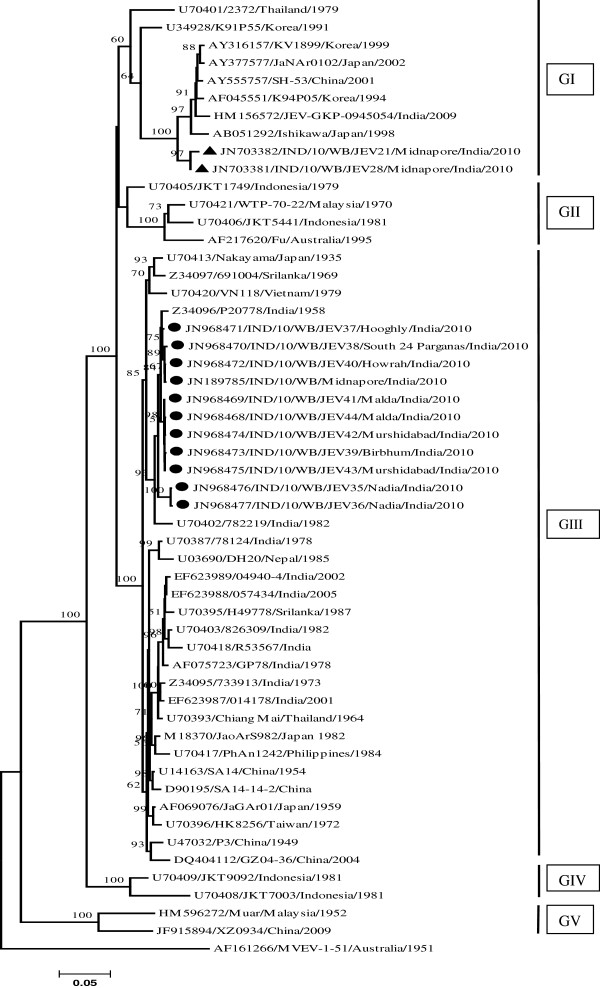
JEV etiology was confirmed in 36/135 (26.6%) and 13/61 (21.3%) 2-15 days' febrile illness samples from AES cases by analyzing Mac-ELISA followed by RT-PCR test respectively. Phylogenetic analysis based on complete envelope gene sequences of 13 isolates showed the emergence of JEV genotype I (GI), co-circulating with genotype III (GIII).
This study represents the first report of JEV GI with GIII, co-circulating in West Bengal. The efficacy of the vaccine (derived from JEV GIII strain SA-14-14-2) to protect against emerging JEV GI needs careful evaluation. In future, JE outbreak is quite likely in the state, if this vaccine fails to protect sufficiently against GI of JEV.
日本脑炎病毒(JEV)是一种由蚊子传播的人畜共患病原体,是日本脑炎(JE)的唯一病原体;JE 是一种神经毒致死性疾病,是全球主要病毒性脑炎的原因之一,是主要的公共卫生关注点。1973 年在印度西孟加拉邦首次报告了 JE。自那时以来,尽管已经进行了疫苗接种,但该州不同地区每年仍有报告。因此,这表明疫苗的覆盖范围可能不完整,或者 JEV 出现了突变/新株。考虑到这一事实,为了了解 JEV 基因型分布,我们对总共 135 份来自印度西孟加拉邦不同地区医院的疑似急性脑炎综合征(AES)患者的血清/脑脊液(CSF)样本进行了分子流行病学研究,这些样本是参考和/或收集的。
通过分析 Mac-ELISA 后进行 RT-PCR 试验,分别在 36/135(26.6%)和 13/61(21.3%)的 AES 病例 2-15 天发热性疾病样本中证实了 JEV 病因。对 13 个分离株的完整包膜基因序列进行的系统发育分析显示,JEV 基因型 I(GI)与基因型 III(GIII)同时出现。
本研究代表了 JEV GI 与 GIII 同时在西孟加拉邦流行的首次报告。疫苗(源自 JEV GIII 株 SA-14-14-2)对预防新兴 JEV GI 的功效需要仔细评估。如果这种疫苗不能对 JEV GI 提供足够的保护,那么该州很可能会爆发 JE。