Department of Biochemistry, University of Oxford, Oxford, UK; Lao-Oxford-Mahosot Hospital-Wellcome Trust-Research Unit, Mahosot Hospital, Vientiane, Laos.
Modelling and Simulation Unit, Centre for Epidemiology and Biostatistics, Melbourne School of Population and Global Health, The University of Melbourne, Melbourne, Australia.
Int J Infect Dis. 2020 Jun;95:444-456. doi: 10.1016/j.ijid.2020.03.039. Epub 2020 Mar 20.
Japanese encephalitis virus infection (JE) remains a leading cause of neurological disease in Asia, mainly involving individuals living in remote areas with limited access to treatment centers and diagnostic facilities. Laboratory confirmation is fundamental for the justification and implementation of vaccination programs. We reviewed the literature on historical developments and current diagnostic capability worldwide, to identify knowledge gaps and instill urgency to address them.
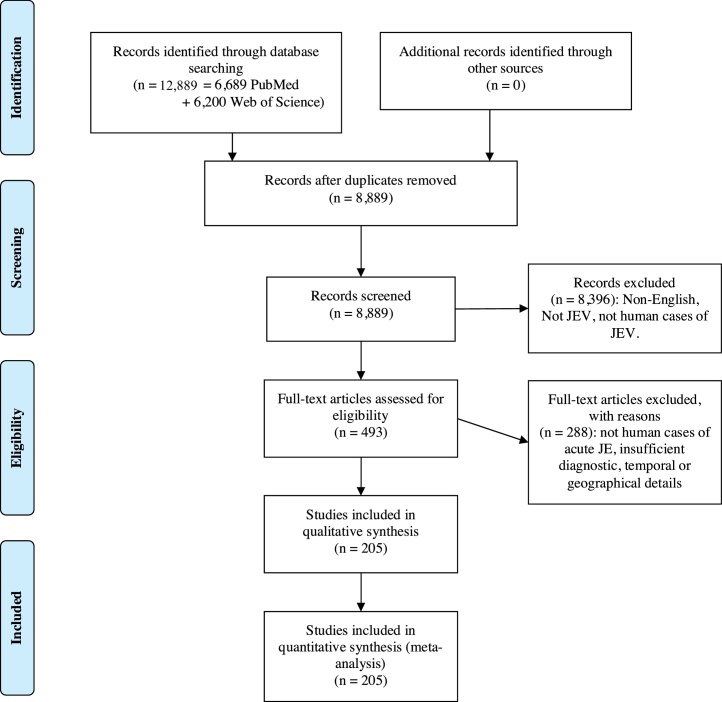
Searches were performed in Web of Science and PubMed using the term 'Japanese encephalitis' up to 13th October 2019. Studies reporting laboratory-confirmed symptomatic JE cases in humans were included, and data on details of diagnostic tests were extracted. A JE case was classified according to confirmatory levels (Fischer et al., 2008; Campbell et al., 2011; Pearce et al., 2018; Heffelfinger et al., 2017), where level 1 represented the highest level of confidence.
20,212 published JE cases were identified from 205 studies. 15,167 (75%) of these positive cases were confirmed with the lowest-confidence diagnostic tests (level 3 or 4, or level 4). Only 109 (53%) of the studies reported contemporaneous testing for dengue-specific antibodies.
A fundamental pre-requisite for the control of JEV is lacking - that of a simple and specific diagnostic procedure that can be adapted for point-of-care tests and readily used throughout JE-endemic regions of the world.
日本脑炎病毒感染(JE)仍然是亚洲主要的神经疾病病因,主要涉及到居住在偏远地区、难以获得治疗中心和诊断设施的人群。实验室确认是制定和实施疫苗接种计划的基础。我们对全球历史发展和当前诊断能力的文献进行了回顾,以确定知识空白,并迫切需要解决这些问题。
使用术语“日本脑炎”在 Web of Science 和 PubMed 中进行了搜索,截至 2019 年 10 月 13 日。纳入了报告人类实验室确诊的有症状 JE 病例的研究,并提取了关于诊断测试详细信息的数据。根据确认水平(Fischer 等人,2008 年;Campbell 等人,2011 年;Pearce 等人,2018 年;Heffelfinger 等人,2017 年)对 JE 病例进行分类,其中 1 级代表最高置信度。
从 205 项研究中确定了 20,212 例已发表的 JE 病例。这些阳性病例中有 15,167 例(75%)是通过最低置信度的诊断测试(3 级或 4 级或 4 级)确认的。只有 109 项研究(53%)报告了同时检测登革热特异性抗体。
缺乏 JEV 控制的基本前提——即缺乏简单、特异的诊断程序,该程序可适用于床边检测,并在世界上 JE 流行地区广泛使用。