• 文献检索
  • 文档翻译
  • 深度研究
  • 学术资讯
  • Suppr Zotero 插件Zotero 插件
  • 邀请有礼
  • 套餐&价格
  • 历史记录
应用&插件
Suppr Zotero 插件Zotero 插件浏览器插件Mac 客户端Windows 客户端微信小程序
定价
高级版会员购买积分包购买API积分包
服务
文献检索文档翻译深度研究API 文档MCP 服务
关于我们
关于 Suppr公司介绍联系我们用户协议隐私条款
关注我们

Suppr 超能文献

核心技术专利:CN118964589B侵权必究
粤ICP备2023148730 号-1Suppr @ 2026

文献检索

告别复杂PubMed语法,用中文像聊天一样搜索,搜遍4000万医学文献。AI智能推荐,让科研检索更轻松。

立即免费搜索

文件翻译

保留排版,准确专业,支持PDF/Word/PPT等文件格式,支持 12+语言互译。

免费翻译文档

深度研究

AI帮你快速写综述,25分钟生成高质量综述,智能提取关键信息,辅助科研写作。

立即免费体验

通过链路移除控制网络上随机演化的流行病:方法比较

Link removal for the control of stochastically evolving epidemics over networks: a comparison of approaches.

作者信息

Enns Eva A, Brandeau Margaret L

机构信息

Division of Health Policy and Management, University of Minnesota School of Public Health, 420 Delaware St. SE, MMC 729, Minneapolis, MN 55455, USA.

Department of Management Science and Engineering, Stanford University, 475 Via Ortega, Stanford, CA 94305, USA.

出版信息

J Theor Biol. 2015 Apr 21;371:154-65. doi: 10.1016/j.jtbi.2015.02.005. Epub 2015 Feb 16.

DOI:10.1016/j.jtbi.2015.02.005
PMID:25698229
原文链接:https://pmc.ncbi.nlm.nih.gov/articles/PMC4372451/
Abstract

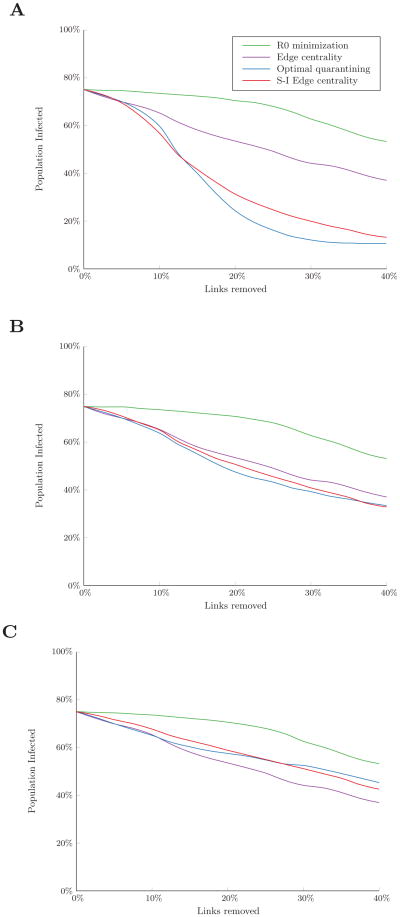
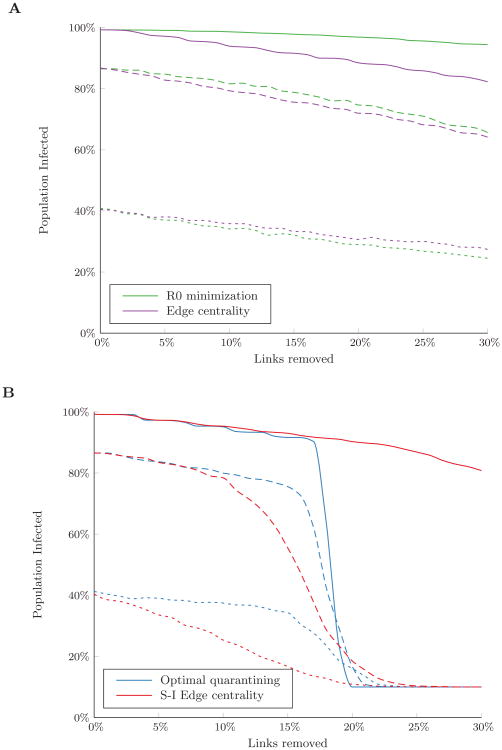
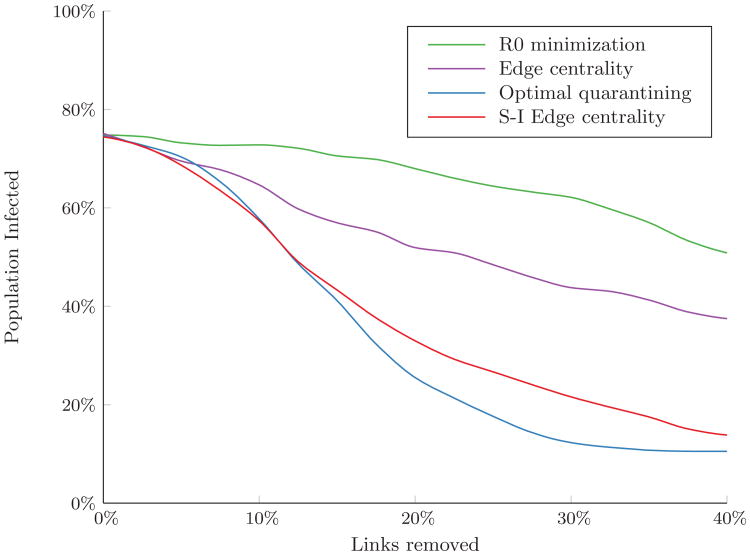
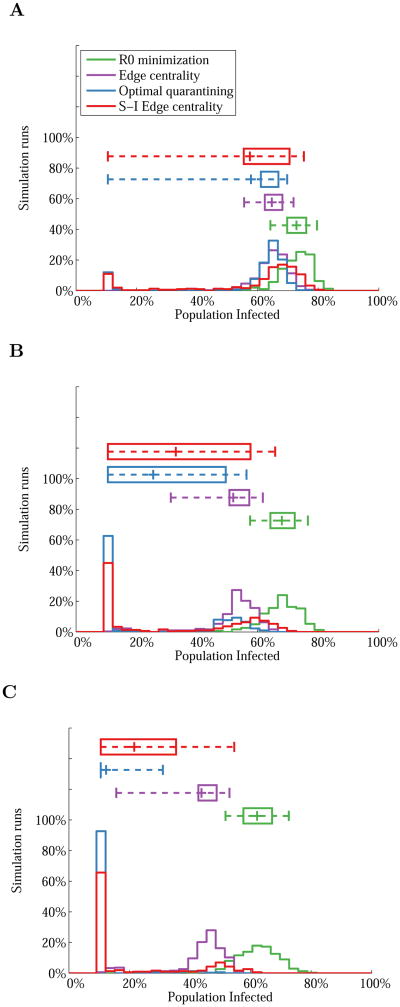
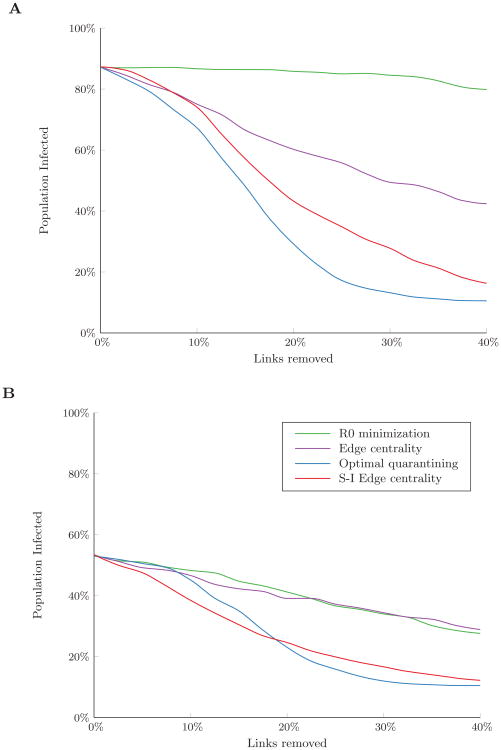
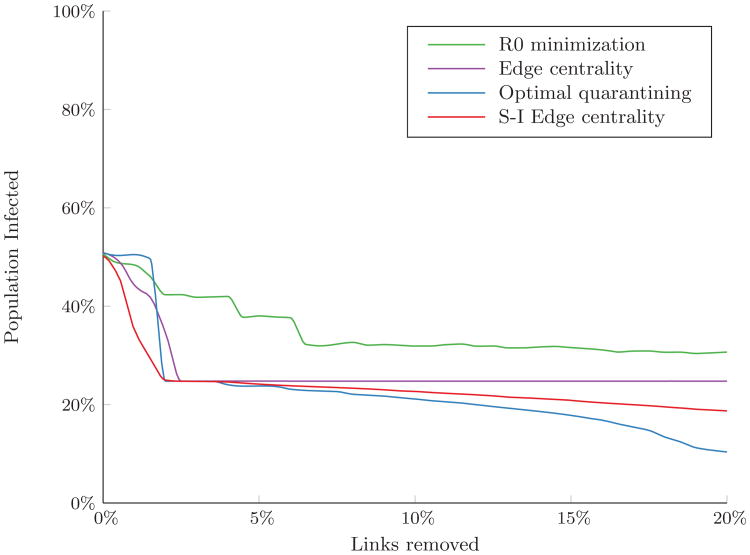
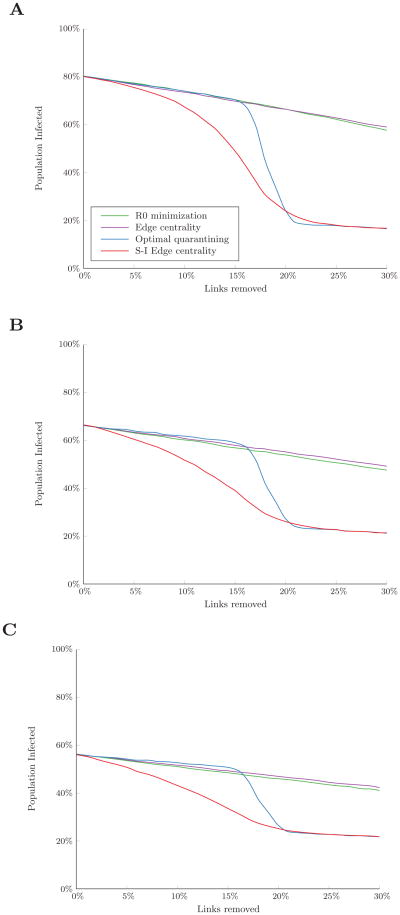
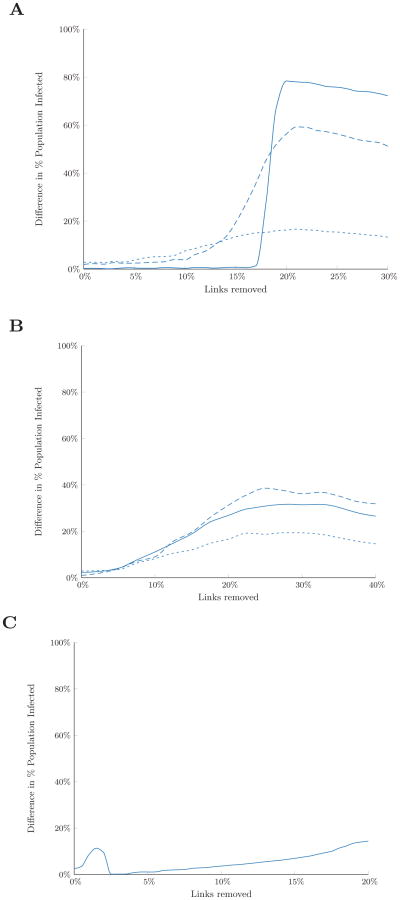
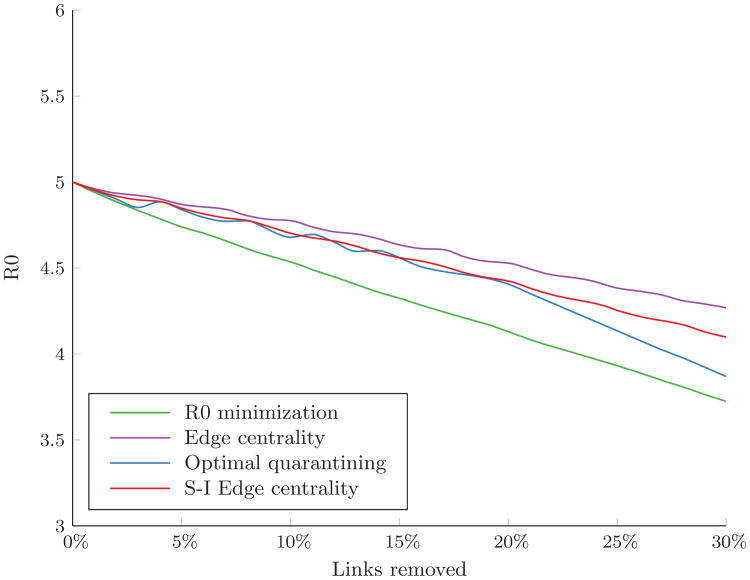
For many communicable diseases, knowledge of the underlying contact network through which the disease spreads is essential to determining appropriate control measures. When behavior change is the primary intervention for disease prevention, it is important to understand how to best modify network connectivity using the limited resources available to control disease spread. We describe and compare four algorithms for selecting a limited number of links to remove from a network: two "preventive" approaches (edge centrality, R0 minimization), where the decision of which links to remove is made prior to any disease outbreak and depends only on the network structure; and two "reactive" approaches (S-I edge centrality, optimal quarantining), where information about the initial disease states of the nodes is incorporated into the decision of which links to remove. We evaluate the performance of these algorithms in minimizing the total number of infections that occur over the course of an acute outbreak of disease. We consider different network structures, including both static and dynamic Erdös-Rényi random networks with varying levels of connectivity, a real-world network of residential hotels connected through injection drug use, and a network exhibiting community structure. We show that reactive approaches outperform preventive approaches in averting infections. Among reactive approaches, removing links in order of S-I edge centrality is favored when the link removal budget is small, while optimal quarantining performs best when the link removal budget is sufficiently large. The budget threshold above which optimal quarantining outperforms the S-I edge centrality algorithm is a function of both network structure (higher for unstructured Erdös-Rényi random networks compared to networks with community structure or the real-world network) and disease infectiousness (lower for highly infectious diseases). We conduct a value-of-information analysis of knowing which nodes are initially infected by comparing the performance improvement achieved by reactive over preventive strategies. We find that such information is most valuable for moderate budget levels, with increasing value as disease spread becomes more likely (due to either increased connectedness of the network or increased infectiousness of the disease).

摘要

对于许多传染病而言,了解疾病传播所经由的潜在接触网络对于确定适当的控制措施至关重要。当行为改变是疾病预防的主要干预手段时,了解如何利用有限资源最佳地改变网络连通性以控制疾病传播就显得尤为重要。我们描述并比较了四种从网络中选择有限数量链路进行移除的算法:两种“预防性”方法(边中心性、R0最小化),其中移除哪些链路的决策在任何疾病爆发之前做出,且仅取决于网络结构;以及两种“反应性”方法(S - I边中心性、最优隔离),其中节点的初始疾病状态信息被纳入移除哪些链路的决策中。我们评估了这些算法在最小化急性疾病爆发过程中发生的感染总数方面的性能。我们考虑了不同的网络结构,包括具有不同连通性水平的静态和动态厄多斯 - 雷尼随机网络、通过注射吸毒连接的住宅酒店的真实世界网络以及呈现社区结构的网络。我们表明,反应性方法在避免感染方面优于预防性方法。在反应性方法中,当链路移除预算较小时,按S - I边中心性顺序移除链路更受青睐,而当链路移除预算足够大时,最优隔离表现最佳。最优隔离优于S - I边中心性算法的预算阈值是网络结构(与具有社区结构的网络或真实世界网络相比,非结构化厄多斯 - 雷尼随机网络的该阈值更高)和疾病传染性(高传染性疾病的该阈值更低)两者的函数。我们通过比较反应性策略与预防性策略所实现的性能提升,对知晓哪些节点最初被感染进行了信息价值分析。我们发现,此类信息对于中等预算水平最为有价值,并且随着疾病传播可能性增加(由于网络连通性增加或疾病传染性增加)其价值也会增加。
https://cdn.ncbi.nlm.nih.gov/pmc/blobs/d500/4372451/b316739ebf55/nihms664814f9.jpg
https://cdn.ncbi.nlm.nih.gov/pmc/blobs/d500/4372451/6fba3ce92252/nihms664814f1.jpg
https://cdn.ncbi.nlm.nih.gov/pmc/blobs/d500/4372451/a94c348b4965/nihms664814f2.jpg
https://cdn.ncbi.nlm.nih.gov/pmc/blobs/d500/4372451/cf327f0baa9f/nihms664814f3.jpg
https://cdn.ncbi.nlm.nih.gov/pmc/blobs/d500/4372451/4a5b4c6ad190/nihms664814f4.jpg
https://cdn.ncbi.nlm.nih.gov/pmc/blobs/d500/4372451/dd982a749ab3/nihms664814f5.jpg
https://cdn.ncbi.nlm.nih.gov/pmc/blobs/d500/4372451/e0c53d2a4143/nihms664814f6.jpg
https://cdn.ncbi.nlm.nih.gov/pmc/blobs/d500/4372451/ce9ce436f25e/nihms664814f7.jpg
https://cdn.ncbi.nlm.nih.gov/pmc/blobs/d500/4372451/5fbed2b683f5/nihms664814f8.jpg
https://cdn.ncbi.nlm.nih.gov/pmc/blobs/d500/4372451/b316739ebf55/nihms664814f9.jpg
https://cdn.ncbi.nlm.nih.gov/pmc/blobs/d500/4372451/6fba3ce92252/nihms664814f1.jpg
https://cdn.ncbi.nlm.nih.gov/pmc/blobs/d500/4372451/a94c348b4965/nihms664814f2.jpg
https://cdn.ncbi.nlm.nih.gov/pmc/blobs/d500/4372451/cf327f0baa9f/nihms664814f3.jpg
https://cdn.ncbi.nlm.nih.gov/pmc/blobs/d500/4372451/4a5b4c6ad190/nihms664814f4.jpg
https://cdn.ncbi.nlm.nih.gov/pmc/blobs/d500/4372451/dd982a749ab3/nihms664814f5.jpg
https://cdn.ncbi.nlm.nih.gov/pmc/blobs/d500/4372451/e0c53d2a4143/nihms664814f6.jpg
https://cdn.ncbi.nlm.nih.gov/pmc/blobs/d500/4372451/ce9ce436f25e/nihms664814f7.jpg
https://cdn.ncbi.nlm.nih.gov/pmc/blobs/d500/4372451/5fbed2b683f5/nihms664814f8.jpg
https://cdn.ncbi.nlm.nih.gov/pmc/blobs/d500/4372451/b316739ebf55/nihms664814f9.jpg

相似文献

1
Link removal for the control of stochastically evolving epidemics over networks: a comparison of approaches.通过链路移除控制网络上随机演化的流行病:方法比较
J Theor Biol. 2015 Apr 21;371:154-65. doi: 10.1016/j.jtbi.2015.02.005. Epub 2015 Feb 16.
2
Optimal link removal for epidemic mitigation: a two-way partitioning approach.最优链路移除以缓解疫情:一种双向分区方法。
Math Biosci. 2012 Feb;235(2):138-47. doi: 10.1016/j.mbs.2011.11.006. Epub 2011 Nov 16.
3
Edge removal in random contact networks and the basic reproduction number.随机接触网络中的边移除与基本再生数
J Math Biol. 2013 Aug;67(2):217-38. doi: 10.1007/s00285-012-0545-6. Epub 2012 May 23.
4
The basic reproduction number as a predictor for epidemic outbreaks in temporal networks.作为时间网络中疫情爆发预测指标的基本再生数。
PLoS One. 2015 Mar 20;10(3):e0120567. doi: 10.1371/journal.pone.0120567. eCollection 2015.
5
An Edge-Based Model of SEIR Epidemics on Static Random Networks.基于边的静态随机网络 SEIR 传染病模型。
Bull Math Biol. 2020 Jul 16;82(7):96. doi: 10.1007/s11538-020-00769-0.
6
A Network Epidemic Model with Preventive Rewiring: Comparative Analysis of the Initial Phase.一种具有预防性重连的网络流行病模型:初始阶段的比较分析
Bull Math Biol. 2016 Dec;78(12):2427-2454. doi: 10.1007/s11538-016-0227-4. Epub 2016 Oct 31.
7
Dynamics and control of diseases in networks with community structure.具有社区结构的网络中疾病的动态与控制。
PLoS Comput Biol. 2010 Apr 8;6(4):e1000736. doi: 10.1371/journal.pcbi.1000736.
8
Connectivity, reproduction number, and mobility interact to determine communities' epidemiological superspreader potential in a metapopulation network.连通性、繁殖数和流动性相互作用,决定了在一个集合种群网络中社区的流行病学超级传播者潜力。
PLoS Comput Biol. 2021 Mar 18;17(3):e1008674. doi: 10.1371/journal.pcbi.1008674. eCollection 2021 Mar.
9
Epidemics on networks: Reducing disease transmission using health emergency declarations and peer communication.网络上的流行病:利用健康紧急声明和同伴交流减少疾病传播。
Infect Dis Model. 2019 Dec 11;5:12-22. doi: 10.1016/j.idm.2019.11.002. eCollection 2020.
10
Searching for the most cost-effective strategy for controlling epidemics spreading on regular and small-world networks.搜索控制在规则和小世界网络上传播的传染病的最具成本效益的策略。
J R Soc Interface. 2012 Jan 7;9(66):158-69. doi: 10.1098/rsif.2011.0216. Epub 2011 Jun 8.

引用本文的文献

1
Visibility graph analysis for educational data: potentials and a case study of predicting at-risk online students.教育数据的可见性图分析:潜力及预测在线高危学生的案例研究
Sci Rep. 2025 Sep 1;15(1):32036. doi: 10.1038/s41598-025-17760-1.
2
Reversibility of link prediction and its application to epidemic mitigation.链接预测的可逆转性及其在疫情缓解中的应用。
Sci Rep. 2022 Dec 3;12(1):20880. doi: 10.1038/s41598-022-25023-6.
3
Moving the epidemic tipping point through topologically targeted social distancing.通过拓扑靶向社交距离推动疫情拐点。

本文引用的文献

1
Epidemic threshold and control in a dynamic network.动态网络中的流行阈值与控制
Phys Rev E Stat Nonlin Soft Matter Phys. 2012 Jan;85(1 Pt 2):016103. doi: 10.1103/PhysRevE.85.016103. Epub 2012 Jan 5.
2
Optimal link removal for epidemic mitigation: a two-way partitioning approach.最优链路移除以缓解疫情:一种双向分区方法。
Math Biosci. 2012 Feb;235(2):138-47. doi: 10.1016/j.mbs.2011.11.006. Epub 2011 Nov 16.
3
Community structure in social networks: applications for epidemiological modelling.社交网络中的社区结构:在流行病学建模中的应用。
Eur Phys J Spec Top. 2021;230(16-17):3273-3280. doi: 10.1140/epjs/s11734-021-00138-5. Epub 2021 Jun 28.
4
Implementation Science to Respond to the COVID-19 Pandemic.实施科学应对 COVID-19 大流行。
Front Public Health. 2020 Sep 2;8:462. doi: 10.3389/fpubh.2020.00462. eCollection 2020.
5
Follow the Sex: Influence of Network Structure on the Effectiveness and Cost-Effectiveness of Partner Management Strategies for Sexually Transmitted Infection Control.跟随性取向:网络结构对性传播感染控制中伴侣管理策略有效性和成本效益的影响。
Sex Transm Dis. 2020 Feb;47(2):71-79. doi: 10.1097/OLQ.0000000000001100.
6
Making Smarter Decisions Faster: Systems Engineering to Improve the Global Public Health Response to HIV.更快地做出更明智的决策:系统工程改善全球应对艾滋病毒的公共卫生反应。
Curr HIV/AIDS Rep. 2019 Aug;16(4):279-291. doi: 10.1007/s11904-019-00449-2.
PLoS One. 2011;6(7):e22220. doi: 10.1371/journal.pone.0022220. Epub 2011 Jul 18.
4
An individual-based approach to SIR epidemics in contact networks.基于个体的接触网络中 SIR 传染病模型
J Theor Biol. 2011 Aug 21;283(1):136-44. doi: 10.1016/j.jtbi.2011.05.029. Epub 2011 Jun 6.
5
(Meta)population dynamics of infectious diseases.传染病的(元)种群动态。
Trends Ecol Evol. 1997 Oct;12(10):395-9. doi: 10.1016/s0169-5347(97)01174-9.
6
Epidemic prediction and control in clustered populations.聚集人群中的疫情预测和控制。
J Theor Biol. 2011 Mar 7;272(1):1-7. doi: 10.1016/j.jtbi.2010.12.009. Epub 2010 Dec 13.
7
Disease transmission in territorial populations: the small-world network of Serengeti lions.领域种群中的疾病传播:塞伦盖蒂狮子的小世界网络。
J R Soc Interface. 2011 Jun 6;8(59):776-86. doi: 10.1098/rsif.2010.0511. Epub 2010 Oct 28.
8
How Correlated Are Network Centrality Measures?网络中心性度量的相关性如何?
Connect (Tor). 2008 Jan 1;28(1):16-26.
9
Dynamics and control of diseases in networks with community structure.具有社区结构的网络中疾病的动态与控制。
PLoS Comput Biol. 2010 Apr 8;6(4):e1000736. doi: 10.1371/journal.pcbi.1000736.
10
Reducing in fl uenza spreading over the airline network.减少流感在航空网络中的传播。
PLoS Curr. 2009 Aug 21;1:RRN1005. doi: 10.1371/currents.rrn1005.