Ahadzadeh Ashraf Sadat, Pahlevan Sharif Saeed, Ong Fon Sim, Khong Kok Wei
Universiti Putra Malaysia, Faculty of Modern Languages and Communication, Kuala Lumpur, Malaysia.
J Med Internet Res. 2015 Feb 19;17(2):e45. doi: 10.2196/jmir.3564.
Today, people use the Internet to satisfy health-related information and communication needs. In Malaysia, Internet use for health management has become increasingly significant due to the increase in the incidence of chronic diseases, in particular among urban women and their desire to stay healthy. Past studies adopted the Technology Acceptance Model (TAM) and Health Belief Model (HBM) independently to explain Internet use for health-related purposes. Although both the TAM and HBM have their own merits, independently they lack the ability to explain the cognition and the related mechanism in which individuals use the Internet for health purposes.
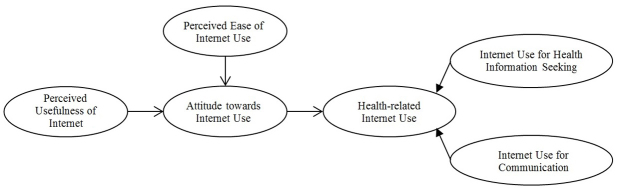
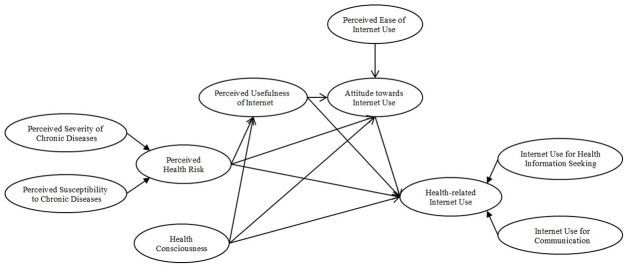
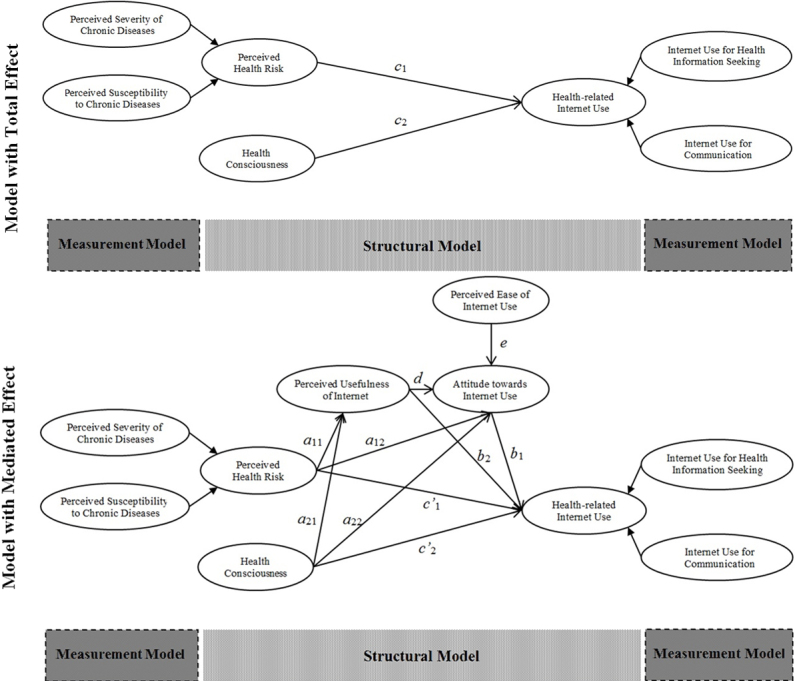
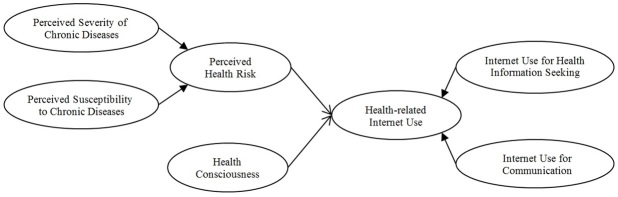
This study aimed to examine the influence of perceived health risk and health consciousness on health-related Internet use based on the HBM. Drawing on the TAM, it also tested the mediating effects of perceived usefulness of the Internet for health information and attitude toward Internet use for health purposes for the relationship between health-related factors, namely perceived health risk and health consciousness on health-related Internet use.
Data obtained for the current study were collected using purposive sampling; the sample consisted of women in Malaysia who had Internet access. The partial least squares structural equation modeling method was used to test the research hypotheses developed.
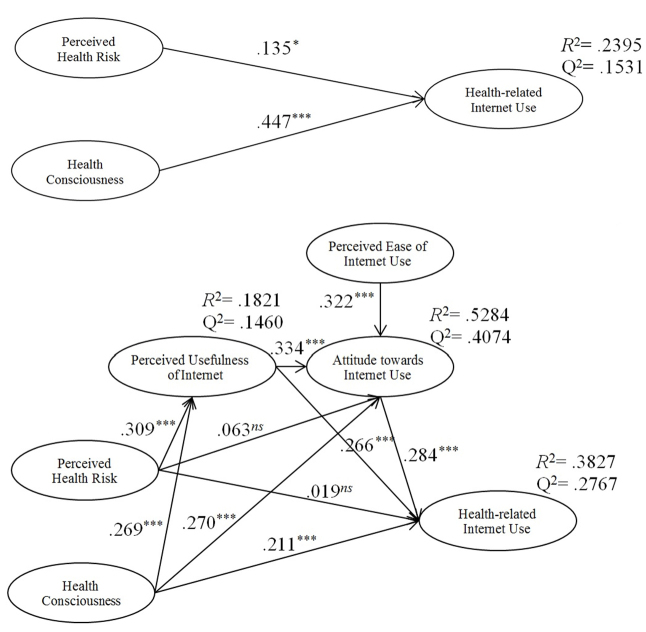
Perceived health risk (β=.135, t1999=2.676) and health consciousness (β=.447, t1999=9.168) had a positive influence on health-related Internet use. Moreover, perceived usefulness of the Internet and attitude toward Internet use for health-related purposes partially mediated the influence of health consciousness on health-related Internet use (β=.025, t1999=3.234), whereas the effect of perceived health risk on health-related Internet use was fully mediated by perceived usefulness of the Internet and attitude (β=.029, t1999=3.609). These results suggest the central role of perceived usefulness of the Internet and attitude toward Internet use for health purposes for women who were health conscious and who perceived their health to be at risk.
The integrated model proposed and tested in this study shows that the HBM, when combined with the TAM, is able to predict Internet use for health purposes. For women who subjectively evaluate their health as vulnerable to diseases and are concerned about their health, cognition beliefs in and positive affective feelings about the Internet come into play in determining the use of health-related Internet use. Furthermore, this study shows that engaging in health-related Internet use is a proactive behavior rather than a reactive behavior, suggesting that TAM dimensions have a significant mediating role in Internet health management.
如今,人们利用互联网来满足与健康相关的信息及交流需求。在马来西亚,由于慢性病发病率上升,尤其是城市女性中慢性病发病率上升以及她们对保持健康的渴望,利用互联网进行健康管理变得愈发重要。过去的研究分别采用技术接受模型(TAM)和健康信念模型(HBM)来解释出于健康相关目的的互联网使用情况。尽管TAM和HBM都有各自的优点,但单独使用它们都无法解释个体出于健康目的使用互联网的认知及相关机制。
本研究旨在基于HBM检验感知健康风险和健康意识对与健康相关的互联网使用的影响。借鉴TAM,本研究还检验了互联网对健康信息的感知有用性以及对出于健康目的使用互联网的态度在健康相关因素(即感知健康风险和健康意识)与与健康相关的互联网使用之间关系中的中介作用。
本研究通过立意抽样收集数据;样本包括马来西亚有互联网接入的女性。采用偏最小二乘结构方程建模方法来检验所提出的研究假设。
感知健康风险(β = 0.135,t1999 = 2.676)和健康意识(β = 0.447,t1999 = 9.168)对与健康相关的互联网使用有正向影响。此外,互联网的感知有用性以及对出于健康相关目的使用互联网的态度部分中介了健康意识对与健康相关的互联网使用的影响(β = 0.025,t1999 = 3.234),而感知健康风险对与健康相关的互联网使用的影响则完全由互联网的感知有用性和态度中介(β = 0.029,t1999 = 3.609)。这些结果表明,对于有健康意识且认为自身健康有风险的女性而言,互联网的感知有用性以及对出于健康目的使用互联网的态度起着核心作用。
本研究提出并检验的整合模型表明,HBM与TAM相结合能够预测出于健康目的的互联网使用情况。对于主观评估自身健康易患疾病且关注自身健康的女性来说,对互联网的认知信念和积极情感在决定与健康相关的互联网使用中发挥着作用。此外,本研究表明,参与与健康相关的互联网使用是一种主动行为而非被动行为,这表明TAM维度在互联网健康管理中具有显著的中介作用。