Sinclair Sara H G, Garcia-Garcia Jose C, Dumler J Stephen
Graduate Program in Cellular and Molecular Medicine, The Johns Hopkins University School of Medicine Baltimore, MD, USA ; Department of Pathology, The Johns Hopkins University School of Medicine Baltimore, MD, USA ; Department of Pathology, University of Maryland School of Medicine Baltimore, MD, USA ; Department of Microbiology and Immunology, University of Maryland School of Medicine Baltimore, MD, USA.
Department of Pathology, The Johns Hopkins University School of Medicine Baltimore, MD, USA ; Procter and Gamble Co. Cincinnati, OH, USA.
Front Microbiol. 2015 Feb 6;6:55. doi: 10.3389/fmicb.2015.00055. eCollection 2015.
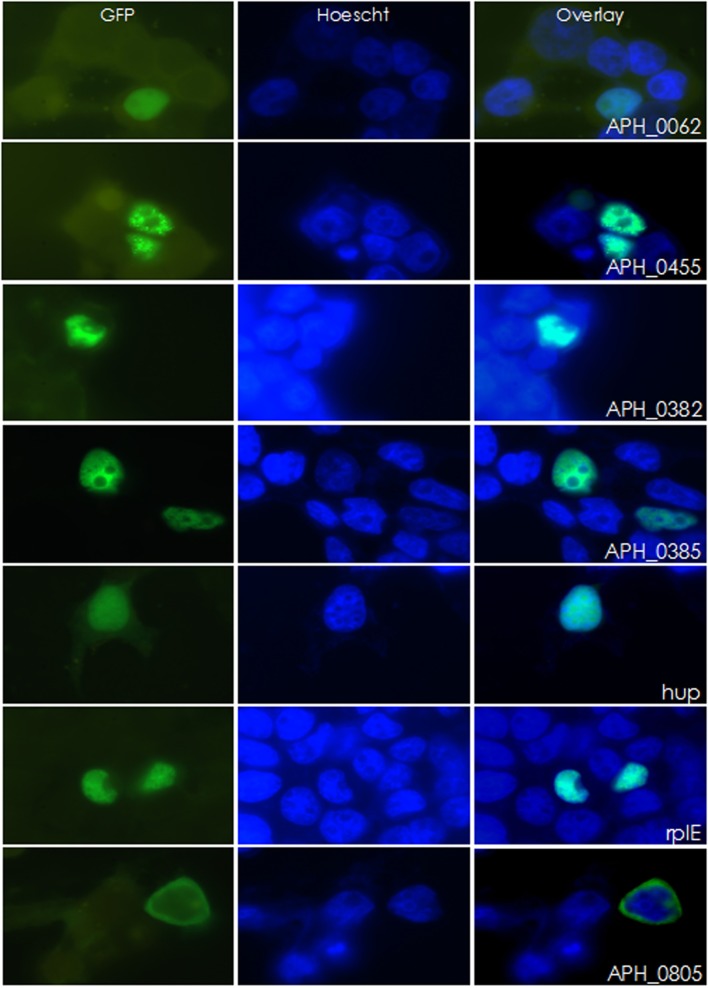
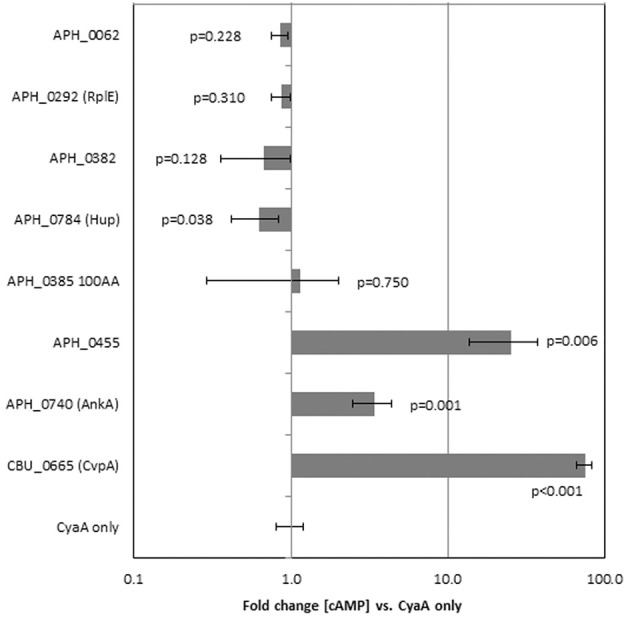
Obligate intracellular bacteria have an arsenal of proteins that alter host cells to establish and maintain a hospitable environment for replication. Anaplasma phagocytophilum secrets Ankyrin A (AnkA), via a type IV secretion system, which translocates to the nucleus of its host cell, human neutrophils. A. phagocytophilum-infected neutrophils have dramatically altered phenotypes in part explained by AnkA-induced transcriptional alterations. However, it is unlikely that AnkA is the sole effector to account for infection-induced transcriptional changes. We developed a simple method combining bioinformatics and iTRAQ protein profiling to identify potential bacterial-derived nuclear-translocated proteins that could impact transcriptional programming in host cells. This approach identified 50 A. phagocytophilum candidate genes or proteins. The encoding genes were cloned to create GFP fusion protein-expressing clones that were transfected into HEK-293T cells. We confirmed nuclear translocation of six proteins: APH_0062, RplE, Hup, APH_0382, APH_0385, and APH_0455. Of the six, APH_0455 was identified as a type IV secretion substrate and is now under investigation as a potential nucleomodulin. Additionally, application of this approach to other intracellular bacteria such as Mycobacterium tuberculosis, Chlamydia trachomatis and other intracellular bacteria identified multiple candidate genes to be investigated.
专性细胞内细菌拥有一系列蛋白质,这些蛋白质可改变宿主细胞,以建立并维持适宜复制的环境。嗜吞噬细胞无形体通过IV型分泌系统分泌锚蛋白A(AnkA),该蛋白会转移至其宿主细胞——人类中性粒细胞的细胞核中。感染嗜吞噬细胞无形体的中性粒细胞具有显著改变的表型,部分原因可由AnkA诱导的转录改变来解释。然而,AnkA不太可能是导致感染诱导转录变化的唯一效应蛋白。我们开发了一种结合生物信息学和iTRAQ蛋白质谱分析的简单方法,以鉴定可能影响宿主细胞转录编程的潜在细菌来源的核转位蛋白。该方法鉴定出了50个嗜吞噬细胞无形体候选基因或蛋白。将编码基因克隆,以创建表达绿色荧光蛋白融合蛋白的克隆,这些克隆被转染到HEK-293T细胞中。我们证实了6种蛋白的核转位:APH_0062、RplE、Hup、APH_0382、APH_0385和APH_0455。在这6种蛋白中,APH_0455被鉴定为IV型分泌底物,目前正在作为一种潜在的核调节蛋白进行研究。此外,将该方法应用于其他细胞内细菌,如结核分枝杆菌、沙眼衣原体和其他细胞内细菌,鉴定出了多个有待研究的候选基因。