Ben Maamar Millissia, Lesné Laurianne, Desdoits-Lethimonier Christèle, Coiffec Isabelle, Lassurguère Julie, Lavoué Vincent, Deceuninck Yoann, Antignac Jean-Philippe, Le Bizec Bruno, Perdu Elisabeth, Zalko Daniel, Pineau Charles, Chevrier Cécile, Dejucq-Rainsford Nathalie, Mazaud-Guittot Séverine, Jégou Bernard
Inserm (Institut national de la santé et de la recherche médicale), IRSET, U1085, SFR Biosit, Campus de Beaulieu, Rennes, CEDEX, France; Université de Rennes I, Campus de Beaulieu, Rennes, CEDEX, France.
CHU Rennes, Service Gynécologie et Obstétrique, Rennes, France.
PLoS One. 2015 Feb 23;10(2):e0117226. doi: 10.1371/journal.pone.0117226. eCollection 2015.
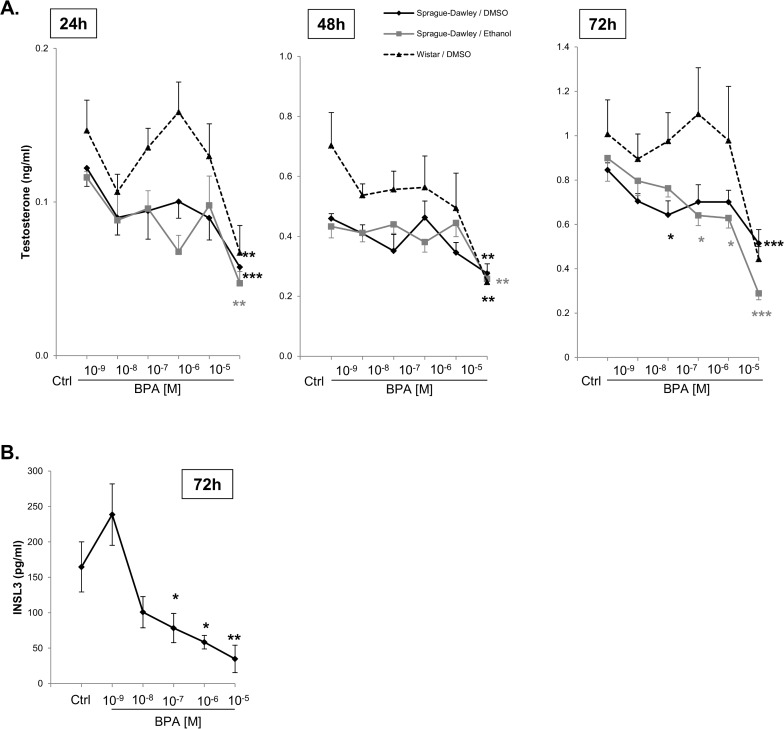
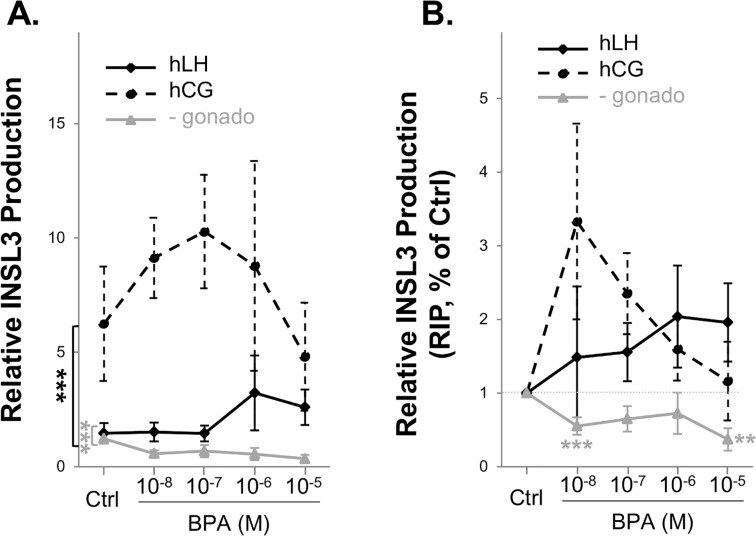
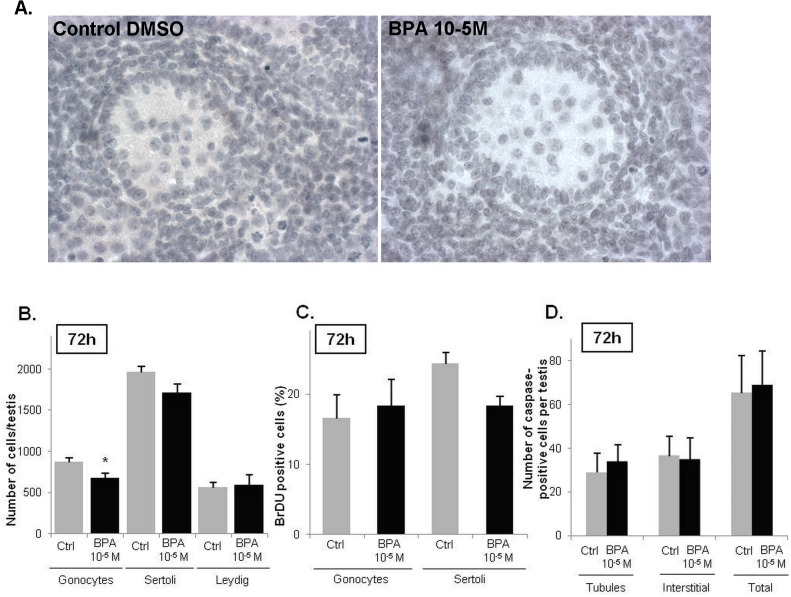
Few studies have been undertaken to assess the possible effects of bisphenol A (BPA) on the reproductive hormone balance in animals or humans with often contradictory results. We investigated possible direct endocrine disruption by BPA of the fetal testes of 2 rat strains (14.5-17.5 days post-coitum) and humans (8-12 gestational weeks) and under different culture conditions. BPA concentrations of 10(-8)M and 10(-5)M for 72 h reduced testosterone production by the Sprague-Dawley fetal rat testes, while only 10-5M suppressed it in the Wistar strain. The suppressive effects at 10-5M were seen as early as 24h and 48 h in both strains. BPA at 10(-7)-10(-5)M for 72 h suppressed the levels of fetal rat Leydig cell insulin-like factor 3 (INSL3). BPA exposure at 10(-8)M, 10(-7)M, and 10(-5)M for 72 h inhibited testosterone production in fetal human testes. For the lowest doses, the effects observed occurred only when no gonadotrophin was added to the culture media and were associated with a poorly preserved testicular morphology. We concluded that (i) BPA can display anti-androgenic effects both in rat and human fetal testes; (ii) it is essential to ascertain that the divergent effects of endocrine disruptors between species in vitro do not result from the culture conditions used, and/or the rodent strain selected; (iii) the optimization of each in vitro assay for a given species should be a major objective rather than the search of an hypothetical trans-species consensual model-system, as the organization of the testis is intrinsically different between mammalian species; (iv) due to the uncertainty existing on the internal exposure of the human fetal testis to BPA, and the insufficient number of epidemiological studies on the endocrine disruptive effects of BPA, caution should be taken in the extrapolation of our present results to the human reproductive health after fetal exposure to BPA.
很少有研究评估双酚A(BPA)对动物或人类生殖激素平衡的可能影响,结果往往相互矛盾。我们研究了BPA在不同培养条件下对2种大鼠品系(受孕后14.5 - 17.5天)和人类(妊娠8 - 12周)胎儿睾丸的直接内分泌干扰作用。10⁻⁸M和10⁻⁵M的BPA浓度处理72小时可降低斯普拉格 - 道利大鼠胎儿睾丸的睾酮生成,而在Wistar品系中只有10⁻⁵M的BPA能抑制睾酮生成。两种品系中,10⁻⁵M的抑制作用在24小时和48小时时就已出现。10⁻⁷ - 10⁻⁵M的BPA处理72小时可抑制大鼠胎儿睾丸间质细胞胰岛素样因子3(INSL3)的水平。10⁻⁸M、10⁻⁷M和10⁻⁵M的BPA处理72小时可抑制人类胎儿睾丸的睾酮生成。对于最低剂量,只有在培养基中不添加促性腺激素时才观察到这种作用,并且与睾丸形态保存不佳有关。我们得出结论:(i)BPA在大鼠和人类胎儿睾丸中均可表现出抗雄激素作用;(ii)必须确定体外物种间内分泌干扰物的不同作用并非源于所用的培养条件和/或所选的啮齿动物品系;(iii)针对给定物种优化每种体外试验应是主要目标,而不是寻找假设的跨物种共识模型系统,因为不同哺乳动物物种的睾丸组织结构本质上是不同的;(iv)由于人类胎儿睾丸内暴露于BPA的情况存在不确定性,且关于BPA内分泌干扰作用的流行病学研究数量不足,在将我们目前的结果外推至胎儿暴露于BPA后的人类生殖健康时应谨慎。