Sebastián-Serrano Álvaro, de Diego-García Laura, Martínez-Frailes Carlos, Ávila Jesús, Zimmermann Herbert, Millán José Luis, Miras-Portugal María Teresa, Díaz-Hernández Miguel
Department of Biochemistry and Molecular Biology, Veterinary School, Complutense University of Madrid, Avda. Puerta de Hierro S/N, 28040 Madrid, Spain ; Instituto de Investigación Sanitaria del Hospital Clínico San Carlos, IdISSC, Madrid, Spain.
Centro de Biología Molecular Severo Ochoa (CSIC-UAM), Madrid, Spain ; Centro de Investigación Biomédica en Red sobre Enfermedades Neurodegenerativas (CIBERNED, ISCIII), Madrid, Spain.
Comput Struct Biotechnol J. 2014 Dec 15;13:95-100. doi: 10.1016/j.csbj.2014.12.004. eCollection 2015.
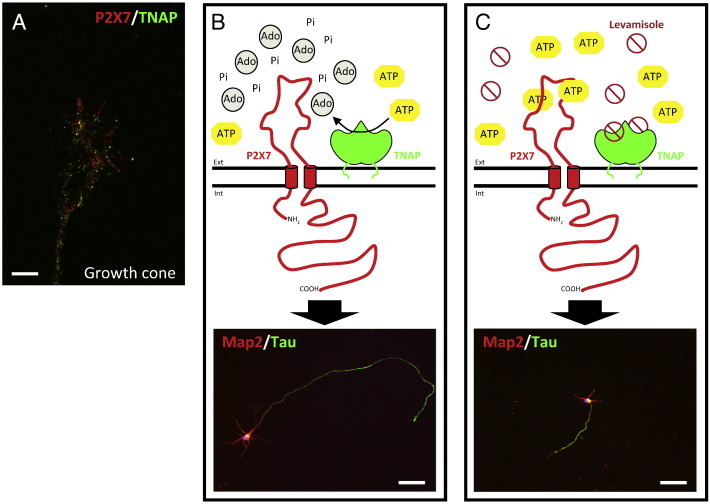
Tissue-nonspecific alkaline phosphatase (TNAP) is one of the four isozymes in humans and mice that have the capacity to hydrolyze phosphate groups from a wide spectrum of physiological substrates. Among these, TNAP degrades substrates implicated in neurotransmission. Transgenic mice lacking TNAP activity display the characteristic skeletal and dental phenotype of infantile hypophosphatasia, as well as spontaneous epileptic seizures and die around 10 days after birth. This physiopathology, linked to the expression pattern of TNAP in the central nervous system (CNS) during embryonic stages, suggests an important role for TNAP in neuronal development and synaptic function, situating it as a good target to be explored for the treatment of neurological diseases. In this review, we will focus mainly on the role that TNAP plays as an ectonucleotidase in CNS regulating the levels of extracellular ATP and consequently purinergic signaling.
组织非特异性碱性磷酸酶(TNAP)是人和小鼠体内四种同工酶之一,能够水解多种生理底物上的磷酸基团。其中,TNAP可降解与神经传递有关的底物。缺乏TNAP活性的转基因小鼠表现出婴儿型低磷酸酯酶症的典型骨骼和牙齿表型,以及自发性癫痫发作,并在出生后约10天死亡。这种病理生理现象与胚胎期TNAP在中枢神经系统(CNS)中的表达模式有关,提示TNAP在神经元发育和突触功能中起重要作用,使其成为治疗神经疾病的一个值得探索的良好靶点。在这篇综述中,我们将主要关注TNAP作为一种胞外核苷酸酶在中枢神经系统中调节细胞外ATP水平从而调控嘌呤能信号传导所发挥的作用。