Stephan Yannick, Sutin Angelina R, Terracciano Antonio
University of Montpellier, Montpellier, France.
College of Medicine, Florida State University, Tallahassee, Florida, United States of America.
PLoS One. 2015 Mar 4;10(3):e0119293. doi: 10.1371/journal.pone.0119293. eCollection 2015.
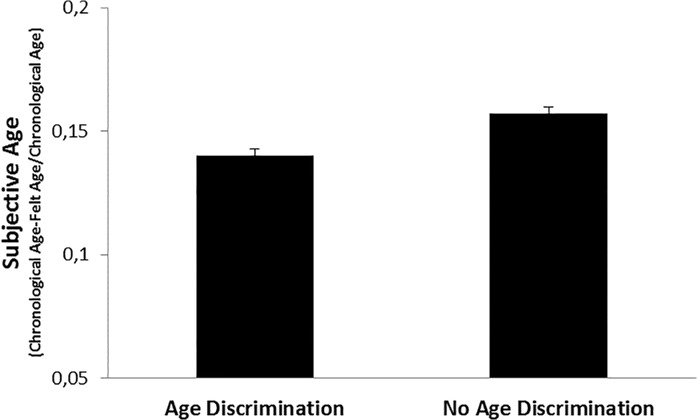
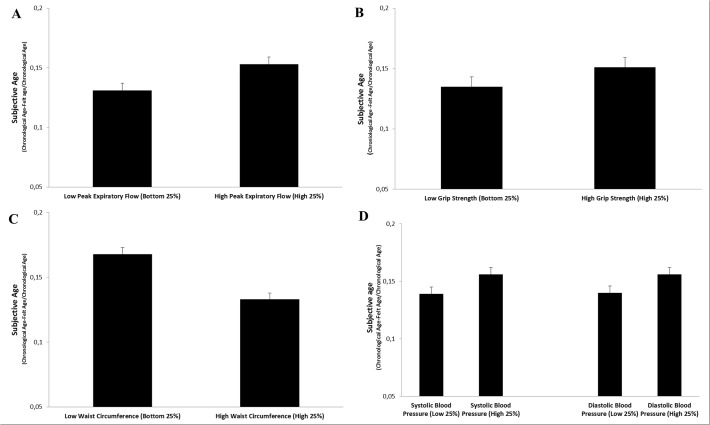
Subjective age, or how young or old individuals experience themselves to be relative to their chronological age, is a crucial construct in gerontology. Subjective age is a significant predictor of important health outcomes, but little is known about the criteria by which individuals' subjectively evaluate their age. To identify psychosocial and biomedical factors linked to the subjective evaluation of age, this study examined whether perceived age discrimination and markers of biological aging are associated with subjective age. Participants were 4776 adults (Mage = 68) from the 2008 and 2010 waves of the Health and Retirement Study (HRS) who completed measures of subjective age, age discrimination, demographic variables, self-rated health and depression, and had physical health measures, including peak expiratory flow, grip strength, waist circumference, systolic and diastolic blood pressure. Telomere length was available for a subset of participants in the 2008 wave (n = 2214). Regression analysis indicated that perceived age discrimination, lower peak expiratory flow, lower grip strength, and higher waist circumference were associated with an older subjective age, controlling for sociodemographic factors, self-rated health, and depression. In contrast, blood pressure and telomere length were not related to subjective age. These findings are consistent with the hypothesis that how old a person feels depends in part on psychosocial and biomedical factors, including the experiences of ageism and perceptible indices of fitness and biological age.
主观年龄,即个体相对于其实际年龄所感受到的自己有多年轻或多老,是老年学中的一个关键概念。主观年龄是重要健康结果的一个重要预测指标,但人们对个体主观评估自己年龄的标准知之甚少。为了确定与年龄主观评估相关的心理社会和生物医学因素,本研究考察了感知到的年龄歧视和生物衰老标志物是否与主观年龄相关。参与者是来自2008年和2010年健康与退休研究(HRS)的4776名成年人(平均年龄=68岁),他们完成了主观年龄、年龄歧视、人口统计学变量、自评健康和抑郁的测量,并进行了身体健康测量,包括呼气峰值流量、握力、腰围、收缩压和舒张压。2008年那一波次的部分参与者(n=2214)可获取端粒长度数据。回归分析表明,在控制了社会人口统计学因素、自评健康和抑郁后,感知到的年龄歧视、较低的呼气峰值流量、较低的握力和较高的腰围与较老的主观年龄相关。相比之下,血压和端粒长度与主观年龄无关。这些发现与以下假设一致,即一个人感觉自己多大年龄在一定程度上取决于心理社会和生物医学因素,包括年龄歧视经历以及健康和生物年龄的可感知指标。