Ikeda Seishi, Tokida Takeshi, Nakamura Hirofumi, Sakai Hidemitsu, Usui Yasuhiro, Okubo Takashi, Tago Kanako, Hayashi Kentaro, Sekiyama Yasuyo, Ono Hiroshi, Tomita Satoru, Hayatsu Masahito, Hasegawa Toshihiro, Minamisawa Kiwamu
Memuro Research Station, Hokkaido Agricultural Research Center, National Agriculture and Food Research Organization.
Microbes Environ. 2015;30(1):51-62. doi: 10.1264/jsme2.ME14117. Epub 2015 Feb 4.
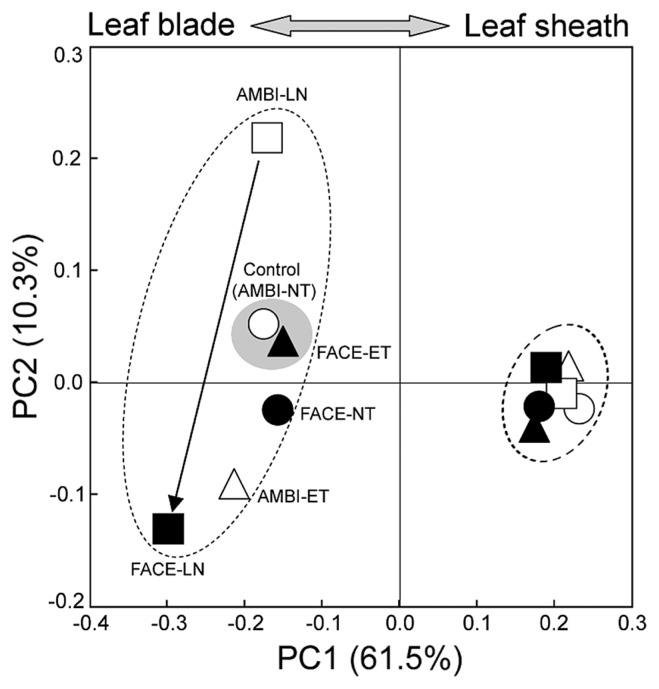
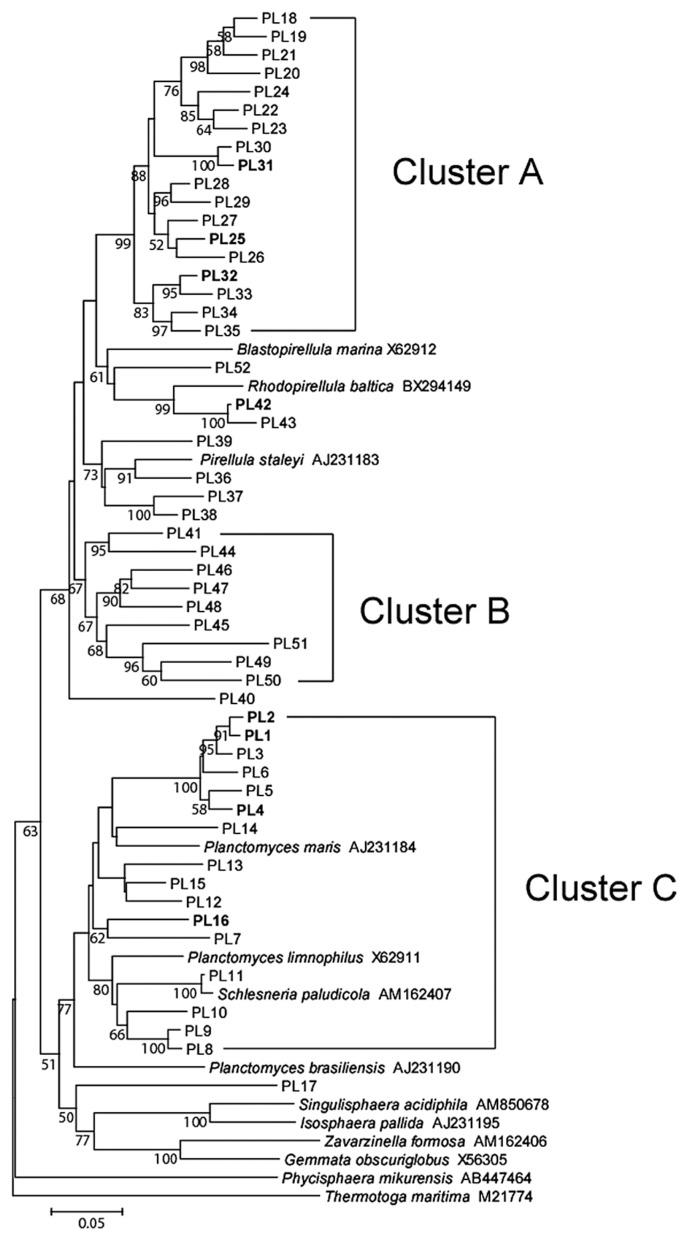
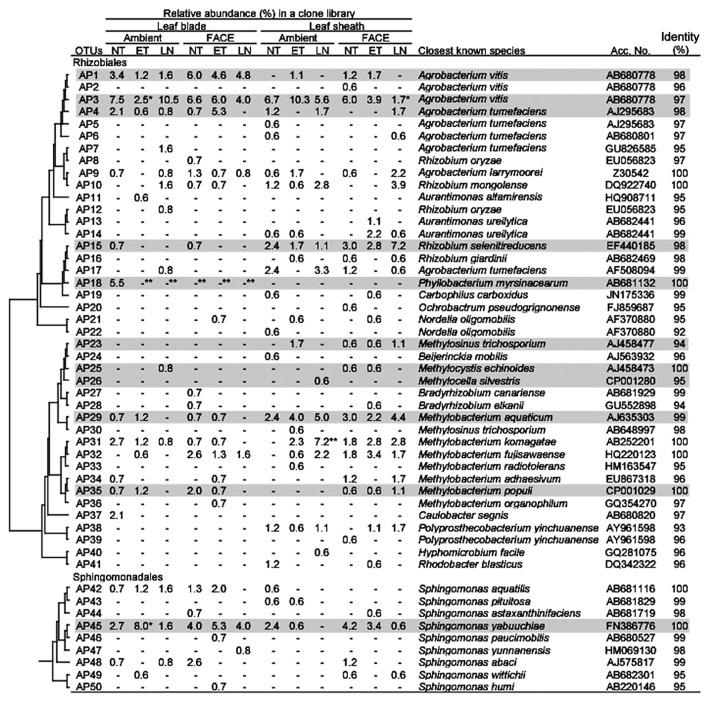
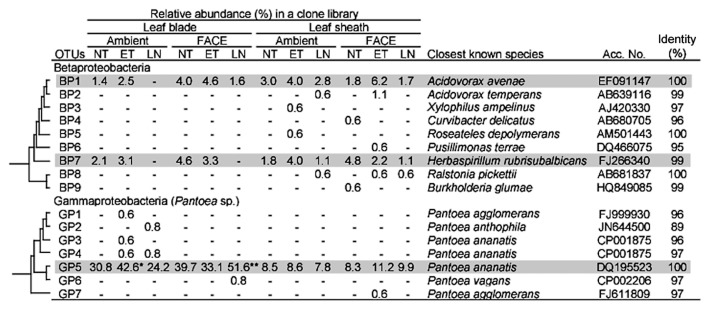
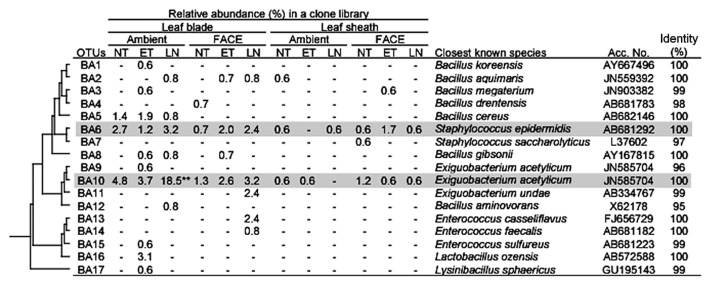
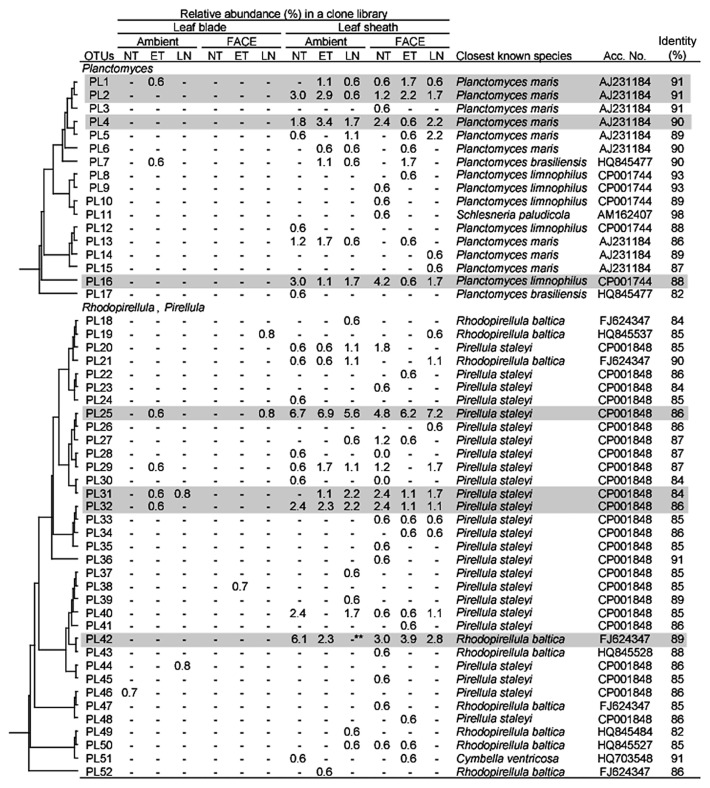
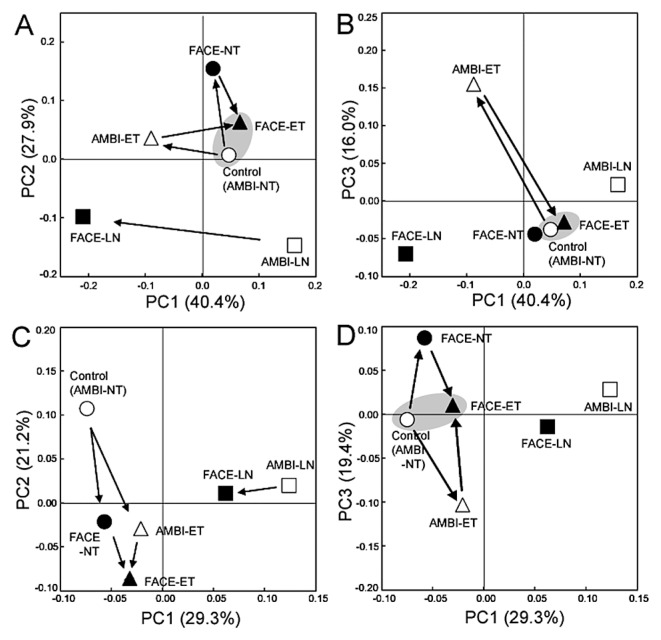
Rice shoot-associated bacterial communities at the panicle initiation stage were characterized and their responses to elevated surface water-soil temperature (ET), low nitrogen (LN), and free-air CO2 enrichment (FACE) were assessed by clone library analyses of the 16S rRNA gene. Principal coordinate analyses combining all sequence data for leaf blade- and leaf sheath-associated bacteria revealed that each bacterial community had a distinct structure, as supported by PC1 (61.5%), that was mainly attributed to the high abundance of Planctomycetes in leaf sheaths. Our results also indicated that the community structures of leaf blade-associated bacteria were more sensitive than those of leaf sheath-associated bacteria to the environmental factors examined. Among these environmental factors, LN strongly affected the community structures of leaf blade-associated bacteria by increasing the relative abundance of Bacilli. The most significant effect of FACE was also observed on leaf blade-associated bacteria under the LN condition, which was explained by decreases and increases in Agrobacterium and Pantoea, respectively. The community structures of leaf blade-associated bacteria under the combination of FACE and ET were more similar to those of the control than to those under ET or FACE. Thus, the combined effects of environmental factors need to be considered in order to realistically assess the effects of environmental changes on microbial community structures.
通过对16S rRNA基因进行克隆文库分析,对水稻幼穗分化期与稻株相关的细菌群落进行了表征,并评估了它们对地表水 - 土壤温度升高(ET)、低氮(LN)和自由空气CO₂富集(FACE)的响应。结合叶片和叶鞘相关细菌的所有序列数据进行的主坐标分析表明,每个细菌群落都有独特的结构,这得到了PC1(61.5%)的支持,PC1主要归因于叶鞘中大量的浮霉菌门。我们的结果还表明,与叶片相关的细菌群落结构比与叶鞘相关的细菌群落结构对所研究的环境因素更敏感。在这些环境因素中,低氮通过增加芽孢杆菌的相对丰度强烈影响与叶片相关的细菌群落结构。在低氮条件下,FACE对与叶片相关的细菌也有最显著的影响,这分别由农杆菌属的减少和泛菌属的增加来解释。FACE和ET组合条件下与叶片相关的细菌群落结构比单独ET或FACE条件下更接近对照。因此,为了实际评估环境变化对微生物群落结构的影响,需要考虑环境因素的综合作用。