Kim Deok-Gyu, Park Jae-Hwan, Kim Jae-Lip, Jung Bong-Kwang, Jeon Sarah Jiyoun, Lim Hyemi, Lee Mi Youn, Shin Eun-Hee, Klein Terry A, Kim Heung-Chul, Chong Sung-Tae, Song Jin-Won, Baek Luck-Ju, Chai Jong-Yil
Department of Parasitology and Tropical Medicine, Seoul National University College of Medicine, Seoul 110-799, Korea ; Department of Parasitology, College of Medicine, Dankook University, Chonan 330-714, Korea.
Department of Parasitology and Tropical Medicine, Seoul National University College of Medicine, Seoul 110-799, Korea.
Korean J Parasitol. 2015 Feb;53(1):135-9. doi: 10.3347/kjp.2015.53.1.135. Epub 2015 Feb 27.
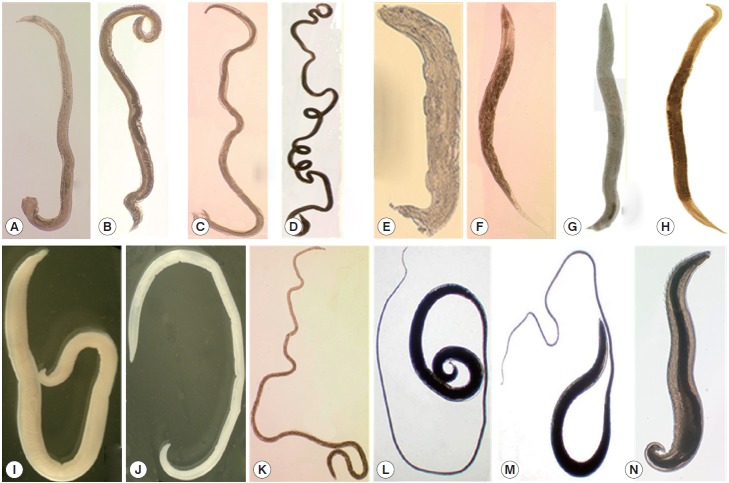
A total of 1,708 small mammals (1,617 rodents and 91 soricomorphs), including Apodemus agrarius (n = 1,400), Microtus fortis (167), Crocidura lasiura (91), Mus musculus (32), Myodes (= Eothenomys) regulus (9), Micromys minutus (6), and Tscherskia (= Cricetulus) triton (3), were live-trapped at US/Republic of Korea (ROK) military training sites near the demilitarized zone (DMZ) of Paju, Pocheon, and Yeoncheon, Gyeonggi Province from December 2004 to December 2009. Small mammals were examined for their intestinal nematodes by necropsy. A total of 1,617 rodents (100%) and 91 (100%) soricomorphs were infected with at least 1 nematode species, including Nippostrongylus brasiliensis, Heligmosomoides polygyrus, Syphacia obvelata, Heterakis spumosa, Protospirura muris, Capillaria spp., Trichuris muris, Rictularia affinis, and an unidentified species. N. brasiliensis was the most common species infecting small mammals (1,060; 62.1%) followed by H. polygyrus (617; 36.1%), S. obvelata (370; 21.7%), H. spumosa (314; 18.4%), P. muris (123; 7.2%), and Capillaria spp. (59; 3.5%). Low infection rates (0.1-0.8%) were observed for T. muris, R. affinis, and an unidentified species. The number of recovered worms was highest for N. brasiliensis (21,623 worms; mean 20.4 worms/infected specimen) followed by S. obvelata (9,235; 25.0 worms), H. polygyrus (4,122; 6.7 worms), and H. spumosa (1,160; 3.7 worms). A. agrarius demonstrated the highest prevalence for N. brasiliensis (70.9%), followed by M. minutus (50.0%), T. triton (33.3%), M. fortis (28.1%), M. musculus (15.6%), C. lasiura (13.2%), and M. regulus (0%). This is the first report of nematode infections in small mammals captured near the DMZ in ROK.
2004年12月至2009年12月期间,在韩国京畿道坡州、抱川和涟川非军事区附近的美韩军事训练场地,共活捉了1708只小型哺乳动物(1617只啮齿动物和91只鼩形目动物),包括黑线姬鼠(1400只)、东方田鼠(167只)、长尾麝鼩(91只)、小家鼠(32只)、棕背䶄(9只)、巢鼠(6只)和大仓鼠(3只)。通过尸检检查小型哺乳动物的肠道线虫。总共1617只啮齿动物(100%)和91只鼩形目动物(100%)感染了至少1种线虫,包括巴西日圆线虫、多枝细颈线虫、尖细盲肠线虫、泡翼线虫、鼠原旋尾线虫、毛细属线虫、鼠鞭虫、近缘瑞氏线虫和1个未鉴定的物种。巴西日圆线虫是感染小型哺乳动物最常见的物种(1060只;62.1%),其次是多枝细颈线虫(617只;36.1%)、尖细盲肠线虫(370只;21.7%)、泡翼线虫(314只;18.4%)、鼠原旋尾线虫(123只;7.2%)和毛细属线虫(59只;3.5%)。鼠鞭虫、近缘瑞氏线虫和1个未鉴定物种的感染率较低(0.1 - 0.8%)。回收的线虫数量以巴西日圆线虫最多(21623条;平均每条感染标本20.4条),其次是尖细盲肠线虫(9235条;25.0条)、多枝细颈线虫(4122条;6.7条)和泡翼线虫(1160条;3.7条)。黑线姬鼠的巴西日圆线虫感染率最高(70.9%),其次是巢鼠(50.0%)、大仓鼠(33.3%)、东方田鼠(28.1%)、小家鼠(15.6%)、长尾麝鼩(13.2%)和棕背䶄(0%)。这是韩国非军事区附近捕获的小型哺乳动物线虫感染的首次报告。