Fang Xiangming, Fry Deborah A, Brown Derek S, Mercy James A, Dunne Michael P, Butchart Alexander R, Corso Phaedra S, Maynzyuk Kateryna, Dzhygyr Yuriy, Chen Yu, McCoy Amalee, Swales Diane M
International Center for Applied Economics and Policy, College of Economics and Management, China Agricultural University, Haidian District, Beijing, China.
Moray House School of Education, University of Edinburgh, Scotland, UK.
Child Abuse Negl. 2015 Apr;42:146-62. doi: 10.1016/j.chiabu.2015.02.012. Epub 2015 Mar 7.
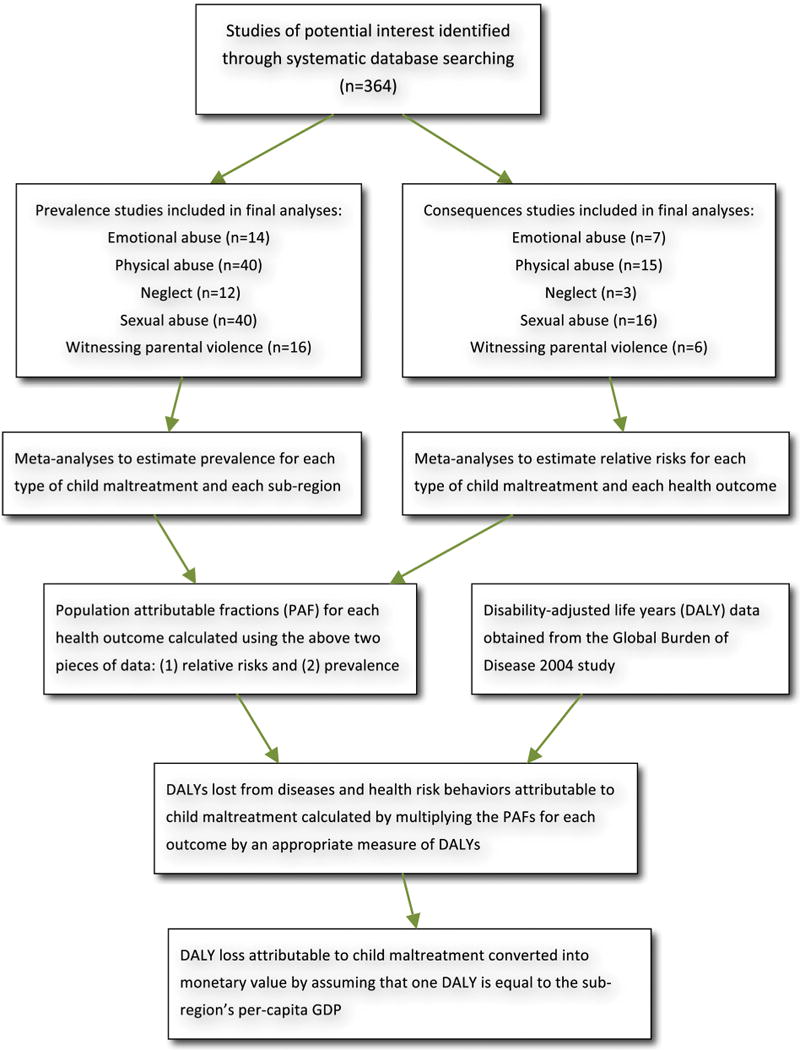
This study estimated the health and economic burden of child maltreatment in the East Asia and Pacific region, addressing a significant gap in the current evidence base. Systematic reviews and meta-analyses were conducted to estimate the prevalence of child physical abuse, sexual abuse, emotional abuse, neglect, and witnessing parental violence. Population Attributable Fractions were calculated and Disability-Adjusted Life Years (DALYs) lost from physical and mental health outcomes and health risk behaviors attributable to child maltreatment were estimated using the most recent comparable Global Burden of Disease data. DALY losses were converted into monetary value by assuming that one DALY is equal to the sub-region's per capita GDP. The estimated economic value of DALYs lost to violence against children as a percentage of GDP ranged from 1.24% to 3.46% across sub-regions defined by the World Health Organization. The estimated economic value of DALYs (in constant 2000 US$) lost to child maltreatment in the EAP region totaled US $151 billion, accounting for 1.88% of the region's GDP. Updated to 2012 dollars, the estimated economic burden totaled US $194 billion. In sensitivity analysis, the aggregate costs as a percentage of GDP range from 1.36% to 2.52%. The economic burden of child maltreatment in the East Asia and Pacific region is substantial, indicating the importance of preventing and responding to child maltreatment in this region. More comprehensive research into the impact of multiple types of childhood adversity on a wider range of putative health outcomes is needed to guide policy and programs for child protection in the region, and globally.
本研究估计了东亚和太平洋地区儿童虐待的健康和经济负担,填补了当前证据基础中的重大空白。我们进行了系统评价和荟萃分析,以估计儿童身体虐待、性虐待、情感虐待、忽视以及目睹父母暴力行为的发生率。计算了人群归因分数,并使用最新的可比全球疾病负担数据,估计了因儿童虐待导致的身心健康结果和健康风险行为所损失的伤残调整生命年(DALYs)。通过假设一个DALY等于该次区域的人均国内生产总值,将DALY损失换算为货币价值。在世界卫生组织界定的各个次区域中,因暴力侵害儿童行为导致的DALY损失的估计经济价值占国内生产总值的比例在1.24%至3.46%之间。东亚和太平洋地区因儿童虐待导致的DALY损失的估计经济价值(按2000年不变美元计算)总计1510亿美元,占该地区国内生产总值的1.88%。换算为2012年美元后,估计经济负担总计1940亿美元。在敏感性分析中,总成本占国内生产总值的比例在1.36%至2.52%之间。东亚和太平洋地区儿童虐待的经济负担巨大,这表明在该地区预防和应对儿童虐待的重要性。需要对多种类型的童年逆境对更广泛的假定健康结果的影响进行更全面的研究,以指导该地区乃至全球的儿童保护政策和项目。