Sanzani Simona Marianna, Reverberi Massimo, Fanelli Corrado, Ippolito Antonio
Department of Soil, Plant, and Food Sciences, University of Bari Aldo Moro, Via G. Amendola 165/A, 70126 Bari, Italy.
Department of Environmental Biology, Sapienza University of Rome, P.le A. Moro 5, 00185 Rome, Italy.
Toxins (Basel). 2015 Mar 9;7(3):812-20. doi: 10.3390/toxins7030812.
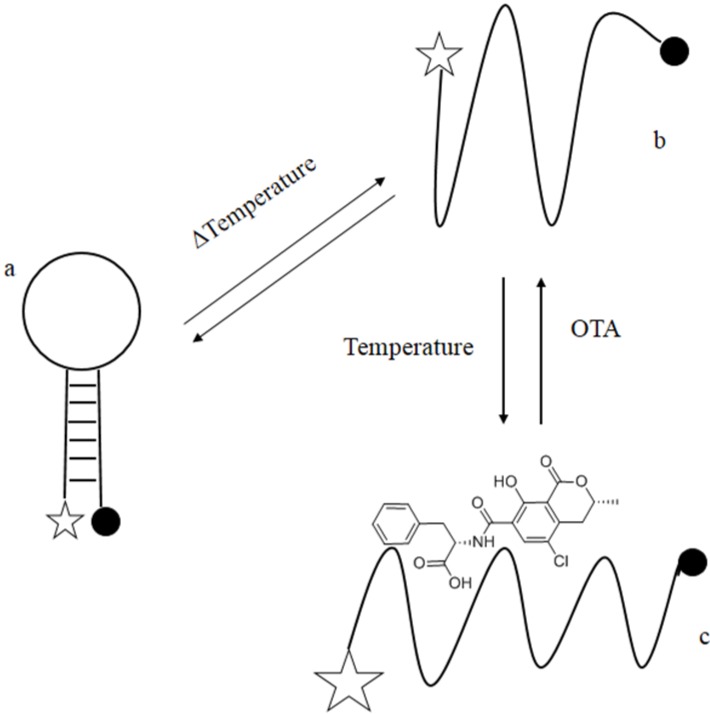
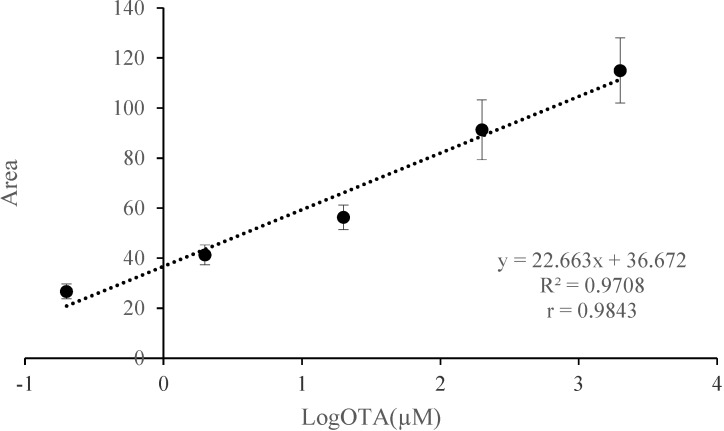
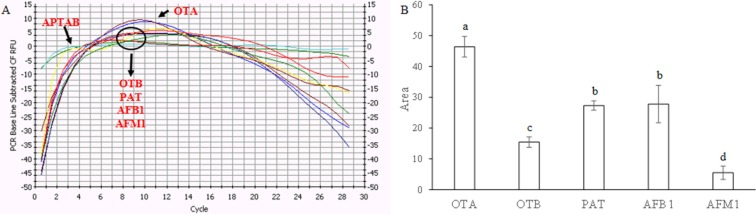
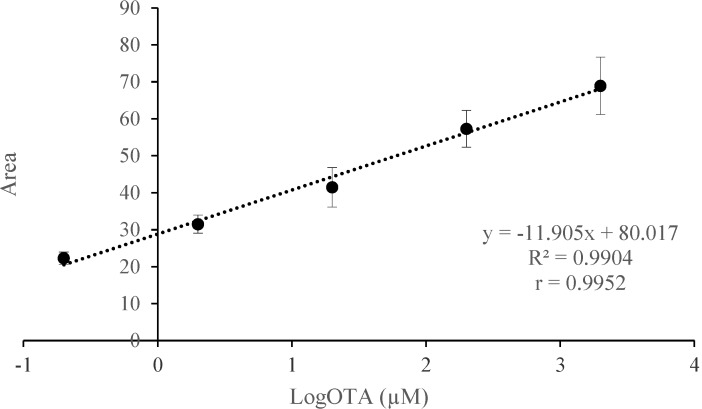
We developed a simple and cheap assay for quantitatively detecting ochratoxin A (OTA) in wine. A DNA aptamer available in literature was used as recognition probe in its molecular beacon form, i.e., with a fluorescence-quenching pair at the stem ends. Our aptabeacon could adopt a conformation allowing OTA binding, causing a fluorescence rise due to the increased distance between fluorophore and quencher. We used real-time PCR equipment for capturing the signal. With this assay, under optimized conditions, the entire process can be completed within 1 h. In addition, the proposed system exhibited a good selectivity for OTA against other mycotoxins (ochratoxin B and aflatoxin M1) and limited interference from aflatoxin B1 and patulin. A wide linear detection range (0.2-2000 µM) was achieved, with LOD = 13 nM, r = 0.9952, and R2 = 0.9904. The aptabeacon was also applied to detect OTA in red wine spiked with the same dilution series. A linear correlation with a LOD = 19 nM, r = 0.9843, and R2 = 0.9708 was observed, with recoveries in the range 63%-105%. Intra- and inter-day assays confirmed its reproducibility. The proposed biosensor, although still being finalized, might significantly facilitate the quantitative detection of OTA in wine samples, thus improving their quality control from a food safety perspective.
我们开发了一种简单且成本低廉的方法,用于定量检测葡萄酒中的赭曲霉毒素A(OTA)。文献中可用的一种DNA适配体以其分子信标形式用作识别探针,即在茎端带有荧光猝灭对。我们的适配体信标可以采用允许OTA结合的构象,由于荧光团和猝灭剂之间的距离增加,导致荧光增强。我们使用实时PCR设备来捕获信号。通过这种方法,在优化条件下,整个过程可在1小时内完成。此外,所提出的系统对OTA相对于其他霉菌毒素(赭曲霉毒素B和黄曲霉毒素M1)表现出良好的选择性,并且黄曲霉毒素B1和展青霉素的干扰有限。实现了宽线性检测范围(0.2 - 2000 µM),检测限为13 nM,r = 0.9952,R2 = 0.9904。该适配体信标还应用于检测添加了相同稀释系列的红酒中的OTA。观察到线性相关性,检测限为19 nM,r = 0.9843,R2 = 0.9708,回收率在63% - 105%范围内。日内和日间分析证实了其重现性。所提出的生物传感器虽然仍在完善中,但可能会显著促进葡萄酒样品中OTA的定量检测,从而从食品安全角度改善其质量控制。