Department of Dental Materials and Prosthodontics, Institute of Science and Technology, UNESP, São José dos Campos, SP, Brazil.
University Veiga de Almeida, Rio de Janeiro, RJ, Brazil.
J Appl Oral Sci. 2015 Jan-Feb;23(1):71-8. doi: 10.1590/1678-775720140113.
The purpose of this study was to assess the influence of conditioning methods and thermocycling on the bond strength between composite core and resin cement.
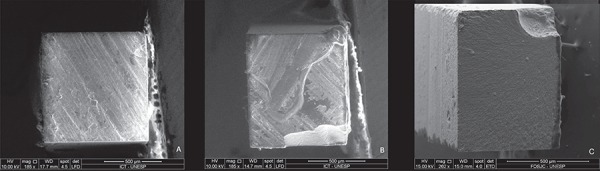
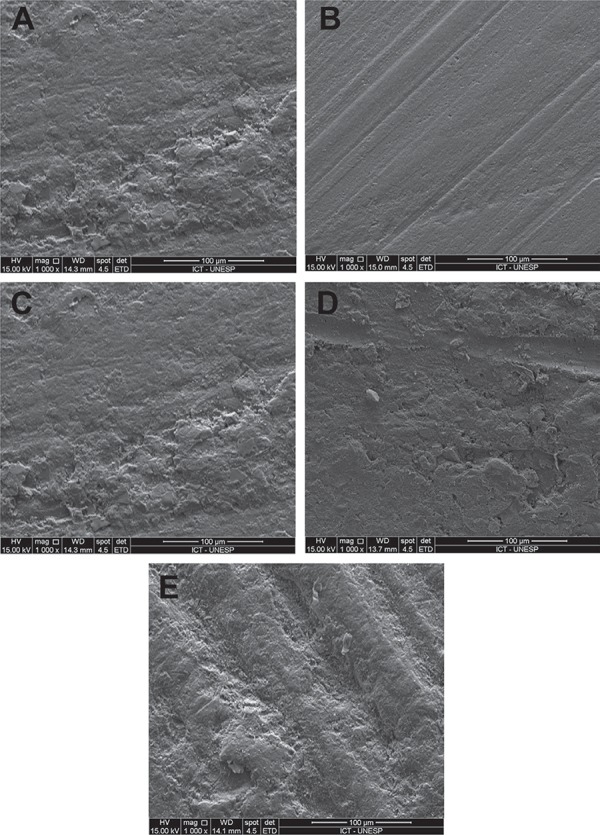
Eighty blocks (8×8×4 mm) were prepared with core build-up composite. The cementation surface was roughened with 120-grit carbide paper and the blocks were thermocycled (5,000 cycles, between 5°C and 55°C, with a 30 s dwell time in each bath). A layer of temporary luting agent was applied. After 24 h, the layer was removed, and the blocks were divided into five groups, according to surface treatment: (NT) No treatment (control); (SP) Grinding with 120-grit carbide paper; (AC) Etching with 37% phosphoric acid; (SC) Sandblasting with 30 mm SiO2 particles, silane application; (AO) Sandblasting with 50 mm Al2O3 particles, silane application. Two composite blocks were cemented to each other (n=8) and sectioned into sticks. Half of the specimens from each block were immediately tested for microtensile bond strength (µTBS), while the other half was subjected to storage for 6 months, thermocycling (12,000 cycles, between 5°C and 55°C, with a dwell time of 30 s in each bath) and µTBS test in a mechanical testing machine. Bond strength data were analyzed by repeated measures two-way ANOVA and Tukey test (α=0.05).
The µTBS was significantly affected by surface treatment (p=0.007) and thermocycling (p=0.000). Before aging, the SP group presented higher bond strength when compared to NT and AC groups, whereas all the other groups were statistically similar. After aging, all the groups were statistically similar. SP submitted to thermocycling showed lower bond strength than SP without thermocycling.
Core composites should be roughened with a diamond bur before the luting process. Thermocycling tends to reduce the bond strength between composite and resin cement.
本研究旨在评估预处理方法和冷热循环对复合核与树脂水泥之间粘结强度的影响。
用核堆积复合材料制备 80 个(8×8×4mm)块。用 120 目碳化硅砂纸对粘结面进行粗化处理,然后将块体进行热循环(5000 次,5°C 和 55°C 之间,每次循环在每个浴槽中停留 30 秒)。应用一层临时粘固剂。24 小时后,去除该层,将块体分为 5 组,根据表面处理情况进行分组:(NT)无处理(对照组);(SP)用 120 目碳化硅砂纸打磨;(AC)用 37%磷酸酸蚀;(SC)用 30mmSiO2 颗粒喷砂,硅烷处理;(AO)用 50mmAl2O3 颗粒喷砂,硅烷处理。将两个复合块粘结在一起(n=8)并切成棒状。每个块体的一半样本立即进行微拉伸粘结强度(µTBS)测试,另一半样本进行储存 6 个月,然后进行冷热循环(12000 次,5°C 和 55°C 之间,每次循环在每个浴槽中停留 30 秒)和在机械试验机上进行µTBS 测试。使用重复测量双向方差分析和 Tukey 检验(α=0.05)对粘结强度数据进行分析。
表面处理(p=0.007)和冷热循环(p=0.000)显著影响 µTBS。在老化前,SP 组与 NT 和 AC 组相比具有较高的粘结强度,而其他所有组之间无统计学差异。老化后,所有组之间无统计学差异。SP 组在冷热循环后显示出比未经冷热循环的 SP 组更低的粘结强度。
在粘固过程之前,核复合材料应用金刚石钻头进行粗化处理。冷热循环会降低复合核与树脂水泥之间的粘结强度。