The Kirby Institute, University of New South Wales , Kensington, NSW , Australia.
The Centre for Social Research in Health, University of New South Wales , Kensington, NSW , Australia.
Front Immunol. 2015 Feb 27;6:86. doi: 10.3389/fimmu.2015.00086. eCollection 2015.
Condomless anal intercourse (CLAI) has long been recognized as the primary mode of sexual transmission of HIV in gay and other men who have sex with men (MSM). A variety of measures of CLAI have been commonly used in behavioral surveillance for HIV risk and to forecast trends in HIV infection. However, gay and other MSM's sexual practices changed as the understanding of disease and treatment options advance. In the present paper, we argue that summary measures such as "any CLAI" do not accurately measure HIV sexual risk behavior.
Participants were 1,427 HIV-negative men from the Health in Men cohort study run from 2001 to 2007 in Sydney, Australia, with six-monthly interviews. At each interview, detailed quantitative data on the number of episodes of insertive and receptive CLAI in the last 6 months were collected, separated by partner type (regular vs. casual) and partners' HIV status (negative, positive, and HIV status unknown).
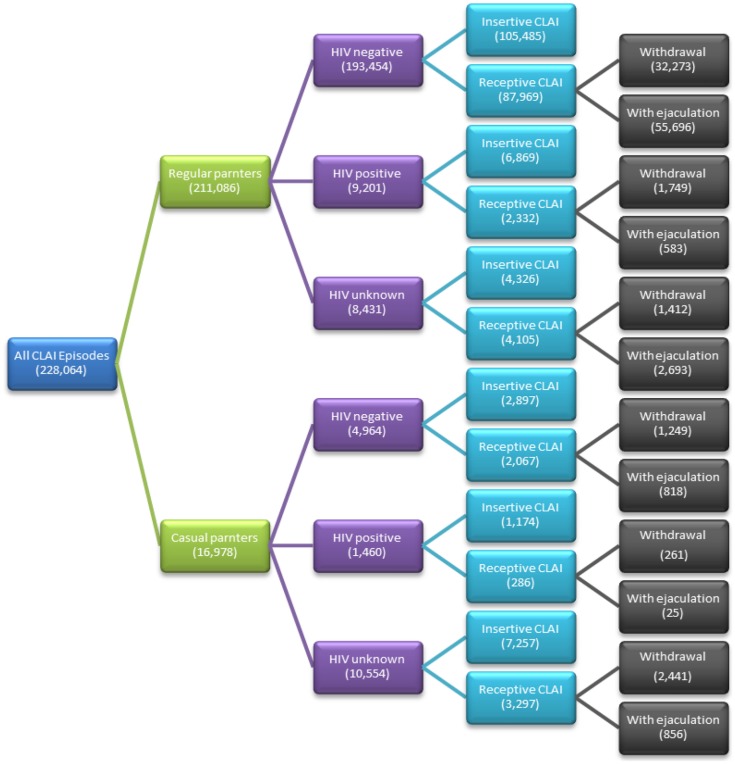
A total of 228,064 episodes of CLAI were reported during the study period with a mean of 44 episodes per year per participant (median: 14). The great majority of CLAI episodes were with a regular partner (92.6%), most of them with HIV-negative regular partners (84.8%). Participants were more likely to engage in insertive CLAI with casual than with regular partners (66.7 vs. 55.3% of all acts of CLAI with each partner type, p < 0.001). Men were more likely to report CLAI in the receptive position with HIV-negative and HIV status unknown partners than with HIV-positive partners (p < 0.001 for both regular and casual partners).
Gay and other MSM engaging in CLAI demonstrate clear patterns of HIV risk reduction behavior. As HIV prevention enters the era of antiretroviral-based biomedical approach, using all forms of CLAI indiscriminately as a measure of HIV behavioral risk is not helpful in understanding the current drivers of HIV transmission in the community.
无保护肛交(CLAI)长期以来一直被认为是男同性恋者和其他男男性行为者(MSM)中 HIV 性传播的主要模式。各种 CLAI 措施已广泛用于 HIV 风险的行为监测,并用于预测 HIV 感染趋势。然而,随着对疾病和治疗选择的了解不断深入,男同性恋者和其他 MSM 的性实践发生了变化。在本文中,我们认为,诸如“任何 CLAI”之类的综合措施并不能准确衡量 HIV 性风险行为。
参与者是来自澳大利亚悉尼的健康男性队列研究(2001 年至 2007 年期间进行)中的 1427 名 HIV 阴性男性,每六个月接受一次访谈。在每次访谈中,都收集了过去 6 个月中插入性和接受性 CLAI 事件的详细定量数据,按伴侣类型(固定伴侣和偶然伴侣)和伴侣的 HIV 状况(阴性、阳性和 HIV 状况未知)进行了区分。
在研究期间共报告了 228064 次 CLAI,每名参与者平均每年发生 44 次(中位数:14 次)。绝大多数 CLAI 事件发生在固定伴侣之间(92.6%),其中大多数与 HIV 阴性的固定伴侣发生(84.8%)。与固定伴侣相比,参与者更有可能与偶然伴侣发生插入性 CLAI(与每种伴侣类型的所有 CLAI 行为相比,分别为 66.7%和 55.3%,p<0.001)。与 HIV 阳性伴侣相比,男性更有可能报告与 HIV 阴性和 HIV 状况未知的伴侣发生被动 CLAI(与固定和偶然伴侣均为 p<0.001)。
进行 CLAI 的男同性恋者和其他 MSM 表现出明确的 HIV 风险降低行为模式。随着 HIV 预防进入基于抗逆转录病毒的生物医学方法时代,不加区分地将所有形式的 CLAI 作为 HIV 行为风险的衡量标准,并不能帮助我们理解当前社区中 HIV 传播的驱动因素。