Bassetti Matteo, De Waele Jan J, Eggimann Philippe, Garnacho-Montero Josè, Kahlmeter Gunnar, Menichetti Francesco, Nicolau David P, Paiva Jose Arturo, Tumbarello Mario, Welte Tobias, Wilcox Mark, Zahar Jean Ralph, Poulakou Garyphallia
Infectious Diseases Division, Santa Maria Misericordia University Hospital, Udine, Italy,
Intensive Care Med. 2015 May;41(5):776-95. doi: 10.1007/s00134-015-3719-z. Epub 2015 Mar 20.
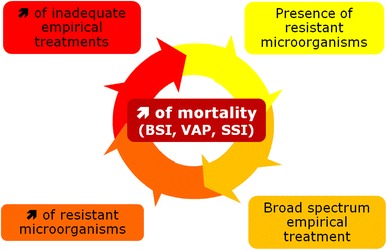
The antibiotic pipeline continues to diminish and the majority of the public remains unaware of this critical situation. The cause of the decline of antibiotic development is multifactorial and currently most ICUs are confronted with the challenge of multidrug-resistant organisms. Antimicrobial multidrug resistance is expanding all over the world, with extreme and pandrug resistance being increasingly encountered, especially in healthcare-associated infections in large highly specialized hospitals. Antibiotic stewardship for critically ill patients translated into the implementation of specific guidelines, largely promoted by the Surviving Sepsis Campaign, targeted at education to optimize choice, dosage, and duration of antibiotics in order to improve outcomes and reduce the development of resistance. Inappropriate antimicrobial therapy, meaning the selection of an antibiotic to which the causative pathogen is resistant, is a consistent predictor of poor outcomes in septic patients. Therefore, pharmacokinetically/pharmacodynamically optimized dosing regimens should be given to all patients empirically and, once the pathogen and susceptibility are known, local stewardship practices may be employed on the basis of clinical response to redefine an appropriate regimen for the patient. This review will focus on the most severely ill patients, for whom substantial progress in organ support along with diagnostic and therapeutic strategies markedly increased the risk of nosocomial infections.
抗生素研发渠道持续缩减,而大多数公众仍未意识到这一严峻形势。抗生素研发减少的原因是多方面的,目前大多数重症监护病房都面临着多重耐药菌的挑战。抗菌药物的多重耐药性在全球范围内不断扩大,极端耐药和泛耐药情况日益常见,尤其是在大型高度专业化医院的医疗相关感染中。针对重症患者的抗生素管理转化为实施特定指南,这在很大程度上是由拯救脓毒症运动推动的,目标是进行教育以优化抗生素的选择、剂量和使用时长,从而改善治疗结果并减少耐药性的产生。不恰当的抗菌治疗,即选择对致病病原体耐药的抗生素,是脓毒症患者预后不良的一个持续预测指标。因此,应凭经验为所有患者给予药代动力学/药效学优化的给药方案,一旦明确病原体和药敏情况,可根据临床反应采用当地的管理措施为患者重新确定合适的治疗方案。本综述将聚焦于病情最严重的患者,对他们而言,器官支持以及诊断和治疗策略方面的显著进展显著增加了医院感染的风险。