Sittig Dean F, Murphy Daniel R, Smith Michael W, Russo Elise, Wright Adam, Singh Hardeep
School of Biomedical Informatics, University of Texas Health Science Center at Houston, TX, USA
Section of Health Services Research, Department of Medicine, Baylor College of Medicine, Houston, Texas, USA Houston VA Center for Innovations in Quality, Effectiveness and Safety, Michael E. DeBakey Veterans Affairs Medical Center, Houston, Texas.
J Am Med Inform Assoc. 2015 Jul;22(4):900-4. doi: 10.1093/jamia/ocv013. Epub 2015 Mar 18.
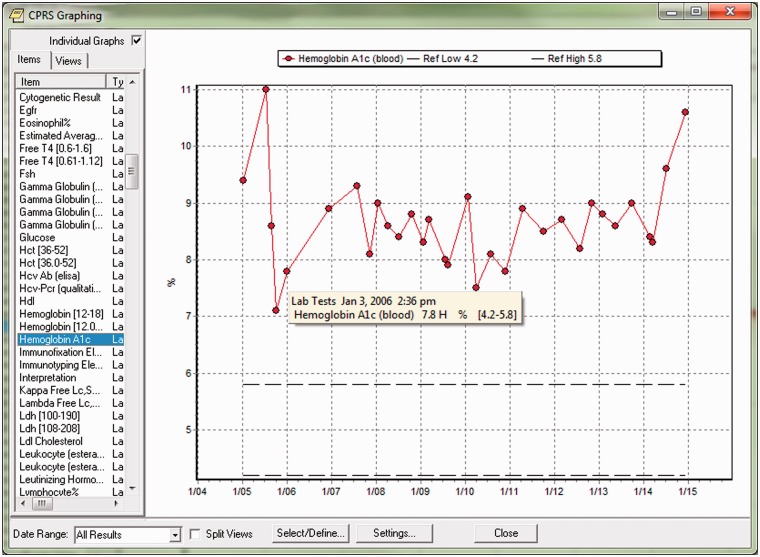
Accurate display and interpretation of clinical laboratory test results is essential for safe and effective diagnosis and treatment. In an attempt to ascertain how well current electronic health records (EHRs) facilitated these processes, we evaluated the graphical displays of laboratory test results in eight EHRs using objective criteria for optimal graphs based on literature and expert opinion. None of the EHRs met all 11 criteria; the magnitude of deficiency ranged from one EHR meeting 10 of 11 criteria to three EHRs meeting only 5 of 11 criteria. One criterion (i.e., the EHR has a graph with y-axis labels that display both the name of the measured variable and the units of measure) was absent from all EHRs. One EHR system graphed results in reverse chronological order. One EHR system plotted data collected at unequally-spaced points in time using equally-spaced data points, which had the effect of erroneously depicting the visual slope perception between data points. This deficiency could have a significant, negative impact on patient safety. Only two EHR systems allowed users to see, hover-over, or click on a data point to see the precise values of the x-y coordinates. Our study suggests that many current EHR-generated graphs do not meet evidence-based criteria aimed at improving laboratory data comprehension.
准确显示和解读临床实验室检测结果对于安全有效的诊断和治疗至关重要。为了确定当前的电子健康记录(EHR)在多大程度上有助于这些过程,我们根据文献和专家意见,使用优化图表的客观标准,评估了八个EHR中实验室检测结果的图形显示。没有一个EHR满足所有11项标准;缺陷程度从一个EHR满足11项标准中的10项到三个EHR仅满足11项标准中的5项不等。所有EHR都缺少一个标准(即EHR有一个带有y轴标签的图表,该标签同时显示测量变量的名称和测量单位)。一个EHR系统按时间倒序绘制结果。一个EHR系统使用等间距的数据点绘制在不等间距时间点收集的数据,这会错误地描绘数据点之间的视觉斜率感知。这种缺陷可能对患者安全产生重大负面影响。只有两个EHR系统允许用户查看、悬停或点击数据点以查看x-y坐标的精确值。我们的研究表明,当前许多由EHR生成的图表不符合旨在提高实验室数据理解的循证标准。