• 文献检索
  • 文档翻译
  • 深度研究
  • 学术资讯
  • Suppr Zotero 插件Zotero 插件
  • 邀请有礼
  • 套餐&价格
  • 历史记录
应用&插件
Suppr Zotero 插件Zotero 插件浏览器插件Mac 客户端Windows 客户端微信小程序
定价
高级版会员购买积分包购买API积分包
服务
文献检索文档翻译深度研究API 文档MCP 服务
关于我们
关于 Suppr公司介绍联系我们用户协议隐私条款
关注我们

Suppr 超能文献

核心技术专利:CN118964589B侵权必究
粤ICP备2023148730 号-1Suppr @ 2026

文献检索

告别复杂PubMed语法,用中文像聊天一样搜索,搜遍4000万医学文献。AI智能推荐,让科研检索更轻松。

立即免费搜索

文件翻译

保留排版,准确专业,支持PDF/Word/PPT等文件格式,支持 12+语言互译。

免费翻译文档

深度研究

AI帮你快速写综述,25分钟生成高质量综述,智能提取关键信息,辅助科研写作。

立即免费体验

用于向临床医生展示糖尿病患者自我收集健康数据的仪表板的设计与预研究评估:迭代方法与定性案例研究

Design and Prestudy Assessment of a Dashboard for Presenting Self-Collected Health Data of Patients With Diabetes to Clinicians: Iterative Approach and Qualitative Case Study.

作者信息

Giordanengo Alain, Årsand Eirik, Woldaregay Ashenafi Zebene, Bradway Meghan, Grottland Astrid, Hartvigsen Gunnar, Granja Conceição, Torsvik Torbjørn, Hansen Anne Helen

机构信息

Department of Computer Science, UiT The Arctic University of Norway, Tromsø, Norway.

Norwegian Centre for E-health Research, Tromsø, Norway.

出版信息

JMIR Diabetes. 2019 Jul 9;4(3):e14002. doi: 10.2196/14002.

DOI:10.2196/14002
PMID:31290396
原文链接:https://pmc.ncbi.nlm.nih.gov/articles/PMC6647758/
Abstract

BACKGROUND

Introducing self-collected health data from patients with diabetes into consultation can be beneficial for both patients and clinicians. Such an initiative can allow patients to be more proactive in their disease management and clinicians to provide more tailored medical services. Optimally, electronic health record systems (EHRs) should be able to receive self-collected health data in a standard representation of medical data such as Fast Healthcare Interoperability Resources (FHIR), from patients systems like mobile health apps and display the data directly to their users-the clinicians. However, although Norwegian EHRs are working on implementing FHIR, no solution or graphical interface is available today to display self-collected health data.

OBJECTIVE

The objective of this study was to design and assess a dashboard for displaying relevant self-collected health data from patients with diabetes to clinicians.

METHODS

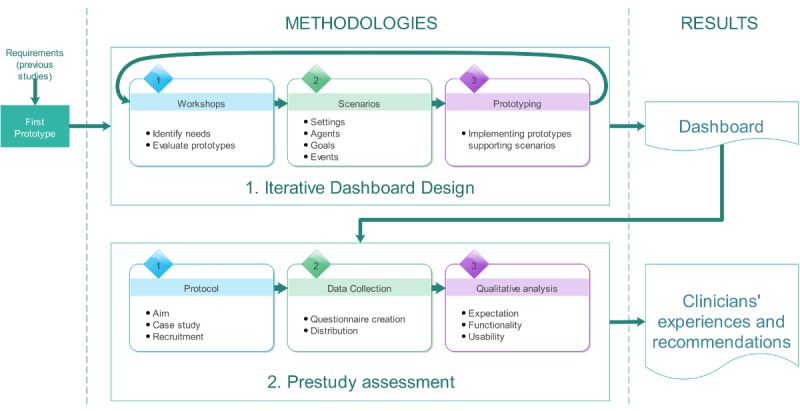
The design relied on an iterative participatory process involving workshops with patients, clinicians, and researchers to define which information should be available and how it should be displayed. The assessment is based on a case study, presenting an instance of the dashboard populated with data collected from one patient with diabetes type 1 (in-house researcher) face-to-face by 14 clinicians. We performed a qualitative analysis based on usability, functionality, and expectation by using responses to questionnaires that were distributed to the 14 clinicians at the end of the workshops and collected before the participants left. The qualitative assessment was guided by the Standards for Reporting Qualitative Research.

RESULTS

We created a dashboard permitting clinicians to assess the reliability of self-collected health data, list all collected data including medical calculations, and highlight medical situations that need to be investigated to improve the situation of the patients. The dashboard uses a combination of tables, graphs, and other visual representations to display the relevant information. Clinicians think that this type of solution will be useful during consultations every day, especially for patients living in remote areas or those who are technologically interested.

CONCLUSIONS

Displaying self-collected health data during consultations is not enough for clinicians; the data reliability has to be assured and the relevant information needs to be extracted and displayed along with the data to ease the introduction during a medical encounter. The prestudy assessment showed that the system provides relevant information to meet clinicians' need and that clinicians were eager to start using it during consultations. The system has been under testing in a medical trial since November 2018, and the first results of its assessment in a real-life situation are expected in the beginning of next year (2020).

摘要

背景

将糖尿病患者自行收集的健康数据引入会诊对患者和临床医生都有益。这样的举措可以让患者在疾病管理中更加积极主动,也能让临床医生提供更具针对性的医疗服务。理想情况下,电子健康记录系统(EHRs)应该能够接收来自移动健康应用等患者系统以快速医疗互操作性资源(FHIR)等医学数据标准表示形式自行收集的健康数据,并将数据直接显示给其用户——临床医生。然而,尽管挪威的电子健康记录系统正在努力实施FHIR,但目前尚无解决方案或图形界面来显示自行收集的健康数据。

目的

本研究的目的是设计并评估一个用于向临床医生展示糖尿病患者自行收集的相关健康数据的仪表板。

方法

该设计依赖于一个迭代参与过程,包括与患者、临床医生和研究人员举办研讨会,以确定应提供哪些信息以及如何展示这些信息。评估基于一个案例研究,展示了一个仪表板实例,其中填充了由14名临床医生面对面从一名1型糖尿病患者(内部研究人员)收集的数据。我们通过使用在研讨会结束时分发给14名临床医生并在参与者离开前收集的问卷回复,基于可用性、功能和期望进行了定性分析。定性评估以定性研究报告标准为指导。

结果

我们创建了一个仪表板,使临床医生能够评估自行收集的健康数据的可靠性,列出所有收集的数据,包括医学计算结果,并突出显示需要调查以改善患者状况的医疗情况。该仪表板使用表格、图表和其他视觉表示形式的组合来显示相关信息。临床医生认为这种类型的解决方案在日常会诊中会很有用,特别是对于居住在偏远地区或对技术感兴趣的患者。

结论

在会诊期间展示自行收集的健康数据对临床医生来说还不够;必须确保数据的可靠性,并且需要提取相关信息并与数据一起显示,以便在医疗问诊期间便于引入。预研究评估表明,该系统提供了满足临床医生需求的相关信息,并且临床医生渴望在会诊期间开始使用它。该系统自2018年11月起一直在进行临床试验测试,预计明年年初(2020年)会得出其在实际应用中的首次评估结果。
https://cdn.ncbi.nlm.nih.gov/pmc/blobs/d599/6647758/e1ceb0668398/diabetes_v4i3e14002_fig7.jpg
https://cdn.ncbi.nlm.nih.gov/pmc/blobs/d599/6647758/c9b05ecde1d6/diabetes_v4i3e14002_fig1.jpg
https://cdn.ncbi.nlm.nih.gov/pmc/blobs/d599/6647758/881f00df9879/diabetes_v4i3e14002_fig2.jpg
https://cdn.ncbi.nlm.nih.gov/pmc/blobs/d599/6647758/16edaa0f9187/diabetes_v4i3e14002_fig3.jpg
https://cdn.ncbi.nlm.nih.gov/pmc/blobs/d599/6647758/247bfb39c8f5/diabetes_v4i3e14002_fig4.jpg
https://cdn.ncbi.nlm.nih.gov/pmc/blobs/d599/6647758/8321e87edcb5/diabetes_v4i3e14002_fig5.jpg
https://cdn.ncbi.nlm.nih.gov/pmc/blobs/d599/6647758/e1ceb0668398/diabetes_v4i3e14002_fig7.jpg
https://cdn.ncbi.nlm.nih.gov/pmc/blobs/d599/6647758/c9b05ecde1d6/diabetes_v4i3e14002_fig1.jpg
https://cdn.ncbi.nlm.nih.gov/pmc/blobs/d599/6647758/881f00df9879/diabetes_v4i3e14002_fig2.jpg
https://cdn.ncbi.nlm.nih.gov/pmc/blobs/d599/6647758/16edaa0f9187/diabetes_v4i3e14002_fig3.jpg
https://cdn.ncbi.nlm.nih.gov/pmc/blobs/d599/6647758/247bfb39c8f5/diabetes_v4i3e14002_fig4.jpg
https://cdn.ncbi.nlm.nih.gov/pmc/blobs/d599/6647758/8321e87edcb5/diabetes_v4i3e14002_fig5.jpg
https://cdn.ncbi.nlm.nih.gov/pmc/blobs/d599/6647758/e1ceb0668398/diabetes_v4i3e14002_fig7.jpg

相似文献

1
Design and Prestudy Assessment of a Dashboard for Presenting Self-Collected Health Data of Patients With Diabetes to Clinicians: Iterative Approach and Qualitative Case Study.用于向临床医生展示糖尿病患者自我收集健康数据的仪表板的设计与预研究评估:迭代方法与定性案例研究
JMIR Diabetes. 2019 Jul 9;4(3):e14002. doi: 10.2196/14002.
2
Design and Development of a Context-Aware Knowledge-Based Module for Identifying Relevant Information and Information Gaps in Patients With Type 1 Diabetes Self-Collected Health Data.用于识别1型糖尿病患者自我收集健康数据中的相关信息和信息差距的情境感知知识模块的设计与开发
JMIR Diabetes. 2018 Jul 11;3(3):e10431. doi: 10.2196/10431.
3
Designing a Clinician-Centered Wearable Data Dashboard (CarePortal): Participatory Design Study.设计以临床医生为中心的可穿戴数据仪表板(CarePortal):参与式设计研究
JMIR Form Res. 2023 Dec 5;7:e46866. doi: 10.2196/46866.
4
Promoting and supporting self-management for adults living in the community with physical chronic illness: A systematic review of the effectiveness and meaningfulness of the patient-practitioner encounter.促进和支持社区中患有慢性身体疾病的成年人进行自我管理:对医患互动的有效性和意义的系统评价。
JBI Libr Syst Rev. 2009;7(13):492-582. doi: 10.11124/01938924-200907130-00001.
5
Co-design of an Electronic Dashboard to Support the Coproduction of Care in Pediatric Rheumatic Disease: Human-Centered Design and Usability Testing.支持儿科风湿性疾病联合照护的电子仪表盘协同设计:以人为本的设计与可用性测试
J Particip Med. 2022 Apr 22;14(1):e34735. doi: 10.2196/34735.
6
A Patient-Facing Diabetes Dashboard Embedded in a Patient Web Portal: Design Sprint and Usability Testing.嵌入患者门户网站的面向患者的糖尿病信息仪表板:设计冲刺与可用性测试
JMIR Hum Factors. 2018 Sep 24;5(3):e26. doi: 10.2196/humanfactors.9569.
7
Developing a Mental Health eClinic to Improve Access to and Quality of Mental Health Care for Young People: Using Participatory Design as Research Methodologies.开发心理健康电子诊所以改善年轻人获得心理健康护理的机会和护理质量:采用参与式设计作为研究方法
J Med Internet Res. 2018 May 28;20(5):e188. doi: 10.2196/jmir.9716.
8
Designing a Self-Management App for Young People With Type 1 Diabetes: Methodological Challenges, Experiences, and Recommendations.为 1 型糖尿病青少年设计自我管理应用程序:方法学挑战、经验与建议
JMIR Mhealth Uhealth. 2017 Oct 23;5(10):e124. doi: 10.2196/mhealth.8137.
9
Design and Evaluation of an Intensive Care Unit Dashboard Built in Response to the COVID-19 Pandemic: Semistructured Interview Study.针对新冠疫情设计并评估重症监护病房信息平台:半结构化访谈研究
JMIR Hum Factors. 2023 Sep 26;10:e49438. doi: 10.2196/49438.
10
Usability Testing a Potentially Inappropriate Medication Dashboard: A Core Component of the Dashboard Development Process.对潜在不适当用药仪表板进行可用性测试:仪表板开发过程的核心组成部分。
Appl Clin Inform. 2020 Aug;11(4):528-534. doi: 10.1055/s-0040-1714693. Epub 2020 Aug 12.

引用本文的文献

1
Exploring Clinician Experiences With a Digital Platform Supporting Orthopedic Care That Integrates Patient-Generated Health Data: Qualitative Study of Early Users.探索临床医生使用支持骨科护理的数字平台的经验,该平台整合了患者生成的健康数据:早期用户的定性研究。
JMIR Hum Factors. 2025 Aug 29;12:e65216. doi: 10.2196/65216.
2
Improving the Implementation of Patient-Reported Outcome Measure in Clinical Practice: Tackling Current Challenges With Innovative Digital Communication Technologies.改善患者报告结局量表在临床实践中的应用:利用创新数字通信技术应对当前挑战
J Med Internet Res. 2025 Feb 5;27:e60777. doi: 10.2196/60777.
3

本文引用的文献

1
Enabling artificial intelligence in high acuity medical environments.在高 acuity 医疗环境中启用人工智能。 注:这里的“acuity”可能是“acute”的错误拼写,原句准确意思可能是“在高急症医疗环境中启用人工智能” 。
Minim Invasive Ther Allied Technol. 2019 Apr;28(2):120-126. doi: 10.1080/13645706.2019.1599957. Epub 2019 Apr 5.
2
5. Lifestyle Management: .5. 生活方式管理: 。
Diabetes Care. 2019 Jan;42(Suppl 1):S46-S60. doi: 10.2337/dc19-S005.
3
Design and Development of a Context-Aware Knowledge-Based Module for Identifying Relevant Information and Information Gaps in Patients With Type 1 Diabetes Self-Collected Health Data.
Development, Implementation, and Evaluation Methods for Dashboards in Health Care: Scoping Review.
医疗保健中仪表板的开发、实施和评估方法:范围审查
JMIR Med Inform. 2024 Dec 10;12:e59828. doi: 10.2196/59828.
4
Developing and Evaluating SEE-Diabetes: A Patient-Centered Educational Decision Support System for Diabetes Care.开发和评估 SEE-Diabetes:一种面向糖尿病护理的以患者为中心的教育决策支持系统。
J Eval Clin Pract. 2025 Feb;31(1):e14234. doi: 10.1111/jep.14234. Epub 2024 Nov 4.
5
Usability of the IDDEAS prototype in child and adolescent mental health services: A qualitative study for clinical decision support system development.IDDEAS原型在儿童和青少年心理健康服务中的可用性:一项用于临床决策支持系统开发的定性研究。
Front Psychiatry. 2023 Feb 23;14:1033724. doi: 10.3389/fpsyt.2023.1033724. eCollection 2023.
6
New Standards for Clinical Decision Support: A Survey of The State of Implementation.临床决策支持新规范:实施现状调查。
Yearb Med Inform. 2021 Aug;30(1):159-171. doi: 10.1055/s-0041-1726502. Epub 2021 Sep 3.
7
Graphical Presentations of Clinical Data in a Learning Electronic Medical Record.临床数据在学习型电子病历中的图形化展示。
Appl Clin Inform. 2020 Aug;11(4):680-691. doi: 10.1055/s-0040-1709707. Epub 2020 Oct 14.
8
Human Factors and Organizational Issues.人为因素和组织问题。
Yearb Med Inform. 2020 Aug;29(1):99-103. doi: 10.1055/s-0040-1702012. Epub 2020 Aug 21.
9
Measuring the Effects of Sharing Mobile Health Data During Diabetes Consultations: Protocol for a Mixed Method Study.衡量糖尿病会诊期间共享移动健康数据的效果:一项混合方法研究的方案
JMIR Res Protoc. 2020 Feb 10;9(2):e16657. doi: 10.2196/16657.
用于识别1型糖尿病患者自我收集健康数据中的相关信息和信息差距的情境感知知识模块的设计与开发
JMIR Diabetes. 2018 Jul 11;3(3):e10431. doi: 10.2196/10431.
4
How Do Experienced Physicians Access and Evaluate Laboratory Test Results for the Chronic Patient? A Qualitative Analysis.经验丰富的医生如何为慢性患者获取和评估实验室检测结果?一项定性分析。
Appl Clin Inform. 2018 Apr;9(2):403-410. doi: 10.1055/s-0038-1653967. Epub 2018 Jun 6.
5
Hypoglycemia: New Definitions and Regulatory Implications.低血糖症:新定义和监管影响。
Diabetes Technol Ther. 2018 Jun;20(S2):S250-S253. doi: 10.1089/dia.2018.0113. Epub 2018 Jun 6.
6
A dashboard-based system for supporting diabetes care.基于仪表盘的糖尿病护理支持系统。
J Am Med Inform Assoc. 2018 May 1;25(5):538-547. doi: 10.1093/jamia/ocx159.
7
Assessment of a personalized and distributed patient guidance system.个性化分布式患者指导系统的评估
Int J Med Inform. 2017 May;101:108-130. doi: 10.1016/j.ijmedinf.2017.02.010. Epub 2017 Feb 21.
8
Sharing Patient-Generated Data in Clinical Practices: An Interview Study.临床实践中患者生成数据的共享:一项访谈研究。
AMIA Annu Symp Proc. 2017 Feb 10;2016:1303-1312. eCollection 2016.
9
Performance of the FreeStyle Libre Flash glucose monitoring system in patients with type 1 and 2 diabetes mellitus.FreeStyle Libre 闪光血糖监测系统在 1 型和 2 型糖尿病患者中的性能表现。
BMJ Open Diabetes Res Care. 2017 Feb 17;5(1):e000320. doi: 10.1136/bmjdrc-2016-000320. eCollection 2017.
10
Development of a clinical decision support system for diabetes care: A pilot study.糖尿病护理临床决策支持系统的开发:一项试点研究。
PLoS One. 2017 Feb 24;12(2):e0173021. doi: 10.1371/journal.pone.0173021. eCollection 2017.