Department of General Surgery, Qilu Hospital Affiliated to Shandong University, Jinan, People's Republic of China ; Department of General Surgery, Yishui Central Hospital, Linyi, People's Republic of China.
Department of General Surgery, Yishui Central Hospital, Linyi, People's Republic of China.
Onco Targets Ther. 2015 Mar 9;8:615-21. doi: 10.2147/OTT.S79204. eCollection 2015.
The clinical significance of fibroblast growth factor 1 (FGF1) has been revealed in several cancers, including ovarian cancer, breast cancer, and bladder cancer. However, the clinical significance of FGF1 in gastric adenocarcinoma has not been explored.
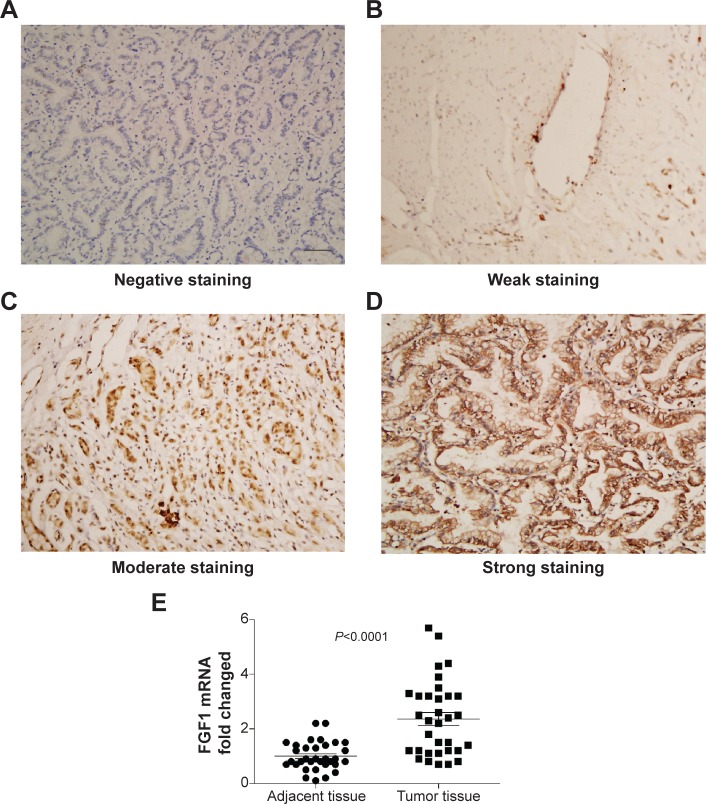
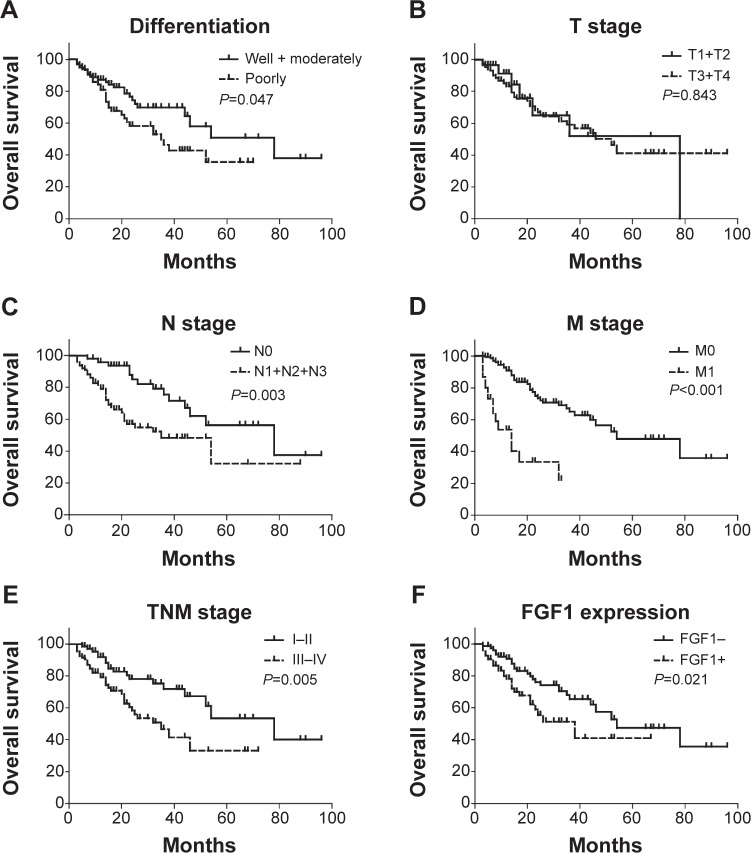
In our experiments, we systematically evaluated FGF1 expression in 178 cases of gastric adenocarcinoma with immunohistochemistry, and subsequently analyzed the correlation between FGF1 expression and clinicopathologic features. Moreover, FGF1 expression in tumor tissue and corresponding adjacent tissue was detected and compared by real-time polymerase chain reaction. The Kaplan-Meier method and the Cox-regression model were used with univariate and multivariate analysis, respectively, to evaluate the prognostic value of FGF1 in gastric adenocarcinoma.
Higher FGF1 expression rate is 56.7% (101/178) in gastric adenocarcinoma. FGF1 expression in gastric adenocarcinoma was significantly higher than adjacent tissue (P<0.0001). Expression of FGF1 is significantly associated with lymph node invasion (P<0.001), distant metastasis (P=0.013), and differentiation (P=0.015). Moreover, FGF1 overexpression was closely related to unfavorable overall survival rate (P=0.021), and can be identified to be an independent unfavorable prognostic factor (P=0.004).
FGF1 is an independent prognostic factor, indicating that FGF1 could be a potential molecular drug target in gastric adenocarcinoma.
成纤维细胞生长因子 1(FGF1)在多种癌症中具有重要的临床意义,包括卵巢癌、乳腺癌和膀胱癌。然而,FGF1 在胃腺癌中的临床意义尚未得到探索。
在我们的实验中,我们通过免疫组织化学系统地评估了 178 例胃腺癌中 FGF1 的表达情况,并随后分析了 FGF1 表达与临床病理特征之间的相关性。此外,通过实时聚合酶链反应检测和比较了肿瘤组织和相应的相邻组织中的 FGF1 表达。Kaplan-Meier 方法和 Cox 回归模型分别用于单因素和多因素分析,以评估 FGF1 在胃腺癌中的预后价值。
胃腺癌中 FGF1 高表达率为 56.7%(101/178)。胃腺癌中 FGF1 的表达明显高于相邻组织(P<0.0001)。FGF1 的表达与淋巴结浸润(P<0.001)、远处转移(P=0.013)和分化(P=0.015)显著相关。此外,FGF1 过表达与不良总生存率密切相关(P=0.021),并且可以被鉴定为独立的不良预后因素(P=0.004)。
FGF1 是一个独立的预后因素,表明 FGF1 可能是胃腺癌潜在的分子药物靶点。