Zhou Lin, Li Tuo, Song Xiusheng, Li Yin, Li Hongyan, Dan Handong
Department of Ophthalmology, Remin Hospital of Wuhan University, Wuhan, Hubei Province, People's Republic of China ; Department of Ophthalmology, Central Hospital of Enshi Autonomous Prefecture, Enshi Clinical College of Wuhan University, Enshi, Hubei Province, People's Republic of China.
Department of Ophthalmology, Central Hospital of Enshi Autonomous Prefecture, Enshi Clinical College of Wuhan University, Enshi, Hubei Province, People's Republic of China.
Mol Vis. 2015 Mar 5;21:213-23. eCollection 2015.
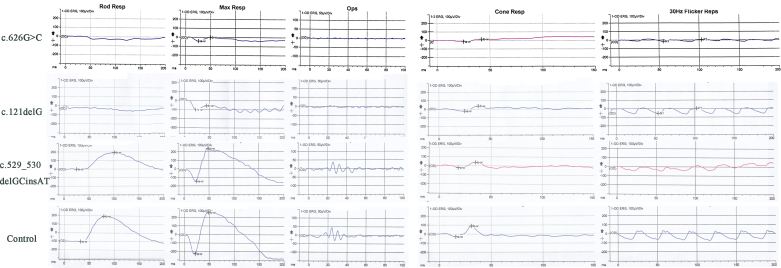
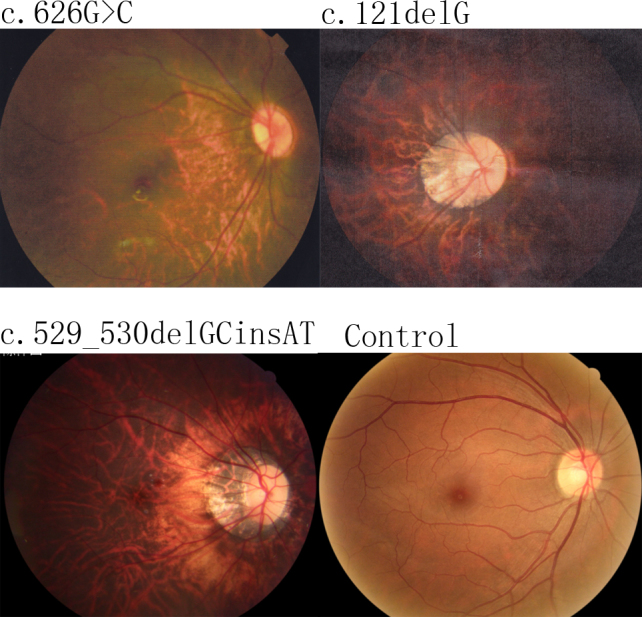
Mutations in the NYX gene are known to cause complete congenital stationary night blindness (CSNB1), which is always accompanied by high myopia. In this study, we aimed to investigate the association between NYX mutations and high myopia with or without CSNB1.
Four Chinese families having high myopia with or without CSNB1 and 96 normal controls were recruited. We searched for mutations in the NYX gene using Sanger sequencing. Further analyses of the detected variations in the available family members were performed, and the frequencies of the detected variations in 96 normal controls were determined to verify our deduction. The effect of each variation on the nyctalopin protein was predicted using online tools.
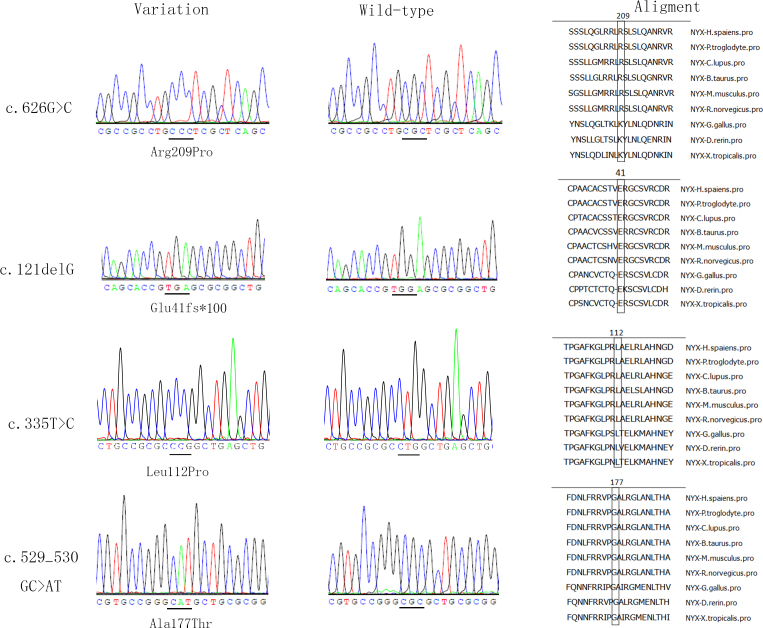
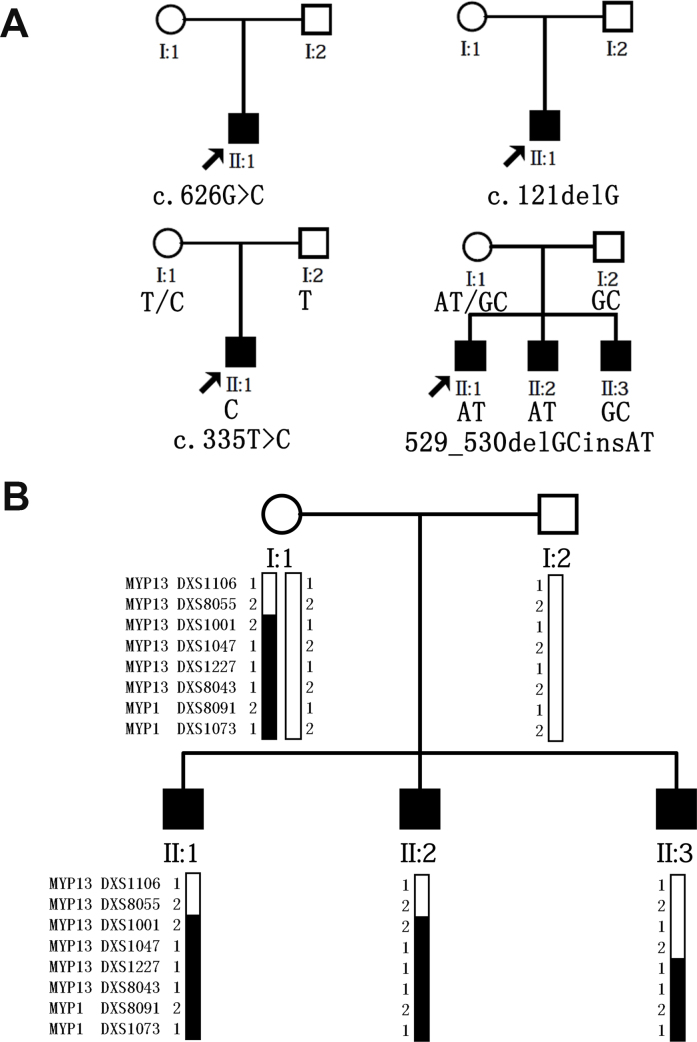
Four potential pathogenic variations in the NYX gene were found in four families with high myopia with or without CSNB1. Three of the four variants were novel (c.626G>C; c.121delG; c.335T>C). The previously identified variant, c.529_530delGCinsAT, was found in an isolated highly myopic patient and an affected brother, but the other affected brother did not carry the same variation. Further linkage analyses of this family showed a coinheritance of markers at MYP1. These four mutations were not identified in the 96 normal controls.
Our study expands the mutation spectrum of NYX for cases of high myopia with CSNB1; however, more evidence is needed to elucidate the pathogenic effects of NYX on isolated high myopia.
已知NYX基因突变会导致完全性先天性静止性夜盲(CSNB1),且常伴有高度近视。在本研究中,我们旨在调查NYX基因突变与伴有或不伴有CSNB1的高度近视之间的关联。
招募了四个患有伴有或不伴有CSNB1的高度近视的中国家庭以及96名正常对照者。我们使用桑格测序法在NYX基因中寻找突变。对可用家庭成员中检测到的变异进行了进一步分析,并确定了96名正常对照者中检测到的变异频率以验证我们的推断。使用在线工具预测每个变异对夜盲蛋白的影响。
在四个患有伴有或不伴有CSNB1的高度近视的家庭中发现了NYX基因的四个潜在致病性变异。这四个变异中的三个是新的(c.626G>C;c.121delG;c.335T>C)。先前鉴定出的变异c.529_530delGCinsAT在一名孤立的高度近视患者及其患病兄弟中被发现,但另一名患病兄弟未携带相同变异。对该家庭的进一步连锁分析显示在MYP1处标记共遗传。在96名正常对照者中未发现这四个突变。
我们的研究扩展了伴有CSNB1的高度近视病例中NYX的突变谱;然而,需要更多证据来阐明NYX对孤立性高度近视的致病作用。