Reeder Tod W, Townsend Ted M, Mulcahy Daniel G, Noonan Brice P, Wood Perry L, Sites Jack W, Wiens John J
Department of Biology, San Diego State University, San Diego, California, 92182, United States of America.
Laboratories of Analytical Biology, Smithsonian Institution, 10th & Constitution Aves. NW, Washington, D.C., 20560, United States of America.
PLoS One. 2015 Mar 24;10(3):e0118199. doi: 10.1371/journal.pone.0118199. eCollection 2015.
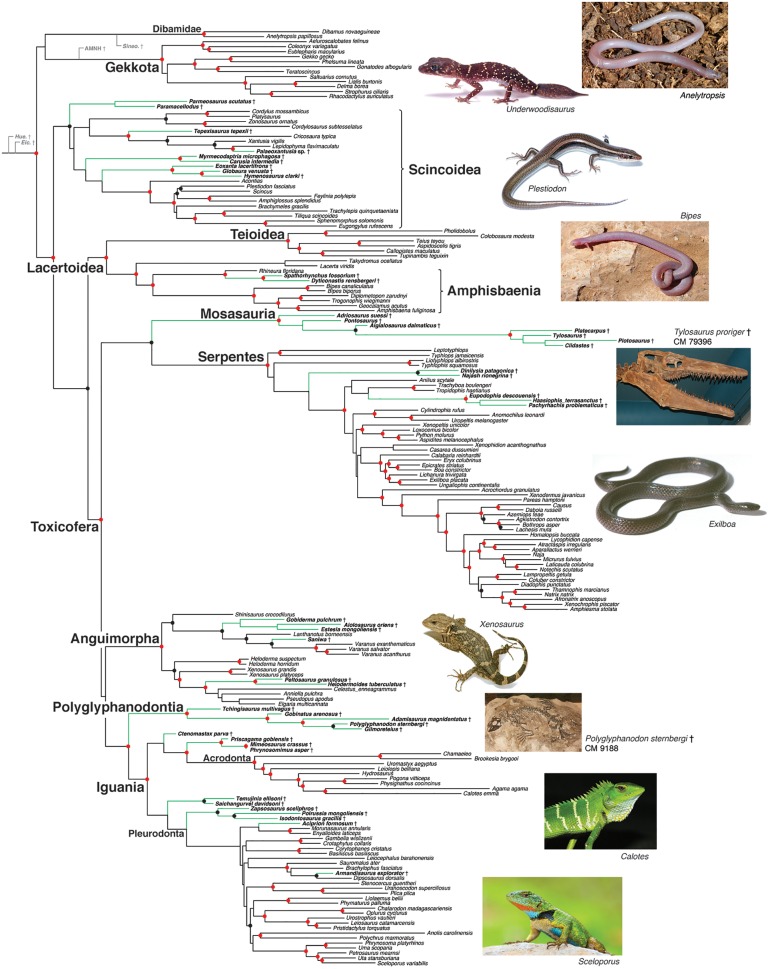
Squamate reptiles (lizards and snakes) are a pivotal group whose relationships have become increasingly controversial. Squamates include >9000 species, making them the second largest group of terrestrial vertebrates. They are important medicinally and as model systems for ecological and evolutionary research. However, studies of squamate biology are hindered by uncertainty over their relationships, and some consider squamate phylogeny unresolved, given recent conflicts between molecular and morphological results. To resolve these conflicts, we expand existing morphological and molecular datasets for squamates (691 morphological characters and 46 genes, for 161 living and 49 fossil taxa, including a new set of 81 morphological characters and adding two genes from published studies) and perform integrated analyses. Our results resolve higher-level relationships as indicated by molecular analyses, and reveal hidden morphological support for the molecular hypothesis (but not vice-versa). Furthermore, we find that integrating molecular, morphological, and paleontological data leads to surprising placements for two major fossil clades (Mosasauria and Polyglyphanodontia). These results further demonstrate the importance of combining fossil and molecular information, and the potential problems of estimating the placement of fossil taxa from morphological data alone. Thus, our results caution against estimating fossil relationships without considering relevant molecular data, and against placing fossils into molecular trees (e.g. for dating analyses) without considering the possible impact of molecular data on their placement.
有鳞目爬行动物(蜥蜴和蛇)是一个关键类群,其亲缘关系已变得越来越具有争议性。有鳞目包含9000多个物种,使其成为陆地脊椎动物的第二大类群。它们在医学上以及作为生态和进化研究的模型系统都很重要。然而,有鳞目生物学的研究因它们亲缘关系的不确定性而受到阻碍,而且鉴于最近分子和形态学结果之间的冲突,一些人认为有鳞目的系统发育尚未解决。为了解决这些冲突,我们扩展了现有的有鳞目形态学和分子数据集(691个形态学特征和46个基因,涉及161个现存物种和49个化石分类单元,包括一组新的81个形态学特征,并从已发表的研究中增加了两个基因)并进行了综合分析。我们的结果解决了分子分析所表明的更高层次的亲缘关系,并揭示了对分子假说的隐藏形态学支持(但反之不然)。此外,我们发现整合分子、形态学和古生物学数据会导致两个主要化石类群(沧龙科和多瘤齿龙科)有惊人的分类位置。这些结果进一步证明了结合化石和分子信息的重要性,以及仅从形态学数据估计化石分类单元位置的潜在问题。因此,我们的结果提醒人们,在不考虑相关分子数据的情况下估计化石亲缘关系以及在不考虑分子数据对其位置可能产生的影响的情况下将化石放入分子树中(例如用于年代测定分析)是不可取的。