Enyedi Balázs, Niethammer Philipp
Cell Biology Program, Memorial Sloan Kettering Cancer Center, New York, NY 10065, USA.
Cell Biology Program, Memorial Sloan Kettering Cancer Center, New York, NY 10065, USA.
Trends Cell Biol. 2015 Jul;25(7):398-407. doi: 10.1016/j.tcb.2015.02.007. Epub 2015 Mar 24.
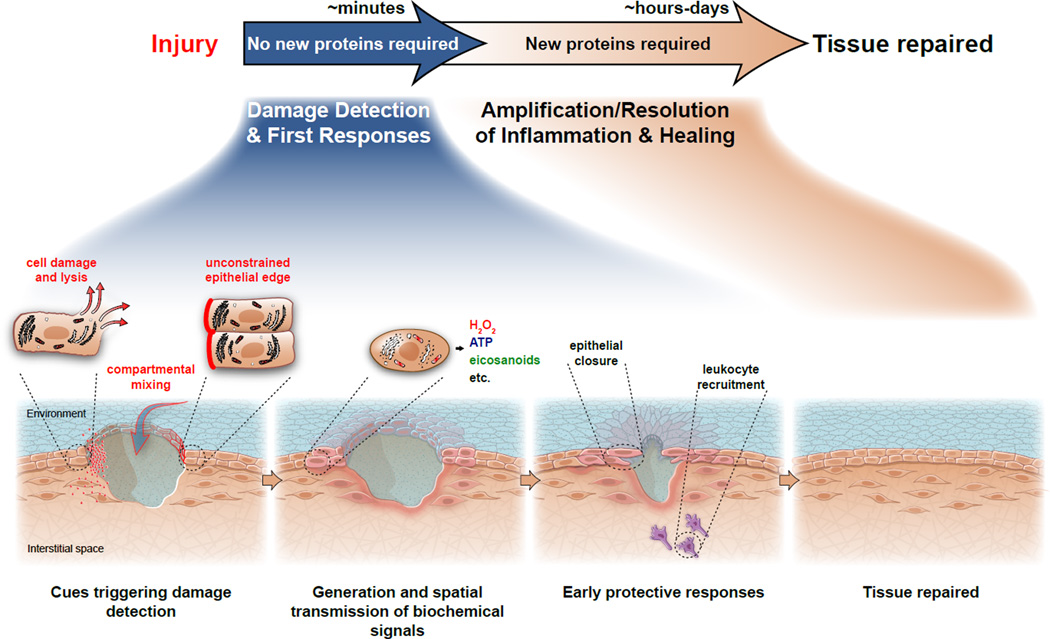
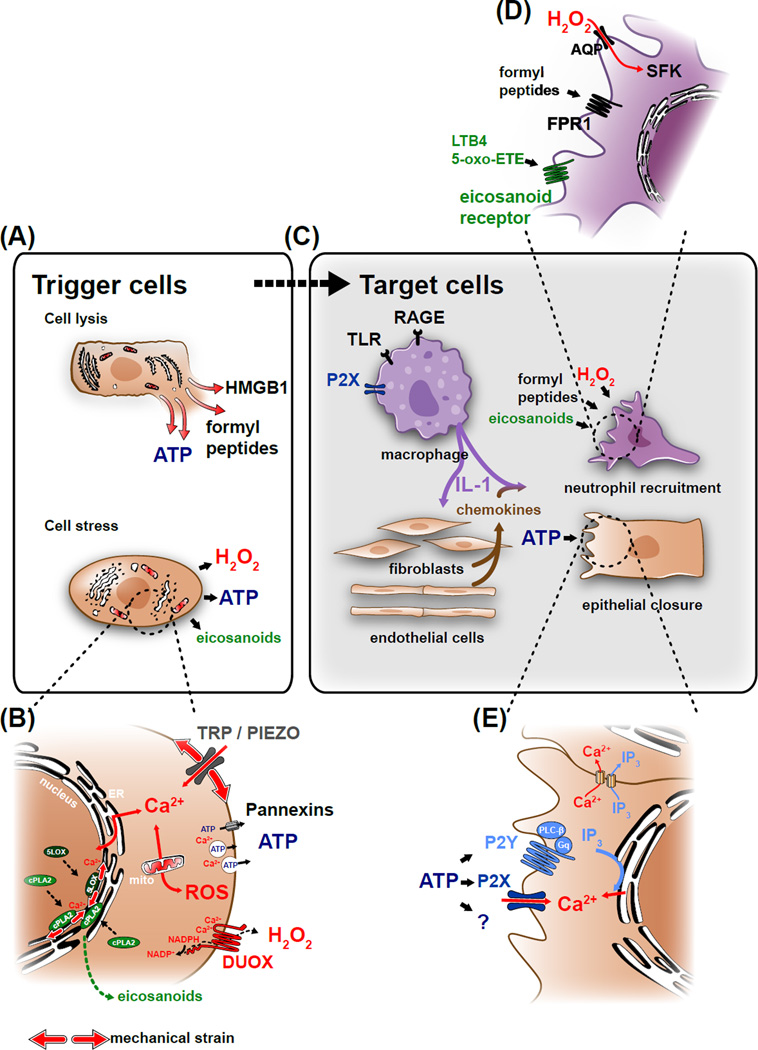
Efficient wound healing requires the coordinated responses of various cell types within an injured tissue. To react to the presence of a wound, cells have to first detect it. Judging from their initial biochemical and morphological responses, many cells including leukocytes, epithelial cells, and endothelial cells detect wounds from over hundreds of micrometers within seconds-to-minutes. Wound detection involves the conversion of an injury-induced homeostatic perturbation, such as cell lysis, an unconstrained epithelial edge, or permeability barrier breakdown, into a chemical or physical signal. The signal is spatially propagated through the tissue to synchronize protective responses of cells near the wound site and at a distance. This review summarizes the triggers and mechanisms of wound detection in animals.
高效的伤口愈合需要受伤组织内各种细胞类型的协同反应。为了对伤口的存在做出反应,细胞必须首先检测到它。从它们最初的生化和形态学反应来看,包括白细胞、上皮细胞和内皮细胞在内的许多细胞能在几秒到几分钟内从数百微米外检测到伤口。伤口检测涉及将损伤诱导的稳态扰动,如细胞裂解、无约束的上皮边缘或通透性屏障破坏,转化为化学或物理信号。该信号在组织中进行空间传播,以同步伤口部位附近和远处细胞的保护反应。这篇综述总结了动物伤口检测的触发因素和机制。