van Oort Bart, van Grondelle Rienk, van Stokkum Ivo H M
†Department of Physics and Astronomy, Faculty of Sciences, VU University Amsterdam, De Boelelaan 1081, 1081 HV Amsterdam, The Netherlands.
‡Institute for Lasers, Life and Biophotonics, Faculty of Sciences, VU University Amsterdam, De Boelelaan 1081, 1081 HV Amsterdam, The Netherlands.
J Phys Chem B. 2015 Apr 23;119(16):5184-93. doi: 10.1021/acs.jpcb.5b01335. Epub 2015 Apr 10.
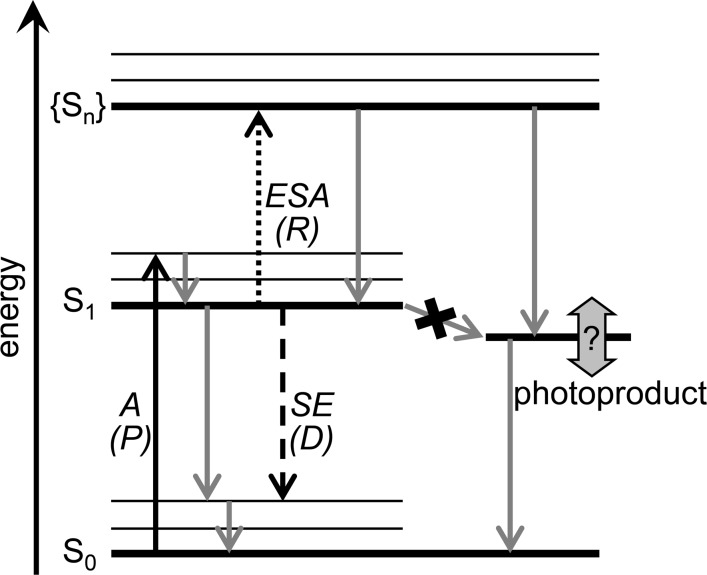
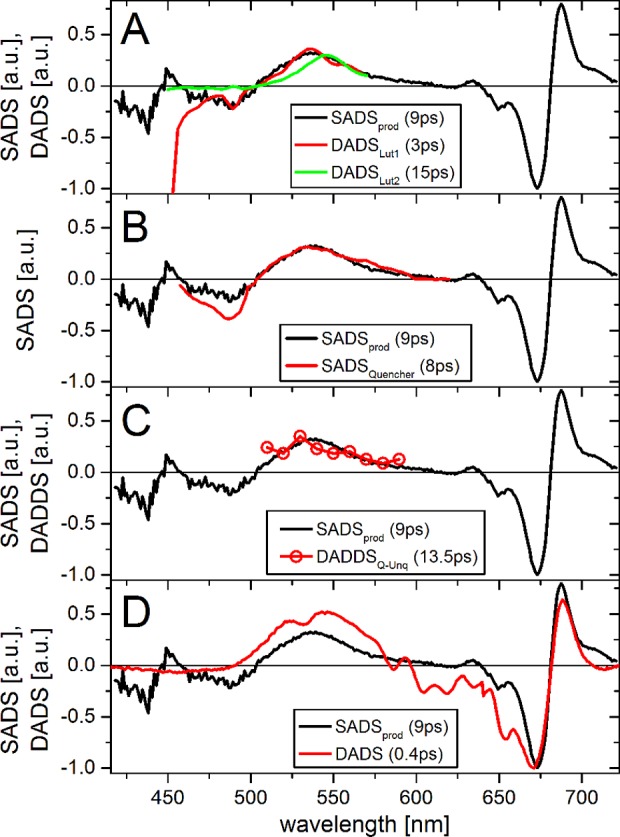
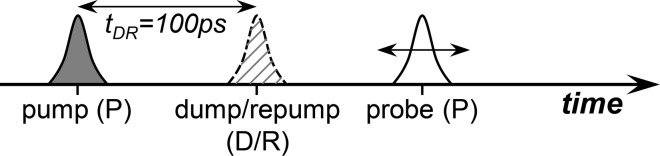
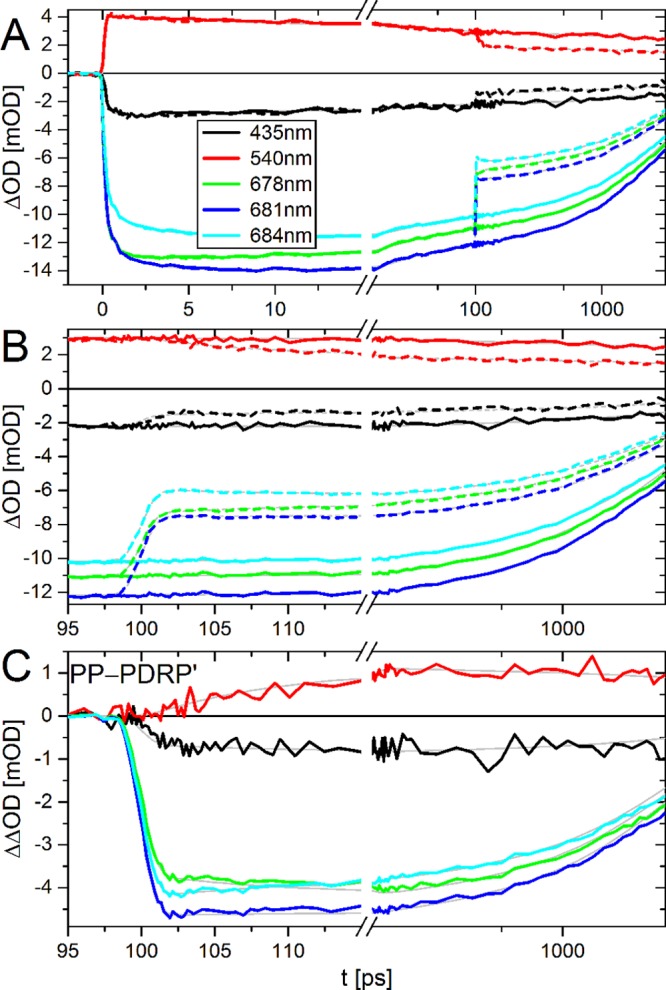
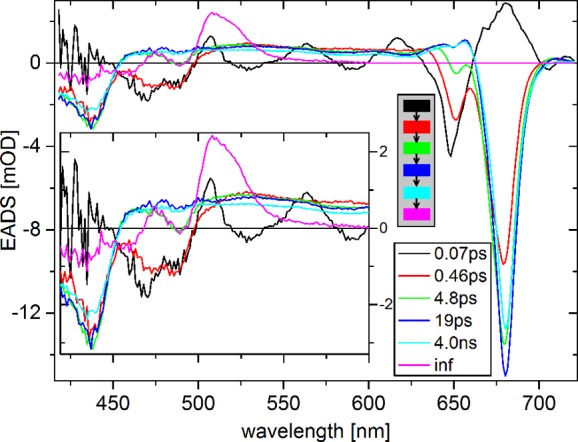
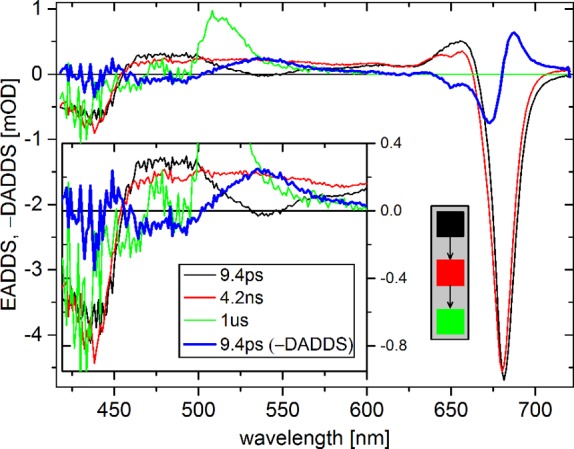
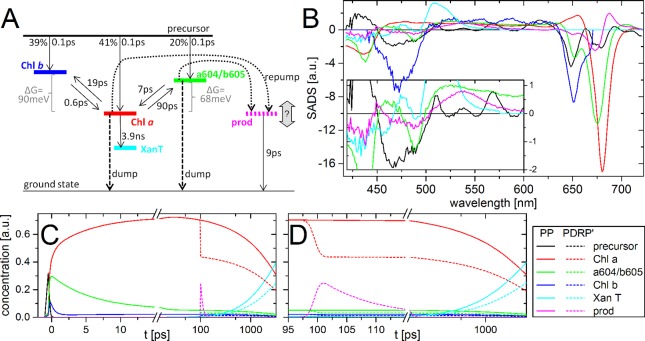
Light-harvesting complex II (LHCII) is pivotal both for collecting solar radiation for photosynthesis, and for protection against photodamage under high light intensities (via a process called nonphotochemical quenching, NPQ). Aggregation of LHCII is associated with fluorescence quenching, and is used as an in vitro model system of NPQ. However, there is no agreement on the nature of the quencher and on the validity of aggregation as a model system. Here, we use ultrafast multipulse spectroscopy to populate a quenched state in unquenched (unaggregated) LHCII. The state shows characteristic features of lutein and chlorophyll, suggesting that it is an excitonically coupled state between these two compounds. This state decays in approximately 10 ps, making it a strong competitor for photodamage and photochemical quenching. It is observed in trimeric and monomeric LHCII, upon re-excitation with pulses of different wavelengths and duration. We propose that this state is always present, but is scarcely populated under low light intensities. Under high light intensities it may become more accessible, e.g. by conformational changes, and then form a quenching channel. The same state may be the cause of fluorescence blinking observed in single-molecule spectroscopy of LHCII trimers, where a small subpopulation is in an energetically higher state where the pathway to the quencher opens up.
捕光复合体II(LHCII)对于收集用于光合作用的太阳辐射以及在高光强度下防止光损伤(通过一种称为非光化学猝灭,NPQ的过程)都至关重要。LHCII的聚集与荧光猝灭相关,并被用作NPQ的体外模型系统。然而,关于猝灭剂的性质以及聚集作为模型系统的有效性尚无定论。在这里,我们使用超快多脉冲光谱在未猝灭(未聚集)的LHCII中产生一种猝灭态。该状态显示出叶黄素和叶绿素的特征,表明它是这两种化合物之间的激子耦合态。这种状态在大约10皮秒内衰减,使其成为光损伤和光化学猝灭的有力竞争态。在三聚体和单体LHCII中,用不同波长和持续时间的脉冲重新激发时都能观察到这种状态。我们提出这种状态总是存在,但在低光强度下很少产生。在高光强度下,它可能更容易出现,例如通过构象变化,然后形成一个猝灭通道。相同的状态可能是在LHCII三聚体的单分子光谱中观察到的荧光闪烁的原因,其中一小部分处于能量较高的状态,通往猝灭剂的途径打开。